L3Harris/UAW887 CBA


https://drive.google.com/file/d/1zLnMa1-Y0uQP1Pnhidm5V10REQXfAtY3/view?usp=sharing


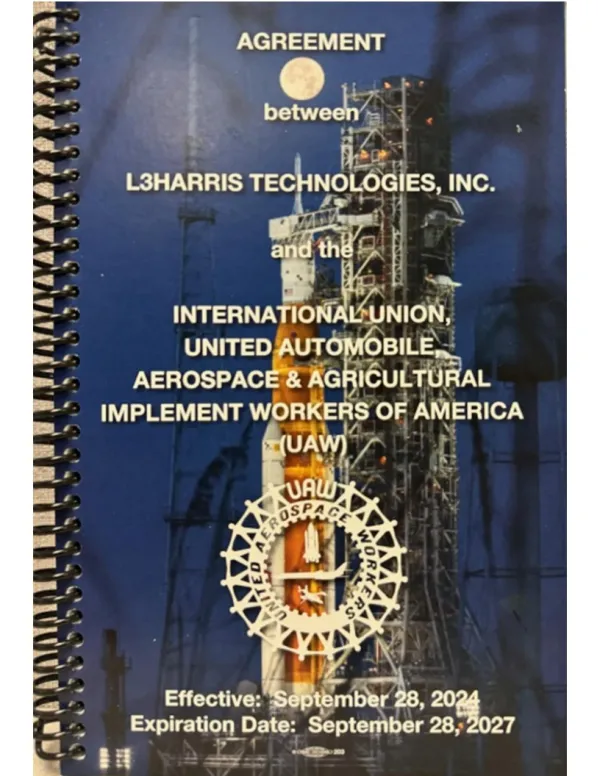
AGREEMENT
between

L3HARRIS TECHNOLOGIES, INC.

and the
INTERNATIONAL UNION,
UNITED AUTOMOBILE,
AEROSPACE & AGRICULTURAL
IMPLEMENT WORKERS OF AMERICA

(UAW)

Effective: September 28, 2024
Expiration Date: September 28, 2027

TABLE OF CONTENTS

Article / Section Page
AGREEMENT.................................................................... 1
PURPOSE......................................................................... 1
ARTICLE 1 – MANAGEMENT FUNCTIONS............................ 1
ARTICLE 2 – COVERAGE.................................................. 2
Section 1 Production & Maintenance Unit.............................. 2
Section 2 Manufacturing Planning and Tool Design Unit............ 2
ARTICLE 3 – RECOGNITION.............................................. 2
ARTICLE 4 – NONDISCRIMINATION................................... 3
ARTICLE 5 – UNION SECURITY, UNION MEMBERSHIP,
AGENCY FEE & CHECK OFF........................... 3
Section 1 Union Membership................................................. 3
Section 2 Union Dues.......................................................... 4
Section 3 Union Fees........................................................... 5
Section 4 Liability and Damage.............................................. 5
Section 5 Union Deductions................................................... 5
Section 6 Off Site Location................................................... 7
ARTICLE 5A – UAW V-CAP CHECK-OFF.............................. 7
Section 1 Contributions to UAW V-Cap.................................... 7
Section 2 Termination of Company Obligation........................... 8
Section 3 Remittance to the Union............................................ 8
Section 4 Indemnification of Company..................................... 8
Section 5 Solicitation, Coercion, Discrimination.......................... 8
ARTICLE 6 – REPRESENTATION........................................ 9
Section 1 Committeeperson Representation.............................. 9
Section 2 Designation of Shop Zones....................................... 9
Section 3 Number of Committee Persons................................. 9
Section 4 Notification Requirements ....................................... 9
Section 5 Union Representative Eligibility................................. 9
Section 6 General Provisions for Representation........................ 9
Section 7 Transfer or Promotion............................................. 11
Section 8 Alleged Abuse...................................................... 11
Section 9 Payment for Union Activity Time............................... 12
Section 10 Investigations..................................................... 12

Article / Section Page
Section 11 Temporary Exceptions.......................................... 12
Section 12 Overtime during Grievance Meetings...................... 12
ARTICLE 7 – GRIEVANCE, APPEAL AND ARBITRATION
PROCEDURE................................................ 13
Section 1 Definition............................................................. 13
Section 2 Grievance Steps................................................... 13
Section 3 Arbitration............................................................ 16
Section 4 Timelines ............................................................ 18
Section 5 Timeliness Requirement......................................... 18
Section 6 Limitations on Retroactivity...................................... 19
Section 7 Grievance Management and Workflow Protocol........... 19
Section 8 Time Recording.................................................... 19
Section 9 Suspensions and Discharge.................................... 20
ARTICLE 8 – WAGES........................................................ 20
Section 1 Wage Structure and Increases.................................. 20
Section 2 New or Substantially Changed Requirements.............. 23
Section 3 Job Classification and Notification for New Operations.. 25
Section 4 Proper Classification.............................................. 25
Section 5 Job Descriptions and Classifications.......................... 26
Section 6 Prohibitions.......................................................... 27
Section 7 Reclassification..................................................... 28
Section 8 Wage Rate Increases............................................. 30
Section 9 Team Lead Pay.................................................... 32
Section 10 Union Listing....................................................... 32
Section 11 Pay Adjustment Following Downgrade...................... 32
Section 12 Effective Dates and Retroactive Payments............... 33
Section 13 Security Clearance Premium ................................. 33
ARTICLE 9 - HOURS AND SPECIAL PAY PROVISIONS.......... 33
Section 1 Work Schedule..................................................... 33
Section 2 Overtime ............................................................. 34
Section 3 Shift Differential.................................................... 35
Section 4 Overtime Equalization ............................................ 36
Section 5 Incomplete Day’s Work........................................... 38
Section 6 Lost Time............................................................ 39
Section 7 Holidays.............................................................. 39
Section 8 Paydays.............................................................. 42
Section 9 Rest Periods........................................................ 42
Section 10 Excused Absences for Union Business.................... 42
Section 11 Jury Duty............................................................ 43

Article / Section Page
Section 12 Bereavement Pay............................................... 43
ARTICLE 10 – SENIORITY................................................. 44
Section 1 Definitions........................................................... 44
Section 2 Measurement of Seniority....................................... 45
SENIORITY MOVEMENT AT TIME OF EXCESS................. 47
Section 3 Temporary Layoffs................................................. 47
Section 4 Layoffs for Extended Periods.................................... 47
Section 5 Scheduling of Seniority Movements........................... 51
FILLING JOB VACANCIES.............................................. 53
Section 6 Priorities............................................................. 53
Section 7 Recall of Employees.............................................. 53
Section 8 Posting and Bidding............................................... 55
Section 9 Preferential Reinstatement...................................... 57
Section 10 Transfers Within the Bargaining Unit......................... 58
Section 11 Transfers Out of the Bargaining Unit........................ 61
Section 12 Limitations on Loan Outs....................................... 62
Section 13 Notifications – Union............................................ 62
Section 14 Notifications – Employees..................................... 63
Section 15 Application of Seniority-Union Representatives.......... 65
Section 16 Breaking of Seniority............................................ 66
Section 17 General Provisions for Seniority.............................. 68
Section 18 Employee Involvement Team Lead Seniority............. 70
ARTICLE 11 – VACATION AND SICK LEAVE ALLOWANCES... 71
Section 1 Definitions............................................................ 71
Section 2 Vacation Allowance................................................. 71
Section 3 Vacation Leaves................................................... 72
Section 4 Sick Leave Allowance............................................ 73
Section 5 Payment of Vacation and Sick Leave Allowance.......... 73
ARTICLE 12 – MILITARY SERVICE..................................... 74
Section 1 Active Duty in Armed Forces for Training & Service...... 74
Section 2 Training Duty by Training Duty Reservists................... 75
ARTICLE 13 – PENSIONS................................................. 75
Section 1 Eligibility ............................................................ 75
ARTICLE 14 – GROUP INSURANCE.................................... 76
Section 1 Benefits and Insurance........................................... 76

Article / Section Page
Section 2 Health Savings Account.......................................... 77
Section 3 New Employee Orientation...................................... 77
ARTICLE 15 – GENERAL PROVISIONS............................... 77
Section 1 Bulletin Boards..................................................... 77
Section 2 Time Spent Posting Bulletins ................................... 78
Section 3 Number and Location of Bulletin Boards..................... 78
Section 4 No Other Distribution or Postings............................... 78
LEAVES OF ABSENCE (PERSONAL, UNION & MEDICAL)... 78
Section 5 Personal – Informal Leaves of Absence...................... 78
Section 6 Personal – Formal Leaves of Absence....................... 78
Section 7 Union Formal Leaves of Absence............................. 79
Section 8 Medical Formal Leaves of Absence........................... 79
Section 9 Family Care Leave................................................ 80
GENERAL PROVISIONS FOR LEAVES OF ABSENCE........ 80
Section 10 Leave of Absence Check Out................................. 80
Section 11 Seniority Accumulation on Leave............................. 80
Section 12 Gainful Occupation............................................... 81
Section 13 Return from Leave of Absence Exam....................... 81
Section 14 Return to Former Job............................................ 81
Section 15 Extensions of Leaves of Absence............................ 81
Section 16 Frequent Absences Due to Illness or Injury............... 81
ARTICLE 16 – HEALTH AND SAFETY................................... 82
Section 1 Work Environment................................................. 82
Section 2 Health and Safety Representative Responsibilities........ 82
Section 3 Health and Safety Representative Requirements.......... 82
Section 4 Ergonomic Program............................................... 83
Section 5 Collaborative Health and Safety Program.................... 84
Section 6 Notification of Incidents........................................... 85
Section 7 National Safety Working Group................................. 85
Section 8 Safety Committee Representative............................. 86
Section 9 Right to Refuse Work............................................. 86
Section 10 Subcontractor Safety Program ............................... 87
ARTICLE 17 – STRIKE OR LOCKOUT................................. 87
Section 1 No Assist in Slowdown, Work Stoppage, or Strike........ 87
Section 2 Unauthorized Labor Action...................................... 87
Section 3 Lockout............................................................... 88

Article / Section Page
ARTICLE 18 – DURATION................................................. 89
Section 1 Duration and Notification........................................ 89
Section 2 Suspension of Collective Bargaining Negotiations....... 89
Section 3 Termination or Modification of Agreement................. 89
Section 4 Notices.............................................................. 89
Section 5 Superseding of Agreement..................................... 90
ARTICLE 19 – NOTICES.................................................. 90
Section 1 Official Notice Delivery Procedures and Requirements 90
Section 2 Employee Address Change and Company Notification 90
Section 3 Company Travel and Education Policies................... 90
ARTICLE 20 – SAVINGS PLAN.......................................... 91
Section 1 Retirement Savings Plan........................................ 91
ARTICLE 21 – SUBCONTRACTING................................... 92
ARTICLE 22 – EMPLOYEE INVOLVEMENT......................... 92
Section 1 Job Combinations/Eliminations............................... 93
Section 2 Local Joint Committee.......................................... 94
Section 3 Bargaining Unit E.I. Facilitator................................. 95
Section 4 Team Leaders..................................................... 95
ARTICLE 23 – PROPRIETARY WORK................................ 97
Section 1 Definitions........................................................... 97
Section 2 Filling Proprietary Job Vacancies............................. 98
Section 3 Selection Procedure for C-Classified Classifications.... 99
Section 4 Transfers........................................................... 100
Section 5 Representation.................................................... 100
Section 6 General Provisions.............................................. 101
Section 7 Proprietary Committee........................................... 103
Section 8 Provisions.......................................................... 103
ARTICLE 24 – NON-BARGAINING UNIT EMPLOYEES.......... 103
Section 1 Skilled Workforce and Customer Support.................. 103
Section 2 Notices............................................................. 104
Section 3 Complaints......................................................... 104
ARTICLE 25 – QUALIFICATIONS AND ENFORCEMENT....... 104
Section 1 Qualifications...................................................... 104
Section 2 Waiver.............................................................. 104
Section 3 Specific Performance........................................... 105

Exhibit Page
EXHIBIT A..................................................................... 106
EXHIBIT A-2.................................................................. 108
EXHIBIT B – CALENDARS................................................ 109
EXHIBIT C – JOB BIDDING INFORMATION........................ 113
Section 1 Posting & Bidding................................................ 113
Section 2 Manufacturing Planning and Tool Design.................. 115
EXHIBIT D – JOB LISTINGS............................................. 116
EXHIBIT E – GLOSSARY................................................. 135
EXHIBIT F – OVERTIME RECORD.................................... 152
EXHIBIT G – OVERTIME AVEREAGE FORM....................... 154

Letter Page
LETTER 1 – EQUALIZATION OF OVERTIME....................... 155
LETTER 2 – SKILLS DEMONSTRATION EXERCISES........... 156
LETTER 3 – OFF-SITE ASSIGNMENT OF BARGAINING
UNIT EMPLOYEES........................................ 159
LETTER 4 – GROW THE BUSINESS / ALTERNATE WORK
SCHEDULE.................................................. 162
LETTER 5 – TEMPORARY RECALL................................... 164
LETTER 6 – SUBCONTRACTING...................................... 166
LETTER 7 – MEMBERS DUES COLLECTION...................... 167
LETTER 8 – RATIFACTION BOUNS................................... 168
LETTER 9 – PAYCHECKS ADMINISTRATION...................... 170
LETTER 10 – DRUG AND ALCOHOL POLICY...................... 171

Letter Page
LETTER 11 – ELIMINATION OF UNUSED JOB
CLASSIFICATIONS...................................... 173
LETTER 12 – AUGMENTATION OF THE WORKFORCE
MANUFACUTRING PLANNING & TOOL
DESIGN UNIT........................................... 178
LETTER 13 – UAW RECORD KEEPING.............................. 181
LETTER 14 – PAID UNION TIME........................................ 182
LETTER 15 – CLARIFICATION OF PLANNER
RESPONSIBILITIES..................................... 184
LETTER 16 – EFFECTS AND LAYOFF BENEFITS................ 186
LETTER 17 – METAL FITTING MECHANIC JOB
CLASSIFICATION ADDITIVE
MANUFACTURING JOB DUTIES.................... 188
LETTER 18 – COMPLEX MULTI AXIS MASTER MACHINIST
JOB COMBINATION...................................... 190
LETTER 19 – APPRENTICESHIP PROGRAM....................... 195

1
AGREEMENT

This Agreement made and entered into by and between L3HARRIS
TECHNOLOGIES, INC. hereinafter the “Company”, and the International
Union, UNITED AUTOMOBILE, AEROSPACE AND AGRICUTLURAL
IMPLEMENT WORKERS OF AMERICA (UAW), and its local 887,
hereinafter “the Union”. It is understood and agreed to by the Company
and the Union that this agreement supersedes any and all previous
agreements which they heretofore have entered into.
PURPOSE

It is the intent and purpose of the parties hereto that this Agreement
promote and improve the industrial and economic status of the parties,
provide orderly collective bargaining relations between the Company
and the Union, and secure a prompt and fair disposition of grievances
so as to eliminate interruptions of work and interference with the
efficient operation of the Company’s business.

ARTICLE 1 – MANAGEMENT FUNCTIONS

It is recognized that in addition to other functions and responsibilities,
the Company has and will retain the sole right and responsibility to
direct the operations of the Company and in this connection to
determine the number and location of its plants; the product to be
manufactured; the types of work to be performed; the size and number
of the working force in the active employ of the Company from time to
time; whether the Company’s work shall be performed by employees
of the Company or independent contractors or their employees; the
identity of the Company’s personnel to whom work shall be assigned;
whether transfers, promotions, or demotions are to be made; the
identity of or number of new employees to be hired; the schedules of
production; shift schedules and hours of work; the methods,
processes, and means of manufacturing; and to select and hire
employees, including the right to make and apply rules and regulations
for production, discipline, efficiency, and safety.
It shall also have the right and responsibility to promote, demote, and
transfer employees, and to discharge or otherwise discipline any
employee for just cause, and to lay off because of lack of work or other
cause.

2

ARTICLE 2 – COVERAGE
Section 1. Production & Maintenance Unit
(a) Inclusions—The term “employee” shall include employees in
production, inspection, timekeeping, production control,
storekeeping and maintenance, employees included as a result of
the decision by the National Labor Relations Board in Case No.
21-UC-10, who work at the facility at 8900 De Soto Avenue,
Canoga Park, California 91304, and its related off-site warehouse
at 9425 Canoga Ave., Chatsworth, CA 91311.
(b) Exclusions—The term “employee” shall not include office
workers, technical employees, professional employees,
employees in classifications on the salaried payroll, welders,
employees of the industrial security department, maintenance
electricians, maintenance painters, stationary engineers-high
pressure, employees regularly assigned to operate licensed
automotive equipment outside the plant and their dispatchers,
officials who have the right to hire and discharge, all other
supervisors including and above the rank of Assistant Supervisor
and all employees excluded by mutual agreement of the parties
or by the National Labor Relations Board in Case No. 21 -UC-10.
Section 2. Manufacturing Planning and Tool Design Unit
(a) Inclusions—The term “employee” shall include employees in the
following job titles: Tool Designer; Planning Status Processor;

Planning Control Analyst; Planner-Electrical/Electronics; Planner-
Machined Parts; Planner-Structures/Installations or their

predecessor classifications set forth in NLRB Case No. 31-RC-
3413.

(b) Exclusions - The term “employee” shall not include professional
employees, technical employees, clerical, guards and supervisors
as defined in the Act or any other employees who were
specifically excluded in NLRB Case No. 31-RC-3413.
ARTICLE 3 – RECOGNITION

The Company, and in the event of its sale, its successor, recognizes
the International Union, United Automobile, Aerospace and
Agricultural Implement Workers of America (UAW), and the Local
Union together referred to as “the Union,” as the sole and exclusive
collective bargaining representative with respect to wages, hours of

3

employment and other conditions of employment, for the employees of
the Company in the bargaining unit described in Article 2 above, with
any other inclusions or exclusions resulting from National Labor
Relations Board certifications or mutual agreements of the parties.

ARTICLE 4 – NONDISCRIMINATION

The Company and the Union recognize that employees covered by
this agreement will abide by policy “HR-01 Respect in the Workplace:

Equal Employment Opportunity, and Anti-Harassment and Non-
Retaliation”. The parties agree to accept the aforementioned policy as

written. Any future revisions will be communicated with the union prior
to implementation. This policy affirms the Company’s commitment to
equal employment opportunity, and providing a workplace free of
discrimination, harassment, and retaliation. It also affirms the

Company’s intent to comply with related federal, state, and local non-
discrimination, anti-harassment, and non-retaliation laws. The

Company further agrees to continue its policy of taking affirmative
action to facilitate employment opportunities to the extent required by
law.

It is further understood that any violations of this Article 4, Non-
Discrimination, are subject to, and must be addressed under, the

provisions of Article 7, Grievance, Appeal and Arbitration Procedure as
well as under other applicable Articles of the Agreement.
Any reference herein to gender shall be construed as being equally
applicable without any reservations to all-inclusive identities.
ARTICLE 5 – UNION SECURITY, UNION MEMBERSHIP,

AGENCY FEE & CHECK OFF

Section 1. Union Membership
(a) Every employee covered by this Agreement must, for the life of
this Agreement satisfy an obligation to the Union as the Unit’s
exclusive bargaining representative. Under this Agreement,
employees must choose one of the two ways of satisfying this
obligation, as described below. Every employee has the right to
make this choice free of interference, restraint or coercion:

4

(1) Full Union membership: The employee chooses to join the
Union as a full member, is subject to all rights and duties
accorded to members and, as a condition of employment,
must pay the full initiation fee and uniform periodic dues
charged by the Union; or
(2) Agency fee payer: The employee does not become a
member of the Union, and thus is not entitled to the full
range and rights and duties of Union membership. This
employee must, as a condition of continued employment,
pay, in an amount permitted by law, a percentage of the
uniform periodic dues charge by the Union to its members
to satisfy an obligation to the Union as the unit’s exclusive
bargaining representative.
(3) Before any termination of employment pursuant to this
Article becomes effective, the employee involved shall first
be given notice in writing by the Union to pay the prescribed
initiation or reinstatement fee and/or delinquent dues. If the
employee fails to pay the initiation or reinstatement fee
and/or delinquent dues, the Union shall then notify the
Company of the delinquency in the manner provided in
Article 19, entitled Notices. The Company shall then notify
the employee to pay the initiation or reinstatement fee
and/or delinquent dues and if such fees and/or dues are
tendered within forty-eight (48) hours after the employee
receives this notification from the Company, his dismissal
hereunder shall not be required.
(4) This Union security provision shall not apply in any case
where it is prohibited by state law, and if so prohibited it
shall apply whenever the law is changed so that it may be
effective.
Section 2. Union Dues
(a) The Company agrees to deduct monthly Union dues in whatever
sum is established by the Union as the regular monthly dues
uniformly require as a condition of retaining membership therein
upon the receipt of a properly executed assignment card. The
Company also agrees to deduct from the earnings from the
employee one (1) initiation fee or reinstatement fee in whatever
amount is authorized by such employee on a properly executed
assignment card, which is delivered to the Company.

5

(b) The Company agrees to deduct fees for an agency fee payer in
whatever sum is established by the Union as the regular monthly
fees and hourly administrative fees uniformly required as a
condition of employment upon receipt of a properly executed
assignment card.
Section 3. Union Fees
The sum which represents such monthly Union dues and monthly
agency fees, initiation fees and reinstatement fees shall be certified to
the Company as constituting such by the duly authorized financial
officer of the Union. If the sum once certified is changed, the amount
deducted from the earnings of an employee who has authorized such
deduction shall not be increased or decreased until 30 days’
written notice of such change has been received by the Company
from the duly authorized financial officer of the Union.
Section 4. Liability and Damage
The Union agrees it will indemnify and save the Company harmless
from any and all liability, claim, responsibility, damage, or suit on
behalf of an employee arising out of action taken by the Company
pursuant to the terms of this paragraph of the Agreement.
Section 5. Union Deductions
(a) The Company agrees to deduct the initiation or reinstatement
fee and regular monthly membership dues uniformly required as
a condition of acquiring and retaining membership from the pay
of those employees who are members of the Union and in the
bargaining unit during said month, and who shall have executed
and furnished to the Company and Union an authorization and
assignment in the form appearing as Exhibit A attached to this
Agreement and by this reference made part hereof.
(b) The Union shall furnish to the Company by the first working day
of each month any authorizations and assignments which have
been executed. As provided on the authorization and assignment
form it shall contain the name, serial (I.D.) number and social
security number of the employee executing the authorization.
(c) Deductions shall be made from the employee's paycheck for the
second pay period beginning in the month in which the deduction
has been properly authorized as outlined above, provided that
sufficient earnings remain to cover the Union dues and initiation
fee after deductions for taxes, old age benefits, insurance

6

premiums, social security and other deductions required by law or
the Company have been made, and such deductions shall
continue in like manner monthly thereafter, except as qualified
herein. In the event there are not sufficient earnings remaining,
deductions shall be made from the employee's paycheck in the
first pay period in which sufficient earnings remain; however, in the
event there are insufficient earnings in each pay period up to the
next regular pay period for dues deductions, the pending
deduction efforts will cease.
(d) In the event dues are not deducted in accordance with (c) above,
the local union financial secretary will submit a list to the company.
The list will contain the employee's name, social security number,
local union, amount of dues (including initiation fee, if any) to be
deducted and the specific month or months for which the union
certifies that dues are required in accordance with the
International Constitution. Such deductions shall be made from
the employee's paycheck no later than the month following the
month in which the notice was received.
(e) The Union accepts full responsibility for the authenticity of each of
said authorizations and assignments and any authorization and
assignment which is incomplete or in error shall be disregarded by
the Company. Authorizations that are incomplete or in error will be
returned to the Union.
(f) Any employee who has previously executed the dues deduction
authorization and assignment referred to in Sections 5(a) and (b)
above, and who thereafter desires to revoke said authorization
and assignment, in accordance with its terms, may do so by
properly executing such revocation and forwarding it to the
appropriate division and to the Union. The Company shall cease
deducting dues from the pay of said employee from and after the
effective pay period of said revocation.
(g) In cases where deductions are made from the pay of any employee
who has previously paid such dues, reinstatement or initiation fee,
the Union will make refund directly to said employee.
(h) Deductions shall be remitted not later than the first day of each
month following the month in which deductions are made to the
Financial Officer who shall be properly designated by the Union.
The Company shall also furnish the designated Financial Officer

7

of the Union with a record of those for whom deductions have
been made.
Section 6. Off Site Location
When an employee is assigned on a short-term basis (twelve [12]
consecutive months or less) to an off-site location where he performs
work which is similar in nature to the work performed within the plant,
he will not be considered as a transfer and will be continued on dues
check-off with his dues submitted to the Local Union. The twelve (12)
consecutive month period will be extended if the employee's off-site
assignment is extended on a short-term basis to permit the completion
of the work.

ARTICLE 5-A – UAW V-CAP CHECK-OFF

Section 1. Contributions to UAW V-Cap
The Company agrees to deduct from the pay of each employee
voluntary contributions to UAW V-CAP, provided that each such
employee executes or has executed the following “Authorization for
Assignment and Check-off of Contributions to UAW V-CAP” form;
provided further, however, that the Company will continue to deduct
the voluntary contributions to UAW V-CAP from the pay of each
employee for whom it has on file an unrevoked “Authorization for
Assignment and Check-off of Contributions to UAW V-CAP” form.
Deductions shall be made only in accordance with the provisions of
and in the amounts designated in said “Authorization for Assignment
and Check-off of Contributions to UAW V-CAP” form, together with the
provisions of this Section of the Agreement.

A properly executed copy of “Authorization for Assignment and Check-
off of Contributions to UAW V-CAP” form for each employee for whom

voluntary contributions to UAW V-CAP are to be deducted hereunder,
shall be delivered to the Company before any such deductions are
made, except as to employees whose authorizations have heretofore
been delivered. Deductions shall be made thereafter, only under the
applicable “Authorization for Assignment and Check-off of
Contributions to UAW V-CAP” forms which have been properly
executed and are in effect.

8

Deductions shall normally be made, pursuant to the forms received by
the Company, from the employee's third paycheck received in each
and every month that the authorization remains in effect.
Section 2. Termination of Company Obligation
The Company's obligation to make such deductions shall terminate
automatically upon the termination of the employee who signs the
authorization, upon written request by the employee, or upon his
transfer to a job not covered by this agreement.
Section 3. Remittance to the Union
The Company agrees to remit the following on a monthly basis:
(a) The total amount of V-Cap contributions deducted.
(b) The names, social security number and amounts from whose
wages such deductions have been made.
(c) The Company shall, at the same time, remit to the Union its check
for the amount shown under item (a) above, care of the
International Union, United Automobile, Aerospace and
Agricultural Implement Workers of America (UAW) applicable local
Union. The check should be made payable to UAW V-CAP fund
and submitted to the UAW Accounting Department, 8000 E.
Jefferson Avenue, Detroit, Michigan 48214.
(d) The Company will provide the local union with a printout each
month, showing how much each member has contributed that
month.
Section 4. Indemnification of Company
The Union agrees that it will indemnify and save the Company
harmless from any and all liability, claim, responsibility, damage, or
suit which may arise out of any action taken by the Company in
accordance with the terms of this Article or in reliance upon the
authorization mentioned herein.
Section 5. Solicitation, Coercion, Discrimination
There shall be no intimidation, coercion, or discrimination in any way
by the Company or its agents or by the Union, its representatives or
employees against any employee because he does or does not
contribute to UAW V-CAP.

9

ARTICLE 6 – REPRESENTATION

For the purpose of this Article and Article 7, the plant shall be defined
in Article 2 and shall include those areas wherein employees work
who are included in the bargaining unit as prescribed in Article 2.
Section 1. Committeeperson Representation
The number of committeepersons and the zone of the shop which
each committeeperson shall represent for the purposes of adjusting
grievances, under the grievance procedure, shall be mutually agreed
upon by the Company and the Union. The number of zones shall be
subject to review upon the request of either the Company or the
Union.
Section 2. Designation of Shop Zones
The zone of the shop, which each committeeperson shall represent for
the purpose of handling grievances, shall be designated by the Union
and a statement of such zones shall be given to the Company within
one month after ratification of the agreement.
Section 3. Number of Committee Persons
There shall be a Bargaining Committee composed of three
Committeepersons one of whom shall be designated as the
Chairperson. In addition, there shall be one committeeperson for every
75 employees.
Section 4. Notification Requirements
The Union shall furnish the Company with a list of its officers,
committeepersons and any special committee representatives. This
list shall be provided to the Company as soon as possible notifying
the Company of any changes therein. No officer or committeeperson
shall be recognized by the Company until such written notification of
his appointment has been received by the Company from a duly
authorized officer of the Union.
Section 5. Union Representative Eligibility
The Union representatives listed above will be active employees who
have acquired six (6) months seniority status with the Company in
accordance with Article 10, Section 15.
Section 6. General Provisions for Representation
(a) Recognized Union representatives will be given permission to
leave their places of work during working hours in the manner

10

provided in this Article in order to perform the duties set forth
herein. It is recognized and agreed that when not so engaged
Committeepersons and Alternate Committee persons have
production work to perform.
(b) All Union representatives shall advise the responsible
Supervisor of their purpose of being in a department.
(c) All Union representatives are subject to all plant rules
regarding conduct of employees.
(d) While on a formal leave of absence, no employee shall serve
as a Union representative in any of the offices listed in this
Section.
(e) Committeepersons shall report to their regular Supervisors or
their representatives at the beginning of their shifts before
investigating, meeting on or attempting to adjust problems
during working hours as outlined in this Article.
(f) Adequate facilities will be provided for Bargaining
Committeepersons/Coordinators to conduct Union business.
(g) Union representatives will be afforded the same promotional
opportunities as all other employees.
(h) Bargaining Committeepersons will be considered for overtime
assignments in their respective base departments and overtime
groups.
(i) In those cases where there is not a full complement of
supervisory personnel to deal with authorized Union
representatives, as provided in the Agreement, the Company
will notify the Union of a designated management
representative.
(j) All Union representatives will keep to a minimum time required
to transfer investigation material, including the exchange of
information between the Alternate Committeeperson and the
Committeeperson in those cases when the Committeeperson
returns prior to the meeting with the Manager. In no event shall
this exceed one hour.
(k) Committeepersons shall not conduct any Union activity,
including transfer of investigation material or meeting with a

11

Bargaining Committeeperson, without obtaining permission, as
described in Section 6(a) hereof.
(l) Should either party desire to discuss subjects not pertaining to
problems, grievances, disputes or interpretations or
applications of the terms of this Agreement, a meeting with
representatives of the other party may be arranged upon
written request. In such written request, the party requesting
the meeting shall set forth the subjects it desires to discuss.
The representatives of the Union at such a meeting shall
consist of the President of the Union and the Chairperson of
the local Bargaining Committee. An International
Representative may also be present and participate in such
meetings.
Section 7. Transfer or Promotion
(a) No Union representative specified in Article 10, Section 15, shall
be transferred or promoted out of the bargaining unit, except in
accordance with the provisions of Article 10, unless mutually
agreed to by the President of the Local Union and the Site Lead,
Labor Relations; provided however, where such President
withholds agreement, such Union representative may, with his
approval, be transferred or promoted out of the bargaining unit to
the same job classification to which agreement of transfer or
promotion was withheld, after ninety (90) working days from the
date the original transfer or promotion was requested.
(b) Any employee who is serving as a Committeeperson or Alternate
Committeeperson shall not be transferred or promoted out of his
zone, unless mutually agreed to by the Chairperson of the
Bargaining Committee or his designated representative and the
Site Lead, Labor Relations.
Section 8. Alleged Abuse
The Company agrees that the authorized Union representatives
designated in this Article shall not be hindered, coerced, restrained or
interfered with in the performance of their duties of investigating,
presenting and adjusting problems and grievances, as provided in this
Article. Alleged abuses of this Section shall be discussed between the
President of the Local Union, the Chairperson of the Bargaining
Committee and the Site Lead, Labor Relations. The Company agrees
that its representatives shall exercise their best efforts to eliminate any
such abuses.

12
Section 9. Payment for Union Activity Time
Time spent away from their regular jobs during working hours by
Union representatives for union business will be paid for by the
Company. This will include time to discuss the transfer of any
unresolved problems with a Bargaining Committeeperson or
Wage/Seniority Coordinator.
Section 10. Investigations
The Company will not pay for investigation of the same problem at
the same level by more than one representative. Alleged abuses of
Union activity time shall be discussed between the Site Lead, Labor
Relations, the President of the Local Union and the Chairperson of
the Bargaining Committee. The Union agrees that its representatives
shall exercise their best efforts to eliminate such abuses.
Section 11. Temporary Exceptions
Temporary exceptions to the above-described methods of
representation may be made by mutual agreement between the
Chairperson of the Bargaining Committee and the Site Lead, Labor
Relations. The President of the Local Union may appoint temporary
assistance to the Wage/Seniority Coordinator to accommodate
unusual work load problems. If, in the opinion of the Site Lead, Labor
Relations, such assistance is not warranted, the situation will be
immediately forwarded to the Director, Human Resources – Labor
Relations for the Company (or a designee) and a representative of the
Director, Region 6 or designee for immediate resolution before such
temporary appointment may become effective. The procedure
described above will apply if a dispute arises as to the duration of such
temporary appointment. Other exceptions may be made only by
mutual agreement between the President of the Local Union, the
Bargaining Committee and the Site Lead, Labor Relations.
Section 12. Overtime during Grievance Meetings
If a Committeeperson is required for the purpose of attending
grievance (Union business) meetings prior to, or after, their
scheduled shift, and the time so spend in such a meeting shall be
considered as part of their scheduled work hours. Time worked in
excess of their scheduled work hours, shall be paid as defined in the
overtime section with pre-approval from Management or Labor
Relations.

13

ARTICLE 7 – GRIEVANCE, APPEAL AND ARBITRATION

PROCEDURE

Section 1. Definition
The term “grievance” shall mean a complaint involving the
interpretation or application of this Agreement. A grievance does not
include a complaint about any act, communication or omission which
occurred before the effective date of this Agreement.
Section 2. Grievance Steps
(a) Step 1 – Oral
(1) Any employee having a potential grievance shall first
enter their name on the Employee Request for
Management and Union Assistance (P Log).
(2) Employee shall next send an email to their immediate
manager with a copy to the Committeeperson
informing the parties they have a potential grievance.
i. In the e-mail the employee will specify
whether they wish to have their
Committeeperson present when meeting
with their immediate manager.
ii. Should the employee need assistance sending
an e-mail, the employee may ask his
immediate manager or Committeeperson to
send an e-mail on the employee’s behalf.
(3) A meeting will be scheduled by the Union and conducted
between the manager, the employee and the
Committeeperson (if a Committeeperson was requested

by the employee) within 24 hours of the employee’s e-
mail.

(4) The manager will have 72 hours to reach a decision and
follow up with the employee.
(5) Once a decision is reached, the manager will send a
written summary of their decision in an email within 48
hours to the employee, Labor Relations and the
Committeeperson.

14

(6) The written decision of the manager will be deemed final
unless, within ten (10) working days of the decision, the
grievance is filed at Step 2.

(b) Step 2 – Written
(1) Any complaint not resolved in Step 1 – Oral, must be
reduced to writing and signed by the grievant. The
grievance will specify the alleged facts giving rise to the
complaint, the Article(s) or Section(s) of his Agreement
alleged to have been violated and the remedy requested.
Attached to the grievance must be appropriate supporting
documentation that is available at the time of the
grievance. At no time will either party prevent the other
from requesting or adding relevant supporting documents
during the grievance process. The grievance must be
submitted to the employee’s manager and the second
level manager within ten (10) working days of the
manager’s Step 1 – Oral decision.
(2) No later than ten (10) working days from the manager’s
receipt of the grievance, the immediate manager will
schedule a meeting between the immediate manager, the
second level manager, the employee, the
Committeeperson in an effort to resolve the grievance
timely. The Union may include a second
Committeeperson or Bargaining Committee Chairperson
to take notes and help facilitate the meeting.
(3) The second level manager will provide a written
grievance answer to the employee, Committeeperson,
Bargaining Committee Chairperson and Labor Relations
within ten (10) working days of the Step 2 meeting.

(c) Step 3 – Appeal
(1) The second level manager’s decision will be final and
binding unless, within ten (10) working days of the receipt
of the Step 2 written grievance answer, the grievance is
appealed in writing to Labor Relations by the delegated
Bargaining Committeeperson.
(2) No later than ten (10) working days from Labor Relations’
receipt of the written appeal, the Company will schedule a

15

meeting between Labor Relations, appropriate Company
leadership, the Committeeperson, and the Bargaining
Committee Chairperson. Labor Relations will
subsequently give a written decision to the Bargaining
Committee Chairperson within ten (10) working days of
the Appeal Meeting.
(3) The Union has ten (10) days to accept or appeal the
Company’s answer. Appeals will move the grievance to
Steps 4 and 5 Pre-Arbitration.

(d) Grievances affecting the following shall be initially presented at
the Appeal Step (Step 3):
(1) Seniority, except Shift Transfers
(2) Wages
(3) Work Assignments to employees of another bargaining
unit
(4) Subcontracting
(5) Discharges
(6) Non-Discrimination and/or harassment and retaliation.
(7) Payment for travel time, travel allowance, and per diems
for time in travel status, Education Reimbursement, and
Education Leave.
(8) Matters affecting in the same manner 5 or more
employees.
(9) Matters the parties agree are general in nature and
application shall be referred by the appropriate Union
representative to Labor Relations and shall be processed
in accordance with this Article and subject to the
provisions of the National Labor Relations Act, as
amended.

(e) Step 4 – Preparation for submission to Pre-Arbitration
(1) The grievance and all related matters will be prepared by

16

the UAW Committee Chairperson and Labor Relations for
submission to Pre-Arbitration no later than ten (10) days
from the date of the appeal decision in Step 3.
(2) Should either party request additional information pertinent
to the grievance, this information will be afforded to both
parties.
(3) Once the Chairperson and Labor Relations agree the
grievance and all supporting documents are complete the
grievance will be signed into Pre-Arbitration.
(4) The agreed upon grievance package shall be sent
electronically by the UAW Committee Chairperson to Labor
Relations, the Vice President, Human Resources Business
Partners and Labor Relations or delegate and the UAW
International Representative.

(f) Step 5 – Pre-Arbitration A meeting shall be held between the Vice
President, Human Resources Business Partners and
Labor Relations, of the Company, or his representative
and the Director, Region 6, or one designated
representative of the Regional Director who is
permanently assigned to handle all grievances arising
under this Agreement, and the Bargaining Committee
Chairperson. The Union will immediately contact the
Company to schedule a pre-arbitration meeting no later
than 30 days from its receipt of the pre-arbitration packet.
The decision of the Company will be given no later than
seven (7) working days after the meeting. The UAW
National Aerospace Department or their approved
designee may attend the pre-arbitration meeting at the
local Union’s request.

Section 3. Arbitration
(a) Any contractual grievance not settled at Pre-Arbitration, shall be
submitted to Arbitration upon the request of either party hereto
filed in accordance with the provisions of this Article with the
exception of Article 1.
(b) Other grievances arising under this contract which are not
settled at Pre-Arbitration may be referred to Arbitration if the
Company and the Union mutually agree in writing.

17

(c) Except for the specific grievances which can be arbitrated under
Section 4(a) of this Article or those grievances which the
Company and the Union may during the life of this Agreement
agree to arbitrate under Section 4(b) of this Article, no disputes,
misunderstandings, differences or grievances arising between
the parties as to the meaning, interpretation, or application of
the provisions of this Agreement shall be submitted to any
arbitrator for decision. It is further understood and agreed that
no grievance, dispute, misunderstanding or difference between
the parties arising out of events which occurred prior to the
execution of this Agreement shall be submitted to Arbitration
under the provisions of this Agreement.
(d) The decision of the arbitrator shall be supported by substantial
evidence on the record as a whole and shall be final and
conclusive and binding upon all employees, the Company, and
the Union.
(e) The arbitrator shall have no power to add to or subtract from or
modify in any way any of the terms of this Agreement; nor
shall the arbitrator have jurisdiction in any case submitted to
Arbitration to affect in any way, directly or indirectly, by any
decision or in any other manner, the right and responsibility of
the Company to direct its operations; to determine the number
and location of the plants; the product to be manufactured; the
types of work to be performed; the size and number of the
working force in the active employ of the Company from time
to time, whether the Company’s work shall be performed by
employees of the Company or independent contractors or their
employees; the identity of the Company’s personnel to whom
work shall be assigned; whether transfers, promotions or
demotions are to be made; the identify of or number of new
employees to be hired; the schedules of production; shift
schedules and hours of work; the methods, processes, and
means of manufacture; and to select and hire employees,
including the right to make and apply rules and regulations for
production, discipline, efficiency, and safety.
(f) The party referring a grievance to Arbitration shall have the
obligation of going forward with its case before the other party
shall be required to present its case or adduce any testimony;
provided, however, that in cases involving discharge or
disciplinary suspension, the Company shall first present to the
arbitrator its case in support of such discharge or suspension.

18

(g) The fee and expenses of the arbitrator shall be divided equally
between the Company and the Union. Either party may request
a court reporter to transcribe the arbitration proceedings at their
own expense; provided that if the non-requesting party desires
a copy of any such transcript, the costs of the court reporter
shall be borne equally by the parties.
(h) Grievances subject to Arbitration under this Section shall be
referred for a decision by an arbitrator who shall be selected
through the Federal Mediation and Conciliation Service under
the following procedure. The parties shall jointly request the
Federal Mediation and Conciliation Service to submit a panel of
seven (7) arbitrators. When notification of the names of the
panel is received, the parties, in turn, shall have the right to
strike a name from the panel until only one name remains. The
remaining person shall be arbitrator. The right to strike the first
name from the panel shall be determined by lot.
(i) Arbitrations involving discharge grievances shall be expedited
ahead of all other arbitrations not as yet scheduled for hearing
at the written request of either the Company or the Union.
Section 4. Timelines
The Union and the Company are bound to the time limits set forth in
this Article unless an extension is mutually agreed upon in writing.
Timelines for Steps 1, 2, and 3 of Section 2 specifically exclude
Saturdays, Sundays and Off Fridays and Holidays. Should the
Company fail to respond to a grievance per the prescribed timelines
the grievance will be granted for the Union. Should the Union fail to
appeal a Company grievance response per the prescribed timelines
the grievance will be deemed closed in accordance with the
Company’s last response. Any disposition of a grievance accepted by
the Union or by the Company in the case of a grievance filed by the
Company, or from which no appeal has been taken, shall be final and
conclusive and binding upon all employees, the Company and the
Union.
Section 5. Timeliness Requirement
Any grievance not presented for disposition through the grievance
procedure described herein within five (5) working days, excluding
Saturdays, Sundays and holidays, from the date it was found to exist
by the employee, shall not thereafter be considered a grievance
under this Agreement unless a reason satisfactory to the Company in

19

explanation of the failure to present the grievance within such time is
given.
Section 6. Limitations on Retroactivity
In no event shall any disposition or award upon any grievance be
made retroactive for any period prior to the date the grievance was
first filed in writing; provided that in cases involving discharge and
suspension, retroactivity will not exceed 30 days prior to the date
the grievance was first filed.
Section 7. Grievance Management and Workflow Protocol
It is agreed that each Committeeperson has assigned work to perform
in the plant and the interests of production and efficiency require that
interruptions of the Committeepersons’ work assignments be as
infrequent and of as short duration as the grievance or problem
reasonably requires. Committeepersons shall first request permission
from their manager before leaving their jobs. Such request shall not
unreasonably be denied.
Upon entering a department other than his own, such
committeeperson shall first report to the department manager or the
manager in charge of the new department and make known the
purpose of his being there.
Time so spent by Committeepersons in handling grievances or
problems in accordance with this Article shall be recorded by the
applicable timekeeping system and the Committeeperson shall receive
pay for such time at his regular base rate exclusive of overtime
allowances, but including shift premium, if any, not exceeding a
reasonable period of time.
Section 8. Time Recording
A member of the Bargaining Committee shall, after notice to and
permission from his department manager, be allowed to leave his job
for attendance at the following meetings when necessary. The time
spent in attendance at such meetings during his scheduled working
hours shall be recorded by the applicable timekeeping system and a
member of the Bargaining Committee shall be paid at his regular base
rate exclusive of overtime allowances, but including shift premiums, if
any, for such time.
(a) To attend meetings at Step 1 with the designated management
representatives not exceeding a reasonable period of time.

20

(b) To attend a regular meeting with the Site Lead, Labor Relations
to be held whenever necessary but not more frequently than
once every two (2) weeks and for not exceeding a reasonable
period of time. Before the holding of such meeting, the
Chairperson of the Bargaining Committee must have presented
to the Site Lead, Labor Relations, an agenda in writing at least
seventy-two (72) hours previous to the time of the meeting.
Such agenda shall state fully the specific grievance which the
union wishes to discuss at such meeting. There shall be no
obligation on the part of the management representatives to
discuss any matter which does not appear on such agenda.
(c) To attend any special meeting not exceeding a reasonable period
of time relating to discharge or other matters which cannot
reasonably be delayed until the next regular meeting of the
Bargaining Committee and the Site Lead, Labor Relations.
Section 9. Appeal – Suspensions and Discharge
Any employee shall have the right to appeal through the grievance
procedure, his suspension, within five (5) working days from the date
thereof, and his discharge within ten (10) working days from the date
thereof. Failure to file such an appeal as described herein shall
prohibit any further consideration of such discharge or suspension. If
as a result of such appeal, the employee is found to have been
discharged or suspended without just cause, he shall receive pay at
his regular rate for the time he would have otherwise normally
worked less any income he may have received from any other
source. An employee who has been discharged or given a
disciplinary suspension shall, before leaving the plant, be permitted
to see the Committeeperson for the area in which he worked at a
location designated by the Company if he requests this privilege of
his department manager.

ARTICLE 8 – WAGES
Section 1. Wage Structure and Increases
(a) The job titles, job codes, and job rates incorporated in Exhibit D
and the job descriptions and Glossary of Terms for all job
classifications within the area units are made a part of this
Agreement and shall not be changed during the life of this
Agreement; provided, however that the Company may place into
effect job descriptions and job rates for new or revised jobs in
accordance with the provisions of Section 2 of this Article.

21

(b) Prior to the General Wage Increase (GWI), on September 28,
2024, all labor grade minimums will be increased by 20%. Labor
grades 2-1 and 4-3 maximums will be increased by one dollar
and ten cents ($1.10). Additionally, such employees will receive a
one-time increase of one dollar and ten cents ($1.10) per hour to
their straight time hourly rate.
(c) (1) Effective September 28, 2024, a four and one-half
percent (4.5%) general wage increase (GWI) shall be
applied to the individual hourly base rate of each
bargaining unit employee on the active payroll and the
labor grade maximums.
(2) Effective September 27, 2025, a three and one-half
percent (3.5%) general wage increase shall be applied
to the individual hourly base rate of each bargaining unit
employee on the active payroll and the labor grade
maximums.
(3) Effective September 26, 2026, a three percent (3.0%)
general wage increase shall be applied to the individual
hourly base rate of each bargaining unit employee on
the active payroll and the labor grade maximums.
(4) Employees who are in their probationary period when the GWI
date occurs will receive the GWI effective on the next pay period
following completion of six months of employment.
(5) If employees reach the top of the labor grade when they receive
their GWI they will receive a prorated lump sum for the difference.

22

PRODUCTION & MAINTENANCE

GRADE

EFFECTIVE EFFECTIVE EFFECTIVE
9/28/2024 9/27/2025 9/26/2026
MIN MAX MIN MAX MIN MAX
19 34.27 57.59 34.27 59.61 34.27 61.39
18 33.44 55.88 33.44 57.83 33.44 59.57
17 33.14 55.39 33.14 57.32 33.14 59.04
16 32.63 54.53 32.63 56.44 32.63 58.13
15 32.30 53.98 32.30 55.87 32.30 57.55
14 31.81 53.15 31.81 55.01 31.81 56.66
13 31.63 52.87 31.63 54.72 31.63 56.36
12 31.50 52.66 31.50 54.50 31.50 56.14
11 31.06 44.76 31.06 46.32 31.06 47.71
10 30.84 44.45 30.84 46.01 30.84 47.39
9 30.61 44.14 30.61 45.69 30.61 47.06
8 30.37 43.79 30.37 45.32 30.37 46.68
7 29.65 42.74 29.65 44.24 29.65 45.56
6 29.53 42.58 29.53 44.07 29.53 45.40
5 29.34 42.28 29.34 43.76 29.34 45.07
4 29.22 42.10 29.22 43.58 29.22 44.88
3 29.11 41.97 29.11 43.44 29.11 44.74
2 29.00 41.82 29.00 43.28 29.00 44.58
1 28.88 41.63 28.88 43.09 28.88 44.38

23
MP&TD

GRADE

EFFECTIVE EFFECTIVE EFFECTIVE
9/28/2024 9/27/2025 9/26/2026
MIN MAX MIN MAX MIN MAX
2-1 35.38 55.28 35.38 57.22 35.38 58.93
4-3 32.39 50.70 32.39 52.48 32.39 54.05
Section 2. New or Substantialy Changed Requirements
(a) When work operations involving new or substantially changed
requirements are established after the effective date of this
Agreement and such requirements are not adequately or
specifically described in an existing job description, the Company
may prepare and develop such new classification, job description,
rates of pay and family group placement, place them into effect
and notify the Chairperson of the Bargaining Committee, the
Local Union, Regional Office and the National Aerospace
Department.
(b) If thirty (30) days after receipt of such notification of the
establishment of the job classification, job description, family
group placement and rates of pay, the National Aerospace
Department has not requested negotiations on the rates of pay or
the family group placement, they will become permanent.
(c) If, however, the National Aerospace Department requests that the
rates of pay or the family group placement of the new job
classification be subject to negotiations, such rates or family
group placement will remain in effect but designated as
temporary until agreement is reached between the parties. Such
negotiations should begin without undue delay at a mutually
agreed upon date. While negotiating on the rates of pay or family
group placement, the parties may discuss the job descriptions
and changes may be made by mutual agreement. If the rates of
pay for the job are changed as a result of negotiations, such
change will be retroactive to the date of installation by the
Company.
(d) In the event that the parties are unable to reach agreement on the
rates of pay or family group placement, such dispute may be
submitted to Arbitration in accordance with the provisions of
Section 2(e) below. However, the job descriptions shall not be
subject to Arbitration.

24

(e) The authority of the Arbitrator shall be limited to a
determination of into which of the existing labor grades or
family groups the new or revised classification shall be
placed. The matter may be submitted to arbitration by the
Union in accordance with the procedures of Article 7, Section
4, within twenty-one (21) days after the Union has notified the
Company that the negotiations specified in Section 2(c)
above have not successfully resolved the matter.
(f) If the Arbitrator designates rates of pay other than those
designated by the Company, such change shall be consistent
with existing wage schedules and may be retroactive to the
date of installation by the Company.
(g) In the event the Union contends the Company has violated
the Agreement (1) on the ground that a new or revised job,
established by the Company pursuant to Section 2(a) above,
is not necessary because the job requirements are
adequately or specifically described in an existing job
description or (2) on the ground that new or substantially
changed requirements are not adequately or specifically
described in an existing job description and the Company has
failed to prepare a new or revised job description, the
Wage/Seniority Coordinator within thirty (30) days of receipt
of notification of the establishment of the new job
classification, in the case of subsection 2(g)(1) above, or
within thirty (30) days after requesting the Company in writing
to establish a new or revised job classification, in the case of
this subsection 2(g)(2) may raise the problem in accordance
with the provisions of Article 7, Section 2(d). The Chairperson
of the Bargaining Committee may submit a grievance to the
Site Lead, Labor Relations within the time and in the manner
provided in Article 7. The grievance shall, at the same time,
be referred to the National Aerospace Department of the
Union by the Chairperson of the Bargaining Committee and to
the Director, Human Resources – Labor Relations of the
Company by the Site Lead, Labor Relations.
(h) Within thirty (30) days from the date of receipt of such
grievance by the Director, Human Resources – Labor
Relations of the Company, or his representative, unless
extended in writing by mutual agreement, the parties shall
meet and attempt to resolve the grievance. If no agreement is
reached, the Union may appeal the grievance to Arbitration,

25

in accordance with the procedures of Article 7, Section 4,
within twenty-one (21) days after such meeting.
Section 3. Job Classification and Notification for New Operations
(a) Where work assignments involving new operations are not
adequately or specifically described in an existing job description
and until the Company has established a new job description in
accordance with Section 2(a) hereof, such work assignments
shall be appraised and accordingly classified as belonging to the
most appropriate existing job description, or in the event there is
no appropriate existing job description, the Company may install
a new job title and rate range, by giving due consideration to the
nature of the work as well as the level of difficulty. The Company
shall establish a new job description for such new work
operations within four (4) months unless such period is extended
by mutual agreement of the parties.
(b) The Company shall notify the Chairperson of the Bargaining
Committee, the Local Union and the National Aerospace
Department of the departments in which the new operations,
referred to in Section 3(a) above, are being performed and the
names and the classifications of the personnel assigned. The four
(4) month period in Section 3(a) above shall commence as of the
date of such notification.
(c) In the event additional employees are assigned to the work
operations referred to in Section 3(a) above, subsequent to the
original staffing by the Company, such openings will be filled in
accordance with the provisions of Article 10, Section 8.
Section 4. Proper Classification
(a) The Company and the Union agree that all employees shall be
properly classified in accordance with the work they are actually
performing and the job descriptions. Upon his request, the
employee may review the job description for his classification.
All reasonable and practical steps will be taken to provide
supervision with job descriptions, to the extent necessary to
fulfill this provision, so that such employee requests will not be
unnecessarily delayed
(b) Any change in an employee's classification will be effective on
the date the employee signs the change of status notice when
such signature is required.

26

Section 5. Job Descriptions and Classifications
Job descriptions are used for the purpose of distinguishing one job
classification from another, as clearly and definitively as possible, in
order that employees may be properly classified in accordance with
the provisions of Sections 4 and 8 hereof. Therefore, to give effect
to this, job descriptions will be applied in accordance with the
following:
(a) Inasmuch as job descriptions can only be definitive and
illustrative of the job requirements as established, the job
description shall be interpreted and applied in its entirety as a
composite picture of the job requirements. An employee shall
not be required to perform all of the work operations described
in a job description in order to be eligible for classification there
under. An employee shall not be eligible for classification under
a job description by reason of performing isolated or singular
duties that are incidental to his job but which are described in
another job description.
(b) An employee must regularly and consistently perform work
operations which are an integral part of and representative of his
normal assignments and the requirements of the classification as
the latter are determined in accordance with Section 2 and other
subsections herein.
(c) An employee normally performs some of the work of higher rated
jobs and some of the work of lower rated jobs when required.
The normal duties of an employee may include some of the work
of related jobs in the same labor grade when required. The
normal duties of an employee may include assistance to others.
(d) An employee is required to perform the work operations and
duties described in or appraised as being covered by a job
description under that degree or amount of guidance or
instruction which is considered usual and normal in order to
qualify for classification thereunder.
(e) When a work operation or function is described in the same
manner in more than one grade of an occupation or in different
occupations, such work operation or function shall be considered
and classified after a manner defined in paragraphs (a) and (f)
and supplemented by other paragraphs of this Section 5. Such
work operations and functions, when described in the same

27

manner in more than one grade of an occupation or more than
one occupation, are not distinguishing elements or determinants
of level of difficulty as between those grades of the occupation or
those different occupations but are only stated for descriptive
purposes or because they are such an integral and necessary
part of the job that their omission would be undesirable from the
standpoint of completeness.
(f) Job classification titles are assigned for identification purposes
only. Occupational summaries in a job description are included
solely for the purpose of distinguishing one occupation from
another, and neither the job title nor occupational summary shall
be considered a basis for classification or application of the job
description.
(g) A job description shall not be construed so as to restrict in any
manner the rights of the Company to assign work to employees
or to grant or concede an employee or group of employees any
right to refuse to perform assigned work for the reason that such
work is not described specifically in the job description of his job
classification or is described in another job description. Further,
whenever a job description defines the operation to be performed
or the machine to be operated in the singular number, the use of
the singular number shall not be interpreted as limiting or
restricting the description to call for the performance of a single
operation or the operation of a single machine, nor shall the use
of the singular number be construed to affirm that the rates of pay
are based upon the performance of a single operation or the
operation of a single machine.
Section 6. Prohibitions
(a) It shall be the sole and exclusive right of the Company to make all
work assignments subject to any prohibitions contained in the
provisions of this Agreement.
(b) Statement of Intent:
(1) The Company recognizes the Union as the exclusive
bargaining representative of those production and
maintenance employees referred to in Article 2 hereof.
The Company further recognizes that one of the
Union's legitimate functions is to safeguard through
the processes of collective bargaining and by other
legal means, maximum work opportunities for
employees it represents.

28

(2) The Company agrees that it will not be its policy to
assign production or maintenance work operations of
a type or scope heretofore normally performed by

employees represented by the Union to un-
represented employees or to discontinue assignment

of such work operations to employees represented by
the Union solely because of improved technology or
new methods of performing such work operations
except
(i) By mutual agreement; or
(ii) Where the nature or type of such new work
operations is such that its performance by other
employees is directly related to their primary
duties and only incidental or collateral to such
duties or is more characteristic of such primary
duties than it is of duties determinative of their
classification normally performed by employees
represented by the Union.

(3) The Union recognizes that, in the highly competitive
industries in which the Company competes, it is
necessary for the Company to design, develop and
improve products, prospective products and production
methods and processes as a prerequisite to successfully
acquiring contracts or orders which provide work
opportunities for production and maintenance employees.
The Union further recognizes the necessity for having
such work operations performed by professional or other
excluded employees with the maximum flexibility of
operation and freedom from limitations. The Union agrees
that it will be its policy to cooperate fully with the
Company in the latter's efforts in this respect and to
explain this Statement of Intent to the employees it
represents.
(4) Any questions or disputes concerning the substance,
application or alleged departure from this Statement of
Intent shall be handled by the normal grievance procedure
through all the steps prior to arbitration.

Section 7. Reclassification
The parties agree that incumbent employees in those classifications
which are eliminated, revised or are no longer appropriate because of

29

the establishment of a new or revised classification as a result of this
Agreement or in accordance with Section 2, will be reclassified in
accordance with the provisions of Section 5 and this section.
(a) All such employees will be reclassified to such new or revised
job classifications within fifteen (15) days of the date of
establishment of such job classification. Such reclassification
shall be made by the Company on the basis of a job-to-job
conversion or on the basis of an individual job audit conducted
by representatives of the Company and the Union of the work
actually performed and the job descriptions.
(b) When a revised job classification is established which does not
involve new operations, employees in a lower labor grade who
have performed related work operations shall be reclassified to
such job classification in accordance with the provisions of
Article 10, Section 8.
(c) When a new job classification is established involving new
operations, employees who have been normally performing the
new operations during the thirty (30) day period, or a period
mutually agreed to by the parties, prior to the date of the
establishment of the new job classification shall be reclassified
to such job classification.
(d) Employees who are reclassified to another classification within
the rate range thereof in accordance with Section 4(a) of this
Article will be placed in the rate range of their new classification
at the same point in cents per hour from the maximum as they
would have held in their former classification on the effective
date of reclassification. Progress to the maximum of the rate
range in these instances will be in accordance with the
provisions of Section 8(c) of this Article except that progression
schedules shall not be interrupted in such cases of
reclassification to job classifications within the same labor
grade.
(e) No employee reclassified as a result of the provisions of this
Section 7 shall thereby suffer a reduction in individual base rate,
and such employees whose individual base rate is above the
maximum of the rate range for the new or revised job
classification shall receive applicable cost-of-living allowances,
annual wage supplements and general wage increases.

30

(f) An employee, who has been placed in an over-rate range
position due to a change in the rate range of his classification,
or the installation of a new or revised classification, will retain
such over-rate position as long as he holds his classification
without interruption.
(g) An employee who is subsequently promoted or is removed
from his classification by the application of seniority and then is
returned to his former classification, will regain his over-rate
range position provided other employees in his classification
and in the division enjoy such over-rate position.
(h) An employee in an over-rate position, who is demoted from his
classification for cause and subsequently is returned to his
classification, will not be restored to his over-rate position.
(i) An employee who returns to a former classification from which
he was promoted will be placed in the over-rate position he
would have held had he remained in his classification provided
other employees in that classification and in the division enjoy
such over-rate position.
Section 8. Wage Rate Increases
(a) An employee reclassified to a higher rated job classification,
other than in accordance with the provisions of Article 8, Section
7, shall receive an increase in the amount necessary to attain
the minimum of the new rate range or at least forty cents ($0.40)
per hour, whichever is greater. However, in no event shall any
such increase result in an employee being placed at a rate in
excess of the maximum of the rate range.
(b) An employee who is on layoff or at work on downgrade and who is
recalled or as a result of a job bid, receives a transfer to a
classification in the same or lower labor grade as the highest
classification to which he has recall rights, will be placed at the
maximum of the rate range of such classification or at the rate
established by the relative position he held in his highest
classification, whichever is lower.
(c) Employees shall be hired or transferred into a job classification at
a rate within the rate range for the job classification. Every
employee who is retained by the Company a particular job
classification at a rate under the maximum and who meets the
knowledge and skill requirement mutually established by the

31

Company and the Union shall have his wages increased sixty-
cents ($0.60) per hour on 1/4/2025 (or the equivalent of the first

pay Saturday in January) in that job classification until paid the
maximum of the rate range. However, in those cases where an
employee is receiving fifty-five cents ($0.55) an hour, or less than
the maximum of the rate range for his job classification, his last
automatic progression increase will be to the maximum of the
appropriate rate range.
Effective 4/5/2025, employees shall receive thirty cents ($.30)
per hour four times a year on the first pay Saturday in January,
April, July, and October in that job classification until paid the
maximum of the rate range. However, in those cases where an
employee is receiving twenty-five five cents ($0.25) an hour, or
less than the maximum of the rate range for his job classification,
his last automatic progression increase will be to the maximum of
the appropriate rate range.
An employee who is on leave of absence shall receive their
automatic progression increase upon their return to work. The
automatic progression cycle will not be interrupted when an
employee is placed on open transfer and reclassified to an equal
or lower labor grade as a result of a workforce reduction and the
exercising of the employee’s seniority to remain at work. Nothing
in this agreement shall be construed to prevent the Company
from advancing employees within their rate ranges more rapidly
on the basis of merit or improvement of workmanship.
When an employee, who is on open transfer as above, is being
reclassified to a classification having a lower rate range maximum,
and the employee's rate is below the maximum of the new lower
classification, the employee will be reclassified with no reduction in
rate and automatic progression will not be interrupted. However, if
such across-the-board rate placement is within fifteen cents
($0.15) or less from the maximum, the employee will be given
such fifteen cents ($0.15) or lesser amount to the maximum of the
rate range upon reclassification to the new lower classification.
An employee who is placed on layoff or downgrade, due to being
placed on open transfer associated with a reduction of workforce,
upon being recalled from that downgrade or layoff to the same
classification held immediately prior to that downgrade or layoff,
will return to the automatic progression cycle.

32
Section 9. Team Lead Pay
Team Leads will be paid at a rate of one dollar ($1.00) per hour bonus
above the maximum of the rate of the highest classification held by
full-time members of their team. Planners and Tool Designers will not
be considered as members of Production and Maintenance teams for
the purpose of determining the Team Leader’s rate of pay. Employees
who lose the Team Leader status will be returned to the same relative
position in the rate range of their classification at the time of their
election, plus allowances for missed automatic progression steps.
Section 10. Union Listing
(a) The Company will furnish on a monthly basis to the Union as of
the week ending closest to the fifteenth (15th) of each month,
the following information:
(1) Number of employees
(2) Average weekly hours
(3) Average weekly earnings
(4) Average hourly gross earnings
(5) Average hourly straight-time earnings
(b) The Company will furnish annually to the Union, as of the week
ending closest to the fifteenth (15th) of July, the following
information
(1) Number of employees in each classification and weighted
average of each classification
(2) Population and weighted average by labor grade
(3) Weighted average base rate
Section 11. Pay Adjustment Following Downgrade
An employee downgraded pursuant to the provisions of Article 10,
Section 4 will have his rate of pay reduced to the maximum of his new
rate range or by ten cents ($0.10) per hour whichever is less. This rate,
if it is higher than the maximum rate of his new classification will
continue in effect, provided the employee remains at work in the
classification to which he was downgraded, for four (4) weeks following

33

the effective date of the downgrade at which time the rate will be
reduced to the maximum rate of his classification. Subsequent

downgrades pursuant to Article 10, Section 4 will establish a new four-
week period of rate retention pursuant to this section.

Section 12. Effective Dates and Retroactive Payments
All transactions increasing or decreasing an individual’s base rate as a
result of the application of this Article, Article 9 Hours and Special Pay
Provisions or Article 10 Seniority, shall be effective on the effective date
of such transaction. Payments may be made retroactively.
Section 13. Security Clearance Premium
Employees who have been issued a Company badge showing a
Security Clearance will move into the applicable critical job
classification in accordance with Article 23 upon the next effective
seniority move date. Such employees shall receive a premium of $1.00
(one dollar) per hour.
ARTICLE 9 – WORK SCHEDULE AND SPECIAL PAY PROVISIONS
Section 1. Work Schedule
Effective December 28th, 2024, Employees covered by this agreement
will follow the Company’s standard 9/80 work schedule. Every two
week period is comprised of eight (8) nine (9) hours days Monday
through Thursday and one eight (8) hour day, every other Friday.
Week 1 ends with the first four (4) hours worked on Friday. Week 2
begins with the second four (4) hours worked on Friday with the
exception of the third shift.
(a) The regular starting times of the three shifts will be as follows:
1st shift: 5:30 a.m. through 8:30 a.m.
2nd shift: 2:30* p.m. through 5:30 p.m.
* On regularly scheduled Friday’s the second shift start
time can be as early as 2:18 p.m.
3rd shift: 10:30 p.m. through 1:30 a.m.
First shift shall start work between 5:30a.m. and 8:30 a.m. and shall
consist of nine and one-half (9 1⁄2) consecutive hour period, Monday
through Thursday, and an eight and one-half (8 1⁄2) consecutive hour

34

period every other Friday, less thirty (30) minutes for meals on the
employee’s time. In recognition of past practice and in compliance with
California Wage Order for the Manufacturing Industry Section 11 (A),
employees will take their meal period at 11:30 a.m. Two Company
paid ten minute breaks will be implemented with this schedule. Pay for
the first shift shall be a sum equivalent to nine (9) times the
employee’s regular rate Monday through Thursday, and on every other
Friday eight (8) times the employee’s regular rate.
Second shift shall start work between 2:30*p.m. and 5:30p.m. and
shall consist of nine and one-half (9 1⁄2) consecutive hour period,
Monday through Thursday, and an eight and one-half (8 1⁄2)
consecutive hour period every other Friday, less thirty (30) minutes for
meals on the employee’s time. Two Company paid ten minute breaks
will be implemented with this schedule. Pay for the second shift shall
be a sum equivalent to nine (9) times the employee’s regular rate
Monday through Thursday, and on every other Friday eight (8) times
the employee’s regular rate.
Third shift shall start work between 10:30p.m. and 1:30a.m. and shall
consist of a six (6) consecutive hour period, Monday through
Thursday, and a seven and one-half (7 1⁄2) consecutive hour period
every other Friday, less thirty (30) minutes for meals on the
employee’s time. Two Company paid ten minute breaks will be
implemented with this schedule. Pay for the third shift shall be a sum
equivalent to nine (9) times the employee’s regular rate Monday
through Thursday, and on every other Friday eight (8) times the
employee’s regular rate.
Section 2. Overtime
Overtime is paid for hours worked beyond the scheduled work day.
(a) If an employee on first or second shift works over 9 hours on a 9-
hour scheduled day, they will receive overtime at 1.5x regular rate
of pay for hours in excess of 9. If an employee works over 12 hours
they will receive 2x regular rate of pay for hours worked in excess
of 12.
(b) If an employee on first or second shift works over 8 hours on the 8-
hour scheduled day, they will receive overtime at 1.5x regular rate
of pay for hours worked in excess of 8. If an employee works over
12 hours they will receive 2x regular rate of pay for hours worked in
excess of 12.

35

(c) If an employee on third shift works over 6 hours on their scheduled
day, they will receive overtime at 1.5x regular rate of pay for hours
in excess of 6. If an employee works over 10.5 hours they will
receive 2x regular rate of pay for hours worked in excess of 10.5.
(d) If an employee on third shift works over 7 hours on their scheduled
day (Friday), they will receive overtime at 1.5x regular rate of pay
for hours worked in excess of 7. If an employee works over 10.5
hours they will receive 2x regular rate of pay for hours worked in
excess of 10.5.
(e) If an employee is scheduled to work any hours on a non-scheduled
workday, including an “off” Friday, they will receive overtime at 1.5x
their regular rate of pay for the first 8 hours and double time for all
hours worked over 8 on any such Friday or Saturday and double
time for all hours worked on Sunday. Third shift employees will
receive 1.5x their regular rate of pay for the first 6.5 and double
time for all hours worked over 6.5 on any such unscheduled
workday, and double time for all hours worked on Sunday.
(f) Holidays which fall on a Scheduled Day Off (“SDO”) under the
Company’s standard 9/80 work schedule shall be paid premium
pay as outlined in Article 9, Section 3 of the CBA for that day if
worked.
Section 3. Shift Differential
(a) Employees who work the second shift shall be paid one dollar
($1.00) per hour bonus.
(b) Employees who work the third shift shall be paid thirty cents
($0.30) per hour bonus.
(c) Employees working six (6) hours on the third shift Monday
through Thursday will receive nine (9) hours of pay.
Employees working seven and one-half (7 1⁄2) hours on the
third shift every other Friday will receive eight (8) hours of
pay. Overtime compensation of third shift employees
regularly assigned to six (6) and seven and one-half (7 1⁄2)
hour shifts shall be computed in accordance with the
following formula:

Monday – Thursday
1
1
/2 X 9 X (hourly base rate + $0.30)

6

36
Working Friday
1
1
/2 X 8 X (hourly base rate + $0.30)

7 1⁄2
Section 4. Overtime Equalization
(a) Extra work in periods of overtime operations shall be equalized
among the employees in the group engaged in similar work as far
as practical. In accordance with the foregoing, supervision will
establish and may reestablish overtime groups in the manner they
deem appropriate to the work operation. When established or
reestablished, the composition of the group will be reduced to
writing; the employees involved and the appropriate Union
representative will be notified. Supervision will, upon request,
discuss the reason for the establishment of such overtime group
with the appropriate Union representative.
(b) Employees required to work special hours or special shifts shall,
whenever possible, be given twenty-four (24) hours’ notice in
advance of the special or overtime work. In the event an employee
has a justifiable reason for refusing assignment of such special or
overtime hours he shall make his refusal and the reason known to
his Supervisor at the time the Supervisor schedules the work and,
in such instances, will not be disciplined. If an employee is not
given twenty-four (24) hours’ notice, when it was possible for the
Company to do so, the working of such overtime shall be
voluntary.
(c) The employee overtime record for each overtime group will be
openly displaced in the department in such a manner that the
employees involved may check their standing.
(d) Overtime hours will be entered on the employee’s overtime record
on the basis of paid hours; overtime hours charged, but not
worked, will be entered on the same basis as if worked; an hour
worked at time and one-half will be recorded as one and one-half
(1-1/2) hours and an hour worked at double time will be recorded
as two (2) hours. Instructions regarding the maintenance and
administration of the overtime record. (Form 130-J-10) have been
agreed to by the parties and are attached hereto as Exhibit G. The
provisions of such instructions shall be applicable to employees
represented by the Union for the term of this Agreement and in
accordance with the provisions thereof.

37

(e) Overtime averaging for groups and shifts will be accomplished in
the following manner:
(1) When there is more than one overtime group on the same
shift and department and classification(s), the average
overtime hours of each such group shall be established an
average of the averages of all such overtime groups will
be established. Such average will be used as the average
written overtime hours for each of the overtime groups
involved in establishing such an average. Average
overtime hours established for each comparable group (or
groups) on each shift of a department will be recorded for
each employee on the appropriate Form 130-J10.
(2) When there is no comparable overtime group on a shift in
a department, the average hours established for that shift
will be the highest average of the other shifts on the
effective date of this procedure.
(3) When there is no comparable overtime group on a shift in
a department, the average of the shift will be the highest
average of the other shifts on the effective date of this
procedure.

(f) When it becomes necessary to augment an overtime group with
employees outside the group, the following procedure will govern
the selection of such employees:
First—Employees from another overtime group in the same
department, classification and shift and who are among those low
on overtime within their own group, will be asked to work.
Second—In the event there are no employees available in the
same classification and shift in the department in which the need
arises, the selection shall be from some other department within
the same classification and shift and shall be from among
employees who are low on overtime within the group from which
the employees are selected.
Third—In the event there are no employees available as described
above, the selection shall be made from same classification, same
department, and different shift and shall be from among

38

employees who are low on overtime within the group from which
the employees are selected.
Fourth—In the event there are no employees available as
described above, the selection shall be made from other
classification within the originating department on the same shift
and shall be from among employees who are low on overtime
within the group from which the employees are selected.
In all cases, the selection will be predicated on the employee’s ability
to perform the work. Departmental moves, which are the responsibility
of the maintenance departments, often require additional employees.
Groups moving bargaining unit departments may be supplemented by
bargaining unit employees in the department or departments being
moved and the selection shall be from among employees who are low
on overtime. The movement of non-bargaining unit departments may
be supplemented from other bargaining unit employees who are low
on overtime.
(g) In those instances when it becomes necessary for employees to
be assigned overtime during any of the negotiated holidays or the
weekends occurring in conjunction with such Monday or Friday
holidays, supervision will solicit volunteers with the ability to
perform the work from the overtime group, classification, and shift
involved. Lacking a sufficient number of volunteers to meet the
overtime requirements, supervision will assign overtime in
accordance with the provisions of Article 9, Section 4, drawing
from the overtime group involved. Still lacking sufficient
employees, additionally required overtime will be assigned under
provisions of Section 4(f) of Article 9.
(h) It is understood by the parties that assigning overtime work as
stated above does not constitute a violation regarding equalizing
overtime as provided in Article 9, 4(a).
Section 5. Incomplete Day’s Work
(a) Any employee called to work or permitted to come to work without
having been properly notified that there will be no work shall be
given at least four (4) hours of work or, if no work is assigned,
four (4) hours of pay except that, if work is unavailable as the
result of causes beyond the control of the Company, the
Company shall not be so obligated.

39

(b) If an employee is injured in the plant during his scheduled shift is
sent home because of such injuries shall receive his regular
straight-time hourly rate for time actually worked and for the
balance of his scheduled shift. If the injury occurs after his
scheduled shift , the employee will receive overtime in
accordance with Article 9, Section 2 of the CBA. If the injury
occurs on a day on which the employee is entitled to overtime
pay, such employee shall be paid for the actual hours worked at
the proper overtime rate or shall receive at least four (4) hours of
pay. The Company will provide transportation to and from the
hospital or any medical facility as required when an employee is
injured on the job.
Section 6. Lost Time
(a) A penalty of 1/10 of an hour will be given to an employee who
punches “IN” four to nine minutes late. For tardiness beyond nine
minutes, the procedure of six-minute intervals will apply, i.e., ten
to fifteen minutes, minus 2/10 of an hour, sixteen to twenty-one
minutes, 3/10 of an hour, twenty-two to twenty-seven minutes,
4/10 of an hour, etc. If an employee is not more than eighteen
minutes tardy, this time will be deducted from his straight-time
hours. If he is tardy in excess of eighteen minutes, he shall not
receive overtime pay until he has worked a full eight hours. This
same process will be used for employees who clock out early.
(b) An employee’s failure to punch his timecard will be brought to his
Supervisor’s attention, in which case such employee will be
required to prove he was at work during the time in question.
When the employee has furnished the necessary proof, his
timecard will be approved by his Supervisor.
Section 7. Holidays
(a) Holidays will be paid by the number of hours an employee would
have been scheduled to work the day the holiday falls when not
worked; provided that the employee shall receive such pay only if
he does not fail to work on such day after receiving reasonable
notice to do so. Twenty- four (24) hours of notice by posting on
Company bulletin boards shall be considered reasonable notice.
The specific scheduled hours described in Article 9 for all working
shifts both during weeks with working Fridays and weeks with
Fridays off, and the paid days off described in Exhibit B will not be
changed. If a holiday falls on an off day it will be moved to the
closest scheduled work day or agreed upon day.

40
HOLIDAY SCHEDULE

Holiday
New Year's Day
Memorial Day
Independence Day
Labor Day
Thanksgiving Thursday November 28 Thursday November 28
Day after Thanksgiving Friday November 29 Friday November 29
Winter Break Tuesday December 24 Tuesday December 24
Winter Break Wednesday December 25 Wednesday December 25
Winter Break Thursday December 26 Thursday December 26
Winter Break Friday December 27 Friday December 27
Winter Break Monday December 30 Monday December 30
Winter Break Tuesday December 31 Tuesday December 31

2024

Day and Date of Holiday Day and Date Observed Holiday
New Year's Day Wednesday January 1 Wednesday January 1
Memorial Day Monday May 26 Monday May 26
Independence Day Friday July 4 Friday July 4
Labor Day Monday September 1 Monday September 1
Thanksgiving Thursday November 27 Thursday November 27
Day after Thanksgiving Off Friday November 28 Wednesday November 26
Winter Break Wednesday December 24 Wednesday December 24
Winter Break Thursday December 25 Thursday December 25
Winter Break Off Friday December 26 Tuesday December 23
Winter Break Monday December 29 Monday December 29
Winter Break Tuesday December 30 Tuesday December 30
Winter Break Wednesday December 31 Wednesday December 31

2025
Day and Date of Holiday Day and Date Observed

41

(b) If any of the above holidays occurs during the period of a
formal or informal leave of absence of an employee; such
Holiday
New Year's Day Thursday January 1 Thursday January 1
Memorial Day Monday May 25 Monday May 25
Independence Day Saturday July 4 Friday July 3
Labor Day Monday September 7 Monday September 7
Thanksgiving Thursday November 26 Thursday November 26
Day after Thanksgiving Off Friday November 27 Wednesday November 25
Winter Break Thursday December 24 Thursday December 24
Winter Break Off Friday December 25 Wednesday December 23
Winter Break Monday December 28 Monday December 28
Winter Break Tuesday December 29 Tuesday December 29
Winter Break Wednesday December 30 Wednesday December 30
Winter Break Thursday December 31 Thursday December 31

2026

Day and Date of Holiday Day and Date Observed Holiday
New Year's Day Friday January 1 Friday January 1
Memorial Day Monday May 31 Monday May 31
Independence Day Sunday July 4 Monday July 5
Labor Day Monday September 6 Monday September 6
Thanksgiving
Day after Thanksgiving
Winter Break
Winter Break
Winter Break
Winter Break
Winter Break
Winter Break

2027
Day and Date of Holiday Day and Date Observed

42

employee will not be compensated. However, when any of
the above holidays falls within an employee’s approved
vacation period or while he is on a temporary layoff in
accordance with Article 10, Section 3 and he is absent from
work during his regularly scheduled work week because of
such vacation or temporary layoff, he shall be paid for such
holiday.
(c) The employee must work or be on approved vacation the last
scheduled work day preceding or the first scheduled work day
following the holiday to be compensated for the holiday. Laid
off employees are not eligible for any holiday pay after the
date of the layoff (excluding temporary layoff provisions).
(d) If any of the above enumerated holidays falls on a Saturday,
the previous day, and not the Saturday, will be observed and
paid for as the holiday. If any of the above enumerated
holidays falls on a Sunday, the next day, and not the Sunday,
will be observed and paid for as the holiday. If any of the
above enumerated holidays falls on an off-Friday, the previous
day, and not the off-Friday will be observed and paid for as the
holiday.
(e) The eligibility rules for holiday pay, set forth in Sections 7(a)
and 7(c) above, may be waived if it is determined that there
were compelling personal reasons preventing the employee
from working on the holiday or on his qualifying scheduled
working day, as the case may be.
Section 8. Paydays
The Company will pay employees weekly on Company time.
Section 9. Rest Periods
The Company shall provide two (2) ten (10) minute rest periods per
shift for each shift mentioned in Section 1(b) hereof. One rest period
shall be scheduled during the first half of each shift and the other
during the last half. Employees at work on overtime will observe the
rest periods applicable to the shift on which they are working
overtime.
Section 10. Excused Absences for Union Business
(a) When situations arise which necessitate the release of
employees from work for partial days or for placing employees on
special leave of absence for a full day for the purpose of

43

conducting Union business, the Union will, whenever possible,
notify the Site Lead, Labor Relations before such absence and he
shall approve such absence. In those cases where it is not
possible for the Union to submit written notice prior to the
absence, the Union will notify the Site Lead, Labor Relations
orally prior to the absence and confirm the oral request in writing
within forty-eight (48) hours.
(b) The total number of absences which will be approved by the Site
Lead, Labor Relations in accordance with requests submitted
under Section 10(a) above, will not exceed fifty (50) per week.
Section 11. Jury Duty
Jury Duty is considered to be an act of public duty and the Company
will compensate employees for such activities. Jury duty leave is not
an accrued benefit.
(a) An employee must notify his supervisor as soon as possible once
informed of the need to participate in jury duty. Following the
completion of such activities, documentation must be submitted to
the supervisor to substantiate that participation occurred. Jury duty
leave may be taken in as little as thirty (30) minute increments.
(b) Employees will be expected to report or return to work for the
remainder of their work schedule on any day they are dismissed
from jury duty. If an employee is not released from jury duty in time
to complete a minimum of three (3) hours of their scheduled shift,
they will receive compensation for the entire duration of their shift
at their regular rate of pay.
(c) All jury duty leave taken must be accurately reported on timecards.
Failure to accurately record jury duty leave is a violation of
Company policy and will subject the employee to discipline up to
and including termination.
(d) Employees who are required to remain in court all day, will not be
required to report to work for a second or third shift.
Section 12. Bereavement Pay
An employee who is absent from work because of a death in his
immediate family will be paid for any three (3) days of absence on
regularly scheduled working days. Additionally, such employees may
take two (2) unpaid leave days within ninety (90) days from the date

44

of death in accordance with state law provided he attends the funeral
or memorial service. The immediate family of an employee includes
only spouse (the term “spouse” includes a registered domestic
partner under this Section), parent, stepparent, parent of current
spouse, stepparent of current spouse, child, grandchild, stepchild,

brother, stepbrother, half brother, sister, stepsister, half-sister, son-
in-law, daughter-in-law, brother-in-law, sister-in-law, foster parents,

foster children and grandparents of employee and current spouse,
and great grandparents of employee and current spouse. In addition,
an employee will be granted bereavement leave for a stillborn child if
the employee provides a certificate of fetal death that has been
certified by the state.
In those instances where, because a member of the employee's
above defined immediate family dies while in the active service of the
U.S. Armed Forces and the funeral is delayed, the three-day absence
from work may also be delayed until such time as the funeral is held.
In the event there are no funeral services held (whether or not in the
armed Forces) due to disposal of the remains outside of North
America, the remains being physically destroyed, or the remains
donated to an accredited hospital or medical center, the funeral
attendance provision shall be waived.
For the purposes of applying the terms of this Section 14, it is agreed
that “funeral” will include bona-fide memorial services associated with
cremation.

ARTICLE 10 – SENIORITY

Section 1. Definitions
(a) Classification—The word “classification” is defined as
consisting of a group of job requirements as established by a
job description identified by an individual title as contained in
the Job Classification Rate List (Exhibit D). For example,

Inspector-Electronic Testing is one classification and Inspector-
Electrical/Electronic Assembly is another.

(b) Family Group – The term “family group” is defined as the
organization of job classifications into groups for the purpose of
applying the seniority rights of employees.
(1) The term “family group” is defined as a group of job
classifications listed under one family group number as

45

contained in the Job Classification Rate List (Exhibit D).
An employee’s family group is the family group in which
he is working if he is not at work on downgrade except as
modified by Section 4(e)(2) hereof. If an employee is at
work on downgrade or is on layoff, his family group is the
family group containing the highest classification to which
he ash recall or upgrade rights.
(2) Intermediate Pool – The term “intermediate pool” is
defined as a separate listing or pool of job classifications
that are listed under a family group(s). An employee's
intermediate pool is the intermediate pool in which he is
working if he is not at work on downgrade except as
modified by Section 4(e)(2) hereof. If an employee is at
work on downgrade or is on layoff, his intermediate pool
is the intermediate pool of the family group containing the
highest classification to which he has recall or upgrade
rights.
(3) Divisional Pool – The term “divisional pool” is defined as
a separate listing or group of job classifications in the
lower labor grades as part of each family group unless
specifically excluded.

(c) Available Job – The term “available job” shall be a job held by a
probationary employee subject to layoff pursuant to Section
4(a) hereof.
(d) Proprietary Work – The term “Proprietary Work” means that
work which, by its unique nature and strict “need-to-know”
criteria, requires, for expose to and/or participation in an
access that is in addition to or in lieu of a security clearance.
Section 2. Measurement of Seniority
(a) Seniority
(1) Seniority shall be measured by the employee’s length of
service with the Company from his effective date of entry
into the bargaining unit, except as modified by the
provisions of Section 2(b), 11 and Selected Skills hereof
and Application of Seniority NLRB Decision 21-UC-10.
The seniority of employees with the same seniority date
will be determined by the alphabetical order of their
names (surname first, then given name, then middle
initial) with the employee whose names appears nearer

46

the beginning of the alphabet having greater seniority.
Employee’s names for this purpose will be established as
their name on the Company’s records as of the effective
date of the Agreement. New employees will have their
names established as their name on the Company’s
records as of their hire date.
(2) The seniority of employees with the same Selected Skills
classification seniority date will be determined first by
their bargaining unit seniority date and second in
accordance with Section 2(a)(1) above.

(b) Probationary Period
(1) All employees are on probation for a period of one
hundred (100) days from their most recent date of hire
(first date worked). They shall not have seniority status
during this period. At the end of the one hundred (100)
day probationary period, an employee's seniority shall
be retroactive to his most recent date of hire or entry
(reentry for employees who transferred out of the
bargaining unit before the end of the probationary
period) into the bargaining unit, whichever occurs later.
All probationary employees shall be considered as
temporary employees.
(2) If a probationary employee is laid off and is subsequently
rehired by the Company within six (6) months of his
original date of hire into the same classification from
which he was laid off, he will complete his probationary
period when he has been on the payroll for a total of one
hundred days including the period prior to his layoff.
When he has completed one hundred (100) days on the
payroll, such employee's seniority shall be retroactive to
his date of hire or entry into the area unit prior to the
layoff which interrupted his probationary period
(3) If a probationary employee is laid off and is subsequently
rehired by the Company within six (6) months of his
original date of hire into a different classification than
that from which he was laid off, the employee will be on
probation for a period of one hundred (100) days from
his date of rehire.

47

However, upon completion of such one hundred (100)
day probationary period, the employee's seniority shall
be retroactive to his date of hire or entry into the
bargaining unit prior to the layoff which interrupted his
probationary period.

(c) No employee who moves between the Manufacturing Planning
and Tool Design Unit and the Production and Maintenance Unit,
both represented by Local 887, shall have his seniority date
changed as a result of such movement.
SENIORITY MOVEMENT AT TIME OF EXCESS

Section 3. Temporary Layoffs
(a) When reducing the working force due to breakdown, shortage of
material or causes of a like nature, which in the judgment of the
Company are of a temporary nature not exceeding one week,
employees directly involved will be laid off and returned to work
accordingly, to their seniority in their classification in their
department in their plant or facility.
(b) When reducing the working force due to breakdown, shortage of
material or causes of a like nature, which in the judgment of the
Company are of a temporary nature not exceeding four (4)
weeks, employees will be laid off and returned to work according
to their seniority in their classification in their department in their
plant or facility.
(c) The Company will pay each employee on temporary layoff
under the provisions of this Section 3 the holiday pay provided
in Article 9, Section 7(a), for each holiday falling during the
period he is on temporary layoff. Such employee will, if eligible,
be paid bereavement pay and jury duty allowance as provided
in Article 9, Sections 11, 12, and 14.
Section 4. Layoffs for Extended Periods
(a) When reducing the working force, other than in accordance with
the provisions of Section 3 hereof, first probationary employees in
the classifications affected and thereafter probationary employees
in the plant shall be laid off, provided there are excess employees
with seniority who have the ability to perform the work and who are
entitled to the classification pursuant to the provisions of Section
4(b) through 4(d) below.

48

(b) A seniority employee whose seniority is insufficient to entitle him to
remain in his classification [if there are employees with more
seniority who have the ability to perform the work and who are
entitled to the classification in accordance with the provisions of this
Section 4(b)] will be afforded the options listed below, as applicable,
provided he has sufficient seniority and in each case conditioned
upon his ability to perform the work.
(1) Effective December 5, 2003, active employees who are to
be downgraded as the result of a seniority move will
displace the least senior employee in a classification that
results in the least reduction in base pay in accordance
with the following:
i. Within their current family group, intermediate pool
or the divisional pool; or if downgrade is from a
selected skills classifications to a related lower level
classification (in accordance with the provisions of
Selected Skills seniority for establishment of
downgrade/layoff and upgrade/recall rights only; or;
ii. To any previously held classification in which he has
successfully performed since January 1, 1977.

OR

(2) Employees who have hired or rehired subsequent to
October 9, 2003 who are to be downgraded as the result
of a seniority move will displace the least senior
employee in a classification which will result in the least
reduction in base pay from among the three most
recently prior held classifications in which he has
successfully performed.
OR

(3) Employees classified via post and bid subsequent to
October 9, 2003 who are to be downgraded as the result
of a seniority move will displace the least senior
employee in a classification which will result in the least
reduction in base pay from among the three most
recently prior-held classification in which he has
successfully performed since January 1, 1977.

49
OR

(4) Transfer to an available job in the same or a lower labor
grade as the highest classification to which he has
upgrade rights if no employee has a right to such job
under Section 4(b)(1) above and if this will result in a
reduction in pay in the same or a lesser amount than
the downgrade to a classification to which he has a
seniority right.
OR

(5) Layoff from his classification to be recalled in
accordance with the provisions of Section 7 hereof.

(c) Inability to Perform
If an employee is unable to perform the work of a classification to
which he would normally have a seniority right in accordance with
the provisions of Section 4(b) hereof, his right under Section 4(b)
will be determined as if the classification which he is unable to
perform did not exist as a seniority right.
(d) Converted Employees
(1) Production & Maintenance – An employee who is in an
over-rate-range position as a result of the application of
Article 8, Section 7 who is excess in the classification to
which converted will have the option of exercising his
seniority under this Section 4 as if he were still in his
former classification, if he has the ability to perform the
work of such classification or exercising his seniority in
his new classification. If he elects to exercise his
seniority in his new classification, the provisions of
Section 10(f)(2) hereof shall apply with regard to his
seniority rights to his former classification. In addition,
any employee converted in accordance with Article 8 on
or after November 17, 1974, will have the same rights.
(2) MP&TD – An employee who is in an over-rate-range
position as a result of the application of Article 8, Section
7, will retain upgrade rights to his former classification
provided he has the ability to perform the work of such
classification. Such employee who is excess in the
classification to which converted will exercise his
seniority under Section 4 hereof, as if he were still in his

50

former classification; provided he has the ability to
perform the work of such classification.

(e) Inverse Seniority Layoff and Recall (ISL) — Not with standing
any other provision of this Article 10, employees with one (1) year
or more of seniority may voluntarily elect to be laid off in inverse or
descending order of their seniority within their classification in their
family group, without losing right of recall. The provisions for such
layoff and recall situations are as set forth below:
(1) Employees with one (1) year or more of seniority and who
desire to be laid off in inverse order of their seniority shall
make application for such layoff to the Transfer
Department, on a form supplied by the Company, at least
two (2) weeks prior to the next regularly schedule
Seniority Movement Date (SMD). Such application shall
remain in force for each succeeding SMD unless canceled
by the employee at least two (2) weeks before such
succeeding SMD.
(2) In the event of a layoff for an extended period, employees
who have made application under the ISL plan shall be
laid off in descending order of their seniority as excesses
occur in their classification.
(3) If additional layoffs are required to reduce the workforce
in accordance with production requirements, the normal
layoff procedure of Article 10, Sections 4(a) and 4(b) shall
apply.
(4) If the Company determines that an employee who has
made application for an ISL cannot be laid off during the
regular SMD because his skills are required on a regular
assignment, the circumstances shall be discussed with
the Wage/Seniority Coordinator and the employee may
be retained on such assignment until another employee
can be trained to perform the work but in any event,
except for extremely rare occasions, no longer than sixty
(60) days.
(5) An employee on layoff under the ISL plan must remain on
layoff for a minimum of sixty (60) days.

51

(6) An employee on layoff under the ISL plan shall have
recall and reinstatement rights and the Company shall
have cancellation of ISL Layoff Rights identical to those
described in Article 10, Section 7(c) of the Agreement.
(7) An ISL employee shall be entitled to all benefits due any
other laid-off employee, just as though the layoff occurred
under the regular Seniority Movement rules.
(8) In the event a ruling is made by the state in which an ISL
employee lives, that such employee is ineligible because
of the voluntary aspects of the ISL plan, the employee
may, at his option, apply to be recalled in line with
seniority as openings occur, but shall not displace an
employee at work.
i. The Company will not contest the right of an
employee who exercises Inverse Seniority Layoff to
apply for and receive Unemployment Insurance
benefits.

Section 5. Scheduling of Seniority Movements
(a) The Company and the Union agree that seniority movements
shall normally be scheduled on a once-a-month basis.
(b) Layoffs of seniority employees will be scheduled for the last
payday of the Calendar Month attached hereto as Exhibit B
except if the last payday of the calendar month is a holiday
identified in Article 9, Section 7, such layoff will be scheduled for
the next payday (or the following payday at the discretion of the
Company) and classification changes as a result of seniority
movement will be made effective the following Monday. The
Company shall during the following week review the effects of the
seniority moves made and correct, without liability any errors
which may have developed as a result of such moves; however,
during that week the Company will assume liability if it does not,
within twenty-four (24) hours after an error is detected, initiate
recall action to correct such error. The Company will also assume
liability for specific errors involving individual employees brought
to its attention by the Wage/Seniority Coordinator in advance of
the seniority movement.
(c) During the period between scheduled seniority movements, when
an employee’s work runs out, the Company will provide another

52

assignment for such employee without liability to employees
currently on layoff or downgrade, with the understanding that at
the time of the next scheduled seniority movement such
employees will be properly classified or laid off in accordance with
the provisions of this Article.
(d) Employees will not be laid off between seniority movements,
except that employees who:
(1) Return from formal leave of absence; or
(2) Return from off-site assignments; or
(3) Lose the seniority status provided by Section 15 hereof
and would be laid off without option at the time of the next
seniority movement may be laid off without option at the
time of such occurrence.

(e) It is the intent of the Company to apply the loan-out provisions of
Section 5(c) hereof to employees who, unless there is a
subsequent change in the work requirements of their department,
will be excess in their classification in their department at the time
of the next seniority movement. In instances where employees
who will clearly not be excess in instances where employees who
will clearly not be in excess in their classification in their
department at the time of the next seniority movement are loaned
out, such actions must be in accordance with the provisions of
Section 12 hereof and the Company will be liable for violations of
such provisions.
(f) When work operations are being reduced in volume or phased
out, the Company shall not be obligated to displace an employee
at the time of a seniority movement if such employee's current
assignment will be completed before the next scheduled seniority
movement. (Similarly, the Company may retain an employee on
his assignment in order to familiarize his replacement. When such
familiarization period is completed, he will be laid off in
accordance with Section 5(d) above or downgraded in
accordance with Section 4. The Company representative
assigned to seniority problems will notify the Wage/Seniority
Coordinator when an employee is retained in accordance with the
provisions of this Section 5(f).
(g) If the Company faces an immediate reduction in the work force
as a result of an occurrence such as a contract cancellation, a

53

stop-work decision or a change in schedule which occurs
between scheduled seniority movements, the circumstances
surrounding the occurrence will be discussed with the Union and
a seniority movement scheduled as soon as practical. Vacation
and sick leave allowance will be prorated to the next regular
seniority movement for those employees laid off under this
Section 5(g) on a special seniority movement.
FILLING JOB VACANCIES

Section 6. Priorities
(a) The priority of rights to fill job vacancies will be as set forth below:
First Priority – Shift transfers in accordance with the
provisions of section 10(g) hereof.
Second Priority – Seniority rights under Sections 4 and 7
hereof. These include rights at time of excess, upgrade of
employees at work and recall of employees from layoff.
Third Priority – Job bidders under the provisions of Section 8
hereof.
Fourth Priority – Preferential reinstatement under
the provisions of Section 9 hereof.
Fifth Priority – Applications for transfer in accordance
with Section 10(h) hereof in their classification.
Sixth Priority – Concurrently, promotion of non-bidders,
internal transfers (other than those covered under the fifth
priority), job bidders from the Manufacturing Planning and
Tool Design Unit and higher. When the Company promotes
a non-bidder to fill an opening, the non-bidder promoted will
be the most senior employee in the department or
historically associated group of departments who is qualified
to fill the opening.
Section 7. Recall of Employees
(a) An employee who was laid off or downgraded with recall or
upgrade rights who retains recall rights will be offered recall or
upgrade in order of his seniority to a vacancy in a classification
to which he had a seniority right in accordance with Section 4(b)
hereof, conditioned in all cases upon his ability to perform the
work.

54

(b) (1) An employee will be recalled only to classifications within
the bracket of labor grades most recently designated in
accordance with the provisions of Sections 14(c) or (d)
hereof. An employee recalled to a classification within the
bracket of labor grades he has most recently designated
in accordance with the provisions of Sections 14(c) or (d)
hereof but lower than the highest labor grade to which he
has recall rights may elect to remain on layoff to be
recalled only to the highest labor grade to which he has
recall rights except that, if the employee is still on layoff

two (2) weeks after he declines such recall, he may re-
designate the lowest labor grade to which he will accept

recall in accordance with Section 14(d) hereof.
(2) An employee laid off or downgrade who has
subsequently been promoted or offered recall or upgrade
to a classification with the same or higher base rate as
the highest classification to which he has recall rights will
no longer have transfer, upgrade or recall rights to the
classification from which he was laid off or downgraded.
(3) An employee offered upgraded to a classification lower
than the highest classification to which he has upgrade
rights may elect to remain on downgrade to be offered
upgrade only to classifications higher than theretofore
offered to which he has upgrade rights in accordance
with the provisions of Section 7(a) and 7(b) hereof.

(c) Suspension of Recall Rights
An employee may suspend his recall rights at the time he is laid
off or following layoff by appearing in person or submitting a
written request by registered or certified mail, return receipt
requested, to the Transfer Section provided such request is made
prior to actual recall. In addition, an employee may suspend his
recall rights when he is recalled, provided he is employed by
another employer. Such suspension shall not, in any event,
extend beyond the period provided in Section 16(g) hereof. A
laid-off employee who has suspended his recall rights will be
provided a document indicating his recall rights have been
suspended. A laid-off employee who has suspended his recall
rights may reinstate such recall rights for future vacancies by
appearing in person or submitting a written request by registered
or certified mail, return receipt requested, to the Transfer Section.
Such requests for reinstatement of recall rights must be received

55

by the Transfer Section by noon Wednesday to become effective
the following Monday. When the Company has recalled all
employees with a recall right to a classification it shall cancel the
suspensions of recall rights currently in effect for employees for
whom the classification is the highest classification to which they
would otherwise have recall rights, in inverse order of seniority.
(d) Suspension of Upgrade Rights
An employee at work on downgrade may request suspension of
his upgrade rights. Such request must be received by the Transfer
Section prior to the occurrence of an upgrade opportunity or at the
time the downgrade job was accepted. A downgraded employee
who has suspended his upgrade rights may request their
reinstatement by appearing in person in the Transfer Section.
Such request must be made by noon Wednesday to become
effective the following Monday.
The Company shall cancel such suspension in accordance with
the provisions of Section 7(c) of this Article.
Section 8. Posting and Bidding
(The rules which apply to posting and bidding are displayed at the
regular posting locations and are attached hereto as Exhibit C.)
(a) If a vacancy occurs in any job, the Company will post such
vacancy with the minimum qualifications reviewed by the parties
for the job attached for five (5) working days at regular posting
locations. During the five (5) working days that the jobs are
posted, employees including employees on layoff with recall
rights who are qualified may submit bids except that, if the
employee returns to work after a posting, the employee may
submit a bid within five (5) days after his return to work and such
bid will become effective within ten (10) days after it is submitted.
On each bid the employee will indicate his name, department
number, serial number, current classification and the specific job
vacancy desired. The employee will submit the bid to his
Supervisor. Employees who are absent or on layoff may submit
their bids either directly or through the Union to the Labor
Relations. The Supervisor or Labor Relations, as applicable, will
sign and date the bid and return a copy to the employee. The
original will be forwarded to Labor Relations for processing.
During the succeeding twenty (20) working days the Company
will determine the most senior employee who bid and is qualified
to fill the vacancy in accordance with the following priorities:

56

(1) Jobs in labor Grade 6 and lower will be filled on plant
wide basis.
(2) Labor Grade 2 - 11 will not be required to take Skills
Demo if they meet the minimum job requirements.
(3) Other jobs will be filled in an order to be determined
by the parties.
(4) Internal requisitions will only be closed or cancelled
for good reason once internally posted. Once the
candidate has successfully passed the Skills Demo
they should be moved to the new classification no
later than 30 days from the results of the demo.
Successful candidates who bid for Labor Grade 2 –
11 will be moved within 30 days of company
notification of their new position.

(b) An employee must accept the first vacancy for a job for which he
has bid and which meets his specifications as to shift, department
and location. If more than one classification for which the
employee has bid becomes available to him at the same time, he
will select the classification he will accept. When an employee is
placed in a classification as a result of a bid, all of his remaining
active bids will immediately become void and he will be ineligible
to bid during the next bidding period unless he is downgraded or
laid off, in which case he will immediately become eligible to bid.
If an employee, after he has bid, receives a job with the same or
a higher maximum rate than that of a job for which he bid, his bid
will be canceled. If an employee who has bid goes on formal
leave of absence, his bids will be suspended while he is on leave,
but will be reactivated for future openings if he returns to work.
(c) As employees who are determined not to be qualified are passed
over, they will be notified of the reason why they are not
promoted or transferred. Problems raised protesting failure of the
Company to promote or transfer an employee in accordance with
this procedure will be processed in accordance with the
provisions of Article 7.
(d) The Company representative responsible for the administration of
the Posting and Bidding system will notify the Wage/Seniority
Coordinator in writing of the qualified and unqualified bidders
before employees are notified, in accordance with Section 8(c)

57

hereof. Furthermore, the Wage / Seniority Coordinator will be
provided the following:
- A list of the open requisitions and the quantity of each
open position
- A list of all Skills Demo test results
(e) If no qualified employees bid on vacancies posted by the
Company, further vacancies will be filled in accordance with the
priorities set forth in Section 6(a) hereof. In instances where there
are no successful bids the requisition can be posted externally for
the general public. If, after 90 days, there has not been an offer
extended to a candidate the external posting will be placed on
hold and an additional internal posting is required.
(f) An employee at work on a downgrade who, as a result of a job bid,
is promoted to a classification in the same or a higher labor grade
as the highest classification to which he had recall rights, will:
(1) If he subsequently returned to the classification from
which he was promoted in accordance with the
provisions of Section 10(d) hereof, reestablish his
upgrade rights to future openings in the highest
classification and lower
classifications to which he previously had recall rights;
(2) If he subsequently demoted in accordance with the
provisions of Section 10(e) hereof, not reestablish the
upgrade rights he had prior to his promotion.

Section 9. Preferential Reinstatement
(a) An employee on layoff may make application for preferential
reinstatement by appearing in person or by registered or certified
mail, return receipt requested. At the time of application for
preferential reinstatement, the employee will designate the lowest
labor grade in which he will accept preferential reinstatement. He
may change such designation (by notifying the Transfer Section
in person or by registered or certified mail, return receipt
requested) no more often than once every four (4) weeks he
remains on layoff following his application for preferential
reinstatement (except as limited by Section 9(c) hereof) and such
changes will be effective the Monday after the Company receives
notification of such change.

58

(b) When an employee on layoff or at time of layoff applies for
preferential reinstatement he will complete an application form
setting forth his qualifications and experience. The information
contained on his Application for Preferential Reinstatement will be
the basis on which the Wage/Seniority Coordinator and the
Transfer Representative will mutually determine the
classifications for which the laid-off employee should be
considered for preferential reinstatement.
(c) An employee offered preferential reinstatement may elect to
remain on layoff. If he declines preferential reinstatement, he may
reapply for preferential reinstatement three (3) months after he
declined preferential reinstatement.
(d) In accordance with the priorities set forth in Section 6 hereof,
employees on layoff who have applied for preferential
reinstatement in accordance with Sections 9(a), (b) and (c) hereof
will be called in order of their seniority to fill openings in
classifications mutually determined by the Wage/Seniority
Coordinator and the Transfer Representative in accordance with
the provisions of Section 9(a) hereof, provided they have the
ability to perform the work. Such employees will not be called to
jobs where training is required as long as there are persons
available in the labor market who do not require training and in
any event will not be called to jobs where training is required
unless (1) the job to which they are called is in the same or a
higher labor grade as the highest classification to which they hold
recall rights, or (2) the highest classifications to which they hold
recall rights are no longer held by any employee at his plant.
Section 10. Transfers within the Bargaining Unit
(a) The Company has the right to transfer employees within their
classifications between departments for the purpose of meeting
operational demands. Transfers will be done by selecting the
most senior qualified volunteer and lacking a volunteer the least
senior employee in the department from which the transfer is
being made will be transferred. Transfers between facilities
within the same department will be considered the same as
transfers between departments
(b) No employee shall be transferred out of his classification without
his permission, except as otherwise provided in this Agreement.

59

(c) When no reduction in the working force is necessary, but where
an excess of employees in a classification occurs, the transfer of
the excess employees shall be handled in accordance with the
provisions of Section 4 hereof.
(d) Where an employee has been promoted or transferred into
another job and does not perform the job in a satisfactory and
efficient manner, he shall be returned to his former classification
within a period of ninety (90) days.
(e) The Company may remove any employee without regard to
seniority who is unable to perform his job in a satisfactory and
efficient manner. Except as provided in Section 10(d) above,
such employee will be placed in a classification to which he has
a right in accordance with the provisions of Section 4 hereof and
which he has the ability to perform. When such changes are
effective, the employee's seniority shall be applied in the
classification to which he is assigned.
(f) Voluntary Removals
(1) An employee may voluntarily remove himself from his
classification and exercise his seniority to remain at work
as if he were excess in his classification. However, such
employee must have enough seniority to remain at work
in a classification to which he has a seniority right and
such employee cannot voluntarily place himself on layoff.
(2) When an employee exercises his right to voluntarily
remove himself, he loses all seniority rights to the
classification from which he is voluntarily removing
himself. If he is at work on downgrade in such
classification, he will retain upgrade rights to higher
classifications but will no longer have a right to the
classification from which he removed himself unless he is
subsequently reinstated in his higher classification and
again becomes excess.
(3) Initiation of voluntary removal by an employee will
preclude him from bidding for the job from which he
voluntarily removed himself for four (4) months.

60

(4) Before action is taken on a request for voluntary removal,
the Wage/Seniority Coordinator will be notified of the
impending action.
(g) Shift Transfers
(1) Requests for shift transfer shall be filed in writing on
forms supplied by the Company. Employees with an
active request for shift transfer will be transferred in order
of their seniority to the shift of their choice to fill vacancies
within their classifications (except that where such
vacancies are to be filled by promotion or hire, they will
be filled on the shift designated by the Company, and the
employees filling the vacancies will not be subject to
displacement under Section 10(g)(3) hereof for three (3)
months.
(2) If an employee has an active request for shift transfer on
file with the Company and an employee with less seniority
exercises his seniority in accordance with Section 4 hereof
to displace an employee in his classification on the shift of
his choice, such employee will be transferred and the less
senior employee will replace him.
The transfer shall take place on the next seniority move
date, provided the request is received at least two (2)
weeks prior to the SMD. Exceptions shall include
situations such as those in which the employee to be
displaced is probationary, new on the job, or performing
critical work. Disputes regarding the critical nature of the
work will be referred to the Site Lead, Labor Relations and
the Chairperson of the Bargaining Committee. In no event
shall the transfer be delayed more than 90 days without
agreement by the parties.
When an employee has had a request for shift transfer on
file with the Company for no longer than three (3) months
without being transferred to the shift of his choice, he will
be transferred to displace the least senior employee in his
classification on the shift of his choice provided he has
more seniority than such least senior employee. If at the
time of an employee's eligibility for transfer under this
Section 10(g)(3) there is no less senior employee in his
classification in his department on the shift of his choice,

61

the employee will transfer to the shift of his choice within
their classification and will displace the least senior
employee upon consultation of management from both
departments. Request for shift transfer will become void
(except that where there is a less senior employee who
filled a vacancy by promotion or hire in accordance with
Section 10(g)(1) hereof, the employee's request for shift
transfer will remain valid until such less senior employee
is subject to displacement.)
(3) When an employee has been transferred to the shift of
his choice as a result of a request for shift transfer, he
will remain on the shift of his choice for at least six (6)
months unless he is moved to another shift as a result of
other provisions of this Article. Such employee may not
file a request for shift transfer for six (6) months following
his transfer to the shift of his choice.

(h) Department Transfers
An employee may apply on forms supplied by the
Company for transfer in his own classification to another
department. Such applications for transfer will be honored
in seniority order in accordance with the priorities set forth
in Section 6 hereof. When an employee has been
transferred to the department of his choice as a result of a
request for departmental transfer, he will remain in the
department of his choice for at least six (6) months unless
he is moved to another department as a result of other
provisions of this Article. Such employee may not file a
request for departmental transfer for six (6) months
following his transfer to the department of his choice.
Section 11. Transfers Out of the Bargaining Unit
Employees who have been transferred out of the bargaining unit will
be permitted to be returned to the bargaining unit for any reason, at
the option of management provided they remained at a facility that is
represented by the UAW Local 887. This option will be available for
these affected employees for the first six-month period following their
transfer out of the bargaining unit. This option may be exercised only
once per employee. The six-month period is the total amount of time
out of the unit. Such employees will return to the bargaining unit with
seniority adjusted up to the date of return. If longer than six (6)
months the employee has no right to return to the bargaining unit and
will lose all seniority rights. Employees can apply to return to the

62

bargaining unit following the external job requisition process. In
instances mentioned above Article 10 Section 13b will apply.
Section 12. Limitations on Loan Outs
(a) Employees may temporarily be given new assignments not
normal to their classifications where they will perform the duties
of classifications from which employees are on downgrade or
layoff with a superior seniority right of upgrade or recall. Except
as provided in Section 12(c) below, such assignments will not
exceed a maximum period of fifteen (15) working days for any
employee involved and will not be made to avoid the upgrade or
recall of employees to fill openings.
(b) When employees are loaned to work in another department in
another classification for a period of more than one full shift
under the provisions of Section 12(a) above, the Company will
notify the Wage/Seniority Coordinator of the names,
classifications, departments and dates involved as soon as
possible.
(c) The fifteen (15) working day limitation on loan outs set forth in
Section 12(a) above does not apply where employees are
loaned because of leaves of absence, vacations and increases
or decreases in the work load which are of short duration but will
exceed fifteen (15) working days. In such situations, whether the
loan is within the same department or is to another department,
the Chairperson of the Bargaining Committee and the Site
Lead, Labor Relations will discuss the circumstances and
mutually determine the period of loan out required to cover the
specific situation involved. The period originally established
under this Section 12(c) may be extended by mutual agreement
if the circumstances change and such extension is warranted.
The provisions of this section will not be applied so as to avoid
the upgrade or recall of employees on downgrade or layoff to fill
long-term openings or to avoid the downgrade or layoff of
employees who are other than temporarily excess.
Section 13. Notifications—Union
(a) The Company will notify the Local Union President of
anticipated layoffs.
(b) The Company will notify the Wage/Seniority Coordinator
of employees scheduled for recall and other seniority
related moves on a current basis. Such notification will

63

include a copy of the interview form for each employee
interviewed in accordance with Section 14(a) hereof,
designation or redesignation forms received in
accordance with Sections 14(c), (d) and (e) hereof, and
suspensions of recall rights and cancellations of
suspensions of recall rights in accordance with Section
7(c) hereof.
(c) The Company will prepare seniority lists monthly on a
classification basis. One copy will be posted by the
Company in a conspicuous location in each facility and
one copy will be given to the Chairperson of the
Bargaining Committee and to the President of the Local
Union.
(d) Once each week the Company will supply the
Chairperson of the Bargaining Committee and the
President of the Local Union a list of employees who:
(1) Started—with appropriate coding to indicate new
hires, rehires, reinstatements and interdivisional
transfers in.
(2) Separated—with appropriate coding to indicate quits,
layoffs, retirees, discharges, deaths and
interdivisional transfers out.
(3) Went on leave of absence, including industrial
medical leave, or returned from leave of absence
during the preceding week.
(4) Have transferred into or out of the bargaining unit.
These lists will include job code numbers, seniority
dates, shifts, identification numbers, effective dates
and identifying codes.
Section 14. Notifications – Employees
(a) When an employee is to be interviewed concerning options
provided in Section 4 hereof, he will, where possible, be given
written notification of such interview on or before the shift
preceding the shift during which he will be interviewed. An
employee who was not at work on the day he would have been
notified will be given written notice as soon as practical after the
start of the shift when he returns to work and will be allowed at

64

least two (2) hours before he is interviewed. An employee who
has been provided notice pursuant to the above shall make his
election from among available options at such interview.
However, before the interview the employee given the two (2)
hour notice will, upon request, be permitted to have a brief
discussion with the Wage/Seniority Coordinator and also, upon
request, will be permitted to leave his job to make a personal
phone call. An employee at work on his shift on the preceding
workday and to whom such notification was not given shall, if he
requests, have until the beginning of the shift following his
interview to indicate his election. One copy of the interview option
form used by the Company will be given to the employee.
(b) When an employee is to be laid off without option he will, where
possible, be given one (1) week oral notification prior to his layoff.
(c) At the time an employee is laid off he will provide the Company
with his correct mailing address and he shall be provided with a
written statement of his obligations while on layoff and a form to
notify the Transfer Section if he changes his mailing address
while on layoff. An employee being laid off will also designate the
lowest labor grade to which he will accept recall.
(d) If, after he has been on layoff for a period of two (2) weeks, an
employee wishes to make a change in the designations he made
at time of layoff under Section 14(c) above, he may do so by
presenting himself in person at the Transfer Section. Such
changes in designation may not be made more often than once
every two (2) weeks after layoff and must be presented to the
Transfer Section by noon Wednesday to become effective the
following Monday.
(e) If a more senior employee's change in designation, in accordance
with Section 14(e) hereof, becomes effective after a less senior
employee has been processed after recall and scheduled to start
work, the more senior employee will not have a prior right to the
opening for which the less senior employee was recalled but will
be recalled in accordance with his seniority and his designation
for future openings.
(f) If a more senior employee's change in designation in accordance
with Section 14(e) hereof, becomes effective after a less senior
employee has been recalled but before he has been processed,
the more senior employee will exercise his seniority for recall to
the opening for which the less senior employee was recalled.

65

Under these circumstances, the recall of the less senior
employee will be canceled unless another opening occurs to
which he is eligible for recall.
Section 15. Application of Seniority-Union Representatives
(a) For the sole purpose of maintaining Union representation at the
time of reduction in force, employees holding Union positions
shall head the seniority list in the following order within their
classification and their representation area as hereinafter
provided:
(1) The Local Union President, if a Company employee
when elected, or on leave from the Company, shall
exercise seniority protection on a plant wide basis.
(2) Members of the Bargaining Committee shall exercise
their seniority protection on a plant wide basis.
Committeepersons or their acting replacements shall
exercise their seniority protection in the zone in which
they work.

(b) When it becomes necessary to remove any one of the Union
representatives listed in Section 15(a)(1) and (2), above from his
classification in his respective representation area, and provided
representation is required in such area, such employee shall be
placed on the job occupied by the employee with the least
seniority in another classification involving the least reduction in
rate which he has the ability to perform. If no job is found which
such employee has the ability to perform, the Union will be
notified, and it shall replace such employee as representative by
another employee who is still at work.
(c) Before an employee who is at work because of Union seniority
may successfully bid for a job, mutual agreement is required
between the Chairperson of the Bargaining Committee and the
Site Lead, Labor Relations, or their designated representatives.
(d) If a Union Representative who is on downgrade in his
representation area refuses upgrade to a job to which he has
seniority rights outside his representation area, he will not lose
upgrade rights within his representation area by such refusal but
will be upgraded in line with his seniority to the next vacancy
within his representation area to which he has recall rights.

66

(e) If a Union representative loses his Union representative status, he
will, by the time of the next seniority movement be returned to his
proper place on the seniority list and exercise his seniority
(f) Written notification of the names of the Union representatives listed
in Section 15(a) above shall be furnished to the Site Lead, Labor
Relations forty-eight (48) hours before the seniority protection
provided in this Section 15 shall become effective.
(g) Changes in the above-described seniority protection may be
made by mutual agreement between the Director, Human
Resources – Labor Relations and the President of the Local
Union or their designated representatives.
Section 16. Breaking of Seniority
Seniority shall be broken and the employee terminated for the
reasons listed below:
(a) If the employee quits.
(b) If the employee is discharged for a justifiable reason.
(c) If the employee refuses reinstatement in the highest
classification to which he has recall rights under Section 7(a) or
7(b) hereof.
(d) If the employee with recall rights fails to report to the Transfer
Section for a work assignment (or if he is being properly recalled
to a classification lower than the highest classification to which he
has recall rights and fails to notify the Transfer Section of his
decision to remain on layoff) within three (3) working days after
receiving notice by registered or certified mail, return receipt
requested, to report to the Transfer Section. However, if the
employee contacts the Transfer Section within the three (3)
working days provided above and states acceptance of recall,
he shall, upon request, be granted reasonable additional time
to report to the Transfer Section for a work assignment.
(e) If any employee fails to keep the Transfer Section of Personnel
notified of his proper address and by such failure the Transfer
Section of Personnel is unable to contact the employee by
registered or certified mail, return receipt requested. When an
employee on layoff notifies the Transfer Section of Personnel of
a change of address, the Transfer Section of Personnel will

67

verify to the employee in writing receipt of such notification and
will provide him with a form to notify the Transfer Section of
Personnel of any subsequent change of address.
(f) If the Company does not receive a reply in writing from any
employee within eight (8) days after written notice of recall is
placed in the mail, registered or certified, return receipt
requested to the latest address of record with the Company. If
thereafter, within the period established in Section 17(g) below,
any such employee is able to establish that his failure to reply
sooner was due to no fault on his part, his seniority shall be
reinstated (or recall rights reestablished) and he shall thereafter
be considered for recall as openings occur.
(g) If the employee is laid off for a period longer than the years of
seniority he had accumulated at the time he was laid off (a
partial year shall count as a full year) except that such period
shall not be less than two (2) years or more than five (5) years.
(h) If the employee retires or is retired. However, full seniority shall
be reestablished for former employees who were disability
pensioners pursuant to the provisions of the retirement plan
referred to in Article 13 and who have recovered to the extent
they are no longer eligible for disability benefits under such
plan.
(i) If the employee fails to report for work within five (5) working
days after the expiration of his formal leave, including the date
he was due to return, unless he presents satisfactory proof that
it was not possible for him to have returned to work or obtained
an extension before the end of the five (5) day period (An
employee who has been on a formal medical leave of absence
for a period of sixty (60) days or more will be sent a notice by
registered or certified mail, return receipt requested, or
confirmed telegram (personal delivery) by the Company at least
three (3) working days before his seniority is broken and he is
terminated in accordance with this section.)
(j) If the employee fails to report to work as scheduled following a
vacation, unless an extension of his vacation is approved or he
presents satisfactory proof that it was not possible for him to
have returned to work. The employee may request an extension
of time in case of emergency by contacting the Personnel
Records Section of the Personnel Department or his Supervisor

68

before the date he is due to return. In requesting an extension,
the employee must include the reason for his request and, if
possible, the address where he can be contacted, if necessary,
regarding the disposition of his request. The Company will, if
possible, promptly notify the employee of the approval or
disapproval of the request for an extension.
(k) If the employee has been on formal medical leave of absence
for a maximum period provided in Article 15, Section 9(b).
Section 17. General Provisions for Seniority
(a) An employee, before exercising his seniority in accordance with
the provisions of this Article, must have the necessary skills and
experience required to perform the work involved; however,
after being placed on the job such employee will be permitted a
reasonable period of familiarization with normal guidance.
Except as provided in Sections 9 hereof, an employee will not
be given training to qualify for a job to which he might otherwise
be entitled in accordance with the provisions of this Article.
(b) If an employee is exercising his seniority to remain at work in
accordance with the provisions of Section 4(b), (c) or (d) hereof
and the Company questions his ability to perform the work of
the least senior employee in a classification to which he
otherwise has a seniority right or if he is unable to perform the
work of such least senior employee because of physical
restrictions, he will be given an opportunity to displace the least
senior employee in the same classification, whose job he can
perform, provided he has more seniority than such employee.
(c) If, after applying the provisions of Section 17(b) above, the
Company questions the ability of an employee who is exercising
his seniority to remain at work in accordance with the provisions
of Section 4 hereof to perform the work of a classification to
which he otherwise has a seniority right, the following provisions
will be invoked:
(1) The employee will be shown the nature of the work
involved and if he agrees that he cannot perform the
work, the provisions of Section 4(e)(1) shall apply.
(2) If, after complying with Section 17(c)(1) above, the
employee indicates that he believes he does have the
ability to perform the work, he will be transferred to the

69

classification to which he has a seniority right and
provided normal guidance, instruction and
familiarization, in the application of the skills and
experience he already possesses for a reasonable trial
period not to exceed the period between normal
seniority movements. Such guidance, instruction and
familiarization will be provided by a team leader rather
than a co-worker if there is a team leader in the group
who is available and qualified.
(3) If the employee demonstrates the ability to perform or a
reasonable expectation that he will soon acquire such
ability to perform the work involved during the trial
period, he will remain in the classification.
(4) If, during the trial period the Company determines that
the employee cannot perform the work involved and he
would be laid off without option, he may be laid off when
determination is made.
(5) If Section 17(c)(4) above is invoked and another less
senior employee could have exercised a seniority right
to the classification except for the application of Section
17(c)(2) above, such less senior employee will be
upgraded or recalled and processed in accordance with
this Section 17(c) if the Company questions his ability to
perform the work of the classification.
(6) The provisions of Section 17(c)(2) and (4) above may
be invoked if, within five (5) working days after his
transfer to a classification to which he has a seniority
right, the Company questions an employee's ability to
perform the work of such classification.

(d) An employee who lacks a certification necessary to remain at
work in his highest classification will be afforded the normal
amount of time necessary to obtain such certification. The
provisions of Section 17(b) above shall apply to an employee
exercising his seniority to remain at work in accordance with the
provisions of Section 4(b), 4(c) and 4(d) hereof, who lacks a
required certification. If because of his lack of a required
certification, there is no job which he is able to perform in a
classification to which he has a right under the provisions of
Section 4(b), 4(c) and 4(d) hereof, he will be afforded the allotted

70

time to obtain the required certification in accordance with his
seniority and the table set forth below:
Employee
Seniority

Maximum Certification
Hours Allowed
Less than 84 days 0 hours
84 days to 1 year 16 hours
1 to 3 years 32 hours
3 to 5 years 48 hours
5 to 10 years 64 hours
10 years and over 80 hours
(e) In the event an employee is determined by the Company
physician to be incapable of performing the work of his job
classification for a period in excess of thirty (30) days, he will be
reclassified or recalled to a job which he has the ability to perform
and to which he may be entitled under the provisions of Sections
4, 7 and 17(b) hereof (or by mutual agreement between the Site
Lead, Labor Relations and the Wage/Seniority Coordinator), he
will be given an opportunity to fill a vacancy which he has the
ability to perform without danger of aggravating any existing
physical or mental disability and without danger of protracting the
period of his disability in a classification from which other
employees are on downgrade or layoff). If the employee is
thereafter determined by the Company physician to be capable of
performing the work of his former classification, he shall be
returned to such classification provided his seniority is sufficient
to entitle him to it.
(f) Under unusual circumstances and after full discussion of the
problem, exceptions to the provisions of this Article may be made
by mutual agreement by the Director, Human Resources – Labor
Relations and the President of the Local Union or their
designated representatives.
Section 18. Employee Involvement Team Lead Seniority
The position of E.I. Team Leader is considered a “status” and as
such there will be no special seniority consideration for those
selected. For an Employee Involvement Team to be eligible to select
(and retain) an E.I. Team Leader, there must be a minimum of five (5)
and a maximum of twenty (20) full-time members on the team,
including the E.I. Team Leader.

71

ARTICLE 11 – VACATION AND SICK LEAVE ALLOWANCES
Section 1. Definitions
(1) Credited Service
Credited Service under this Article is an employee’s total years
of credited employment at the Company plus the duration of
employment recognized by any predecessor or subsidiary
company.
(2) Appropriate Rate
The appropriate rate for an employee's vacation and sick leave
allowance will be the employee's hourly base rate plus the
appropriate shift differential as provided in Article 9, Section 3(a)
or 3(b), and any Team Leader pay as provided in Article 8,
Section 9, except in those instances where an employee has
been downgraded because of reduction of force or medical
restriction within the calendar year, in which case, the appropriate
rate will be the highest base rate plus additives, during the
calendar year. The Union and/or employee shall advise the
Company when this condition occurs and if needed, a
supplemental payment will be provided.
Section 2. Vacation Allowance
(a) Employees covered by this Agreement will receive vacation per
the table below. Employees must use all accrued vacation
prior to requesting unpaid time; except in a case of FMLA,
Industrial Leave, Disability, and operational needs where the
Company may request and authorize unpaid time-off without
requiring that accrued vacation be exhausted first. If the
Company contemplates making changes to vacation that apply
to the Bargaining Unit, the parties agree to bargain in good faith.
No changes will be made without mutual agreement.
(b) Employees will accrue vacation hours for each week of active
employment as follows, based on completion of the designated
years of Credited Service:

72
Vacation Accrual

Years of
Credited Service

Weekly
Accrual

Weeks off
Per Year

Maximum
Accrual

0 – 9 2.31 3 weeks
[120 hrs.]

240 hrs.

10 – 19 3.08 4 weeks
[160 hrs.]

320 hrs.

**More than 20 3.85 5 weeks
[200 hrs.]

400 hrs.

Once an employee reaches the Maximum Accrual amount, no
further vacation is accrued until vacation time is taken, and the
accrued vacation hours fall below the Maximum, at which
point vacation accruals resume.
(c) **Only employees who have an accrual equivalent to 5
weeks of vacation on 9/23/2021 will retain this accrual
during the duration of the contract.**
Section 3. Vacation Leaves
(a) Employees will become immediately eligible for vacation
upon accrual in accordance with Section 2 above.
(b) Vacation leaves will be scheduled and completed in
accordance with the following:
(1) Employees will request vacation from their Supervisor
in writing on forms supplied by the Company. The
Supervisor will respond in a timely manner. The
Supervisor will arrange vacations in accordance with
the requests of the employees and the interests of the
work requirements in the department and notify each
employee of his vacation schedule in writing. A master
vacation schedule will be maintained in the department
and will be available for employees to review. Once an
employee's vacation is scheduled it may not thereafter
be canceled or changed unless the Company has
given the employee notice equivalent to the length of
his scheduled vacation prior to the date for his
vacation to begin or unless the employee and the
Company mutually agree to such cancellation or
change.

73

(2) Vacation leaves may be scheduled to begin on any day,
Monday through Friday. Vacation may be scheduled and
approved in minimum of one (1) hour increments. Such
vacation will not normally be approved on days for
which the employee has been scheduled for more than
eight (8) hours. Time spent on vacation or sick leave
shall not be considered time worked in the calculation
of any premium pay.
Each employee will be given written notice of his
approved vacation period prior to its commencement.
(3) If an employee, while on vacation leave, has a death in his
immediate family (as defined in Article 9, Section 14), and such
employee notifies his supervisor of such death, prior to the
expiration of his vacation leave, the appropriate portion of his
vacation leave will be canceled in order that such employee may
be paid bereavement pay in accordance with Article 9, Section
14.
Section 4. Sick Leave Allowance
(a) Employees covered by this Agreement will receive sick leave
allowances under this Section 4. Employees must use all
accrued sick leave prior to requesting unpaid time; except in a
case of Industrial Leave and Disability, which may coordinate
with sick leave under the provisions of those benefit Plans.
(b) Employees will receive 48 hours of sick leave allowance hours in
the first week of January and thereafter for every year of the
current CBA. Employees may accumulate unlimited amount of
sick time.
Section 5. Payment of Vacation and Sick Leave Allowance
(a) Payment of vacation and sick leave is made when the vacation
and sick leave is actually taken. Vacation and sick leave are paid
at the Appropriate Rate, as defined in Section 1(b) above, at the
time vacation and sick leave are taken.
(b) Employees may take their vacation and/or sick leave time in
minimum one (1) hour increments.
(c) Employees who terminate employment for any reason will be
paid accrued vacation; but not accrued sick leave.

74

(d) Company will pay ambulance transportation and service for
employees that require medical attention moved from Company
facilities to offsite medical facility.

ARTICLE 12 – MILITARY SERVICE

Section 1. Active Duty in Armed Forces for Training and Service
(a) Any employee, subject to the terms of this Agreement, who
enlists in or is inducted or is called into active duty in the Armed
Forces of the United States, under the provisions of applicable
law, shall, upon the satisfactory completion of said period of
active service, be restored by the Company to the position to
which he is entitled in accordance with the provisions of
applicable law and this Agreement, subject to the provisions of
Section (b) and (c) below.
(b) The period in which such employee must make application to
the Company for reinstatement, after satisfactory completion of
service, shall be as provided in applicable law.
(c) The period of time which an employee may spend in the Armed
Forces of the United States and retain his right to reinstatement
shall not exceed that provided for in any applicable law entitling
him to such reinstatement.
(d) Any employee subject to the terms of this Agreement who
terminates his active employment with the Company to enter
the Armed Forces of the United States to perform active duty for
training and service shall be entitled to prorated vacation and
sick leave allowance in accordance with the provisions of Article
11, Section 6.
(e) Any employee, subject to the terms of this Agreement, who has
completed at least one year of continuous service since his
most recent date of hire and who terminates his active
employment with the Company to enter the Armed Forces of
the United States to perform active duty for training and service
shall be entitled to a sum equal to eighty (80) hours of pay at
the straight-time rate he was receiving at the time he entered
such active duty, provided he entered upon such active duty
within sixty (60) days of leaving active employment with the
Company.

75

Section 2. Training Duty by Training Duty Reservists
(a) Employees in any of the reserve services of the United
States Armed Forces ordered to perform training duty of
short duration as Training Duty Reservists shall be granted
leaves of absence for all the time necessary to fulfill their
required duties and obligations to such reserve service.
(b) Employees in any of the reserve services of the United
States Armed Forces who:
(1) Are required to perform temporary short-term
active duty of ninety (90) days or less, including
annual active duty for training as a member of the
United States Armed Forces Reserve, National
Guard, or for Training Duty Enlistment period
under the Armed Forces Reserve Act;
(2) Prior to performing such active duty, have
completed more than one year of continuous
service their most recent date of hire;
(3) Within sixty (60) days after completion of such
service, present a properly executed certification,
satisfactory to the Company, of such active duty
service shall receive a payment of his straight time
pay which would have otherwise been paid by the
Company during the first ten (10) working days of
such period, including holidays, or portion thereof of
each Company fiscal year, that the employee is
called to such duty, less military pay earned during
the fourteen (14) calendar days starting with the
first day of such service.
ARTICLE 13 – PENSIONS

Section 1. Eligibility
Effective November 30, 2014, pension benefits for all employees
covered under the GenCorp Consolidated Pension Plan, Program H
(“Pension Plan”), will be frozen as follows:
(a) No new participants will be eligible to participate in the Pension
Plan.

76
(b) No further pension will accrue.
(c) Credited Service and the Benefit Factor, as defined in the Pension
Plan, will be determined effective November 30, 2014. The
monthly multiplier for pension benefits shall remain at $68.
(d) Continuous Service, for purposes of vesting, disability benefit
eligibility, early retirement, and pre-retirement death benefits will
continue for employees who are not vested, or have not attained
age 65 prior to November 30, 2014.
All other provisions of the Pension Plan shall be applicable to
employees represented by the Union for the term of this Agreement
and in accordance with the Pension plan provisions thereof.
ARTICLE 14 – GROUP INSURANCE

Section 1. Benefits and Insurance
Employees covered by this Contract will be eligible to participate in
the Group Medical and Drug Plans (“Plans”), under the terms of the
Plans, including all terms, conditions and changes uniformly made by
the Company during the term of the Agreement. However, during the
term of this Contract, the Company will continue to review its group
medical/ dental programs, including employee contributions and
benefits in the fall of each year, and the Company will continue to
pay eighty percent (80%) of the aggregate cost increase for the term
of this Contract. The Plans currently provide:
- Medical and Prescription Drug Benefits [Multiple Options],
including HSA and FSA Accounts
- Dental Benefits
- Vision Benefits
- Life Insurance Benefits
- Accidental Death and Dismemberment Benefits
- Short-Term Disability Benefits
- Long-Term Disability Benefits
- Commuter FSA
- Other voluntary benefits offerings
Effective 1/1/25, additional benefits beyond standard L3Harris benefits
include Life Insurance Benefits as well as Accidental Death and
Dismemberment Benefits provided at 2x annual base pay rounded up to
next higher thousand at no additional cost to the employee.

77
Section 2. Health Savings Account
In January of each year, or as soon as practicable thereafter, the
Company will deposit into each eligible Bargaining Unit member’s
Health Savings Account in each year of this Contract the following:
Employee: $1250
Employee plus one (1) or more: $2500
Bargaining Unit members who do not elect the HSA option will not be
eligible for the payments in this Section 2.
Section 3. New Employee Orientation
New employees, during the Orientation Program, will be informed of
the Plan options, particularly the health care options available, with
emphasis on the differences between the available options. The
Company will provide a Benefits Representative to assist new
employees in this process.

ARTICLE 15 – GENERAL PROVISIONS

Section 1. Bulletin Boards

The Company will install and maintain in each zone, a glass-
enclosed locked bulletin board, at locations mutually agreed upon

by the parties. Keys for these boards will be furnished to the duly
designated Union Officer. Such boards may be used by the Union
for posting notices approved by the Union and the Site Lead, Labor
Relations, and restricted to:
(a) Notices of Union recreational and social affairs.
(b) Notices of Union elections.
(c) Notices of Union appointments and results of Union elections.
(d) Notice of Union meetings.
(e) Such other notices as may be mutually agreed to.

78
Section 2. Time Spent Posting Bulletins
Time spent away from their regular jobs by these designated Union
representatives in posting the bulletins provided for in this Article will
be paid for by the Company.
Section 3. Number and Location of Bulletin Boards
Any change in the number or the location of such bulletin boards shall
be decided by the Site Lead, Labor Relations and the duly designated
Union Officer referred to above.
Section 4. No Other Distribution or Postings
There shall be no other distribution or posting by employees of
notices, pamphlets, advertising or political matter or any kind of
literature upon Company property other than as herein provided.

LEAVES OF ABSENCE
(PERSONAL, UNION AND MEDICAL)
Section 5. Personal—Informal Leaves of Absence
(a) An informal leave of absence is one for a period of less than
eight (8) calendar days.
(b) An informal leave of absence without pay for good and sufficient
reason shall be granted by applying to and receiving written
approval from management. Management will respond to the
request in a timely manner.
Section 6. Personal—Formal Leaves of Absence
(a) A formal leave of absence is one for a period of eight (8)
calendar days or more.
(b) A formal leave of absence without pay for good and
sufficient reason shall be granted for a period not to exceed
two (2) months, except as provided in Section 2(d) or (e)
below, upon written application to and receipt of written
approval from the Site Lead, Labor Relations. Management
will not deny a request for a personal leave of absence
based solely on the fact that an employee has accrued
vacation.
(c) A formal leave of absence may be extended upon written
application to and receipt of written approval from the Site
Lead, Labor Relations.

79

(d) A formal leave of absence, without pay, shall be granted to
employees who are either:
(1) Elected to public office at a direct primary,
municipal, special district or general election; or
(2) Appointed by the appropriate elected official of
the Federal, State, County or City government to
a non-civil service government position for which
applications are not taken or requested and
competitive examinations are not a basis of
selection; during the period their absence, on a
full-time basis, is required by the duties of such
position for an extended and uninterrupted
period.

(e) A formal leave of absence, without pay, shall be granted to
employees for training and service in the Peace Corps or Vista
for the period required of such employee by the agency involved,
plus an additional ninety (90) days after completion of such
service to return to work.
Section 7. Union Formal Leaves of Absence
An employee's election or appointment to conduct Union business
shall be considered good and sufficient reason for obtaining a formal
leave of absence. Such employee shall be given, upon written
request from the Regional Director of the International Union or from
the President of the Local Union to the Director, Human Resources –
Labor Relations, a formal leave of absence not to exceed a period of
one year, which shall be extended yearly thereafter upon request.
Section 8. Medical Formal Leaves of Absence
(a) No employee shall be dismissed because of or on account of an
industrial illness or industrial injury.
(b) If an employee is only temporarily disabled, such period not
exceeding thirty (30) days, and is capable of performing some
other duties which will not endanger his complete recovery, the
Company will, pending recovery, place him at work he can
perform at his former rate of pay if and when such work is
available.

80

(c) An employee who must be absent for an extended period due to
a non-industrial illness or injury shall be granted upon written
request to the Company Leave of Absence Coordinator, a leave
of absence not to exceed a period of six (6) months. However, if
such employee has been notified that he is excess and subject
to layoff under the provisions of Article 10, Section 4, such leave
will be granted only in an emergency situation which develops
after he has been notified he is excess.
(d) Upon written request from the employee or their medical
provider, Company Leave of Absence Coordinator will, based
upon documented reasons deemed good cause, grant an
extension to a leave of absence. If a medical leave of absence
requires time off greater than six months the, upon written
request from the employee, the Employee will contact the
Company Leave of Absence Coordinator and will enter into the
reasonable accommodation process in order to determine
whether the Company can accommodate an extension beyond
the six (6) months. An extension will not exceed three (3) years.
Such written request must be accompanied by a written
statement from the employee’s personal physician citing the
reasons for requesting the extension. The Company will
continue healthcare benefits as outlined in the CBA for up to
two (2) years while on Industrial or Non-Industrial medical
leave. Employees will be responsible for their portion of
benefits premiums while on Leave of Absence to avoid
cancellation for non-payment.
Section 9. Family Care Leave
An employee will be granted a family care leave in accordance with
applicable Federal and State law upon written request to his
Supervisor or Department Head.
GENERAL PROVISIONS FOR LEAVES OF ABSENCE
Section 10. Leave of Absence Check Out
An employee who is granted a formal leave of absence will be
required to check out through the tool crib and return his
identification card.
Section 11. Seniority Accumulation on Leave
Employees with seniority will accumulate seniority during such
leaves of absence as are outlined above.

81
Section 12. Gainful Occupation
Any employee who accepts gainful occupation while on leave of
absence may be terminated at the discretion of the Company, subject
to the following exceptions:
(a) Employees whose leave of absence has been approved in
accordance with Section 7 above.
(b) Employees who request leave of absence in accordance
with Section 6 above, for the purpose of accepting specified
gainful occupation and whose request is approved for such
purpose. (The foregoing shall neither create nor imply any
obligation to grant any such request.)
(c) Employees on leave of absence in accordance with
Sections 8 or 9 above whom the Company is continuing on
leave of absence after request in person has been made to
return to work.
Section 13. Return from Leave of Absence Exam
Any employee returning from a leave of absence because of illness
or injury shall at the time of such return be reexamined by the
Company's authorized physician to determine whether the
employee has recovered sufficiently to do his job.
Section 14. Return to Former Job
Each returned employee shall be returned to his former job
classification with no reduction in pay provided he is entitled to said
job in accordance with the provisions governing seniority and
provided further that said employee is capable of performing the work
of his former job. In the event that said employee's former job has
been eliminated, the provisions governing seniority in Article 10 shall
automatically apply to said employee.
Section 15. Extensions of Leaves of Absence
Extension of leaves of absence shall be requested prior to the
expiration of the leave of absence, unless the employee presents
satisfactory proof that it was not possible for him to have done so.
Section 16. Frequent Absences Due to Illness or Injury
An employee who is absent frequently because of illness or injury to
the extent that his normal efficiency on his job is below standard shall

82

be placed on a medical leave of absence until he has recovered
sufficiently to perform his job at normal efficiency.

ARTICLE 16 – HEALTH AND SAFETY

Section 1. Work Environment
The Company recognizes its obligation to provide a safe and
healthful working environment for employees. The Company agrees
to abide by and maintain in its plants and facilities standards of
sanitation, safety and health in accordance with the Federal, State,
County and City laws and regulations.
Section 2. Health and Safety Representative Responsibilities
The Company recognizes a Union Health and Safety Representative.

The Union Health and Safety Representative is assigned on a part-
time basis, reports to the Bargaining Unit Chairperson and receives

direction and assignments based on feedback from the UAW
membership. The International Union, upon the recommendation of
the Local Union, appoints Health and Safety Representatives and
alternates. The Union Health and Safety Representative will function
as needed to carry out his or her roles and responsibilities outlined in
this Article.
Section 3. Health and Safety Representative Requirements
The UAW Health and Safety Representative will work closely with
the facility Health and Safety staff. The Alternate Health and Safety
Representative will function in the absence of the Health and Safety
Representative and will be included in annual training.
(a) Meet not less than monthly with the Environmental Health and
Safety (EH&S) organization to discuss the overall health and
safety program, in addition to the normal day to day working
relationship.
(b) Participate in regulatory audits, appeals and walk-throughs,
including those conducted by the International Union upon
proper notification.
(c) Be promptly informed of Environmental Health and Safety
(EH&S) plant surveys and accident investigations and will be
allowed to participate.

83

(d) Consult with any worker about health and safety concerns.
(e) Has access to information such as: OSHA 300 Log. OSHA Form
101 or equivalent, accident report forms, industrial hygiene
monitoring and chemical exposure data, Material Safety Data
Sheets, accident reports, trend data on work related accidents,
injuries and illnesses. This information will be provided in a
reasonable time period.
(f) Review layout changes that may affect health and safety,
machine modifications, and new equipment and machinery to
ensure that appropriate health and safety considerations have
been addressed.
(g) Conduct regular inspections, documenting deficiencies and
following up on corrective action.
(h) Provide input in developing and evaluating programs such as
Fall Prevention, Noise Abatement, Ergonomics, Toxic Material
Reduction, Preventive Maintenance, Lockout, Powered Industrial
Vehicle safety, etc.
(i) Review new standards and regulations and recommend
appropriate changes in the work environment and plant
procedures.
(j) Monitor compliance with government standards.
(k) Take an active role in reviewing, recommending and presenting
local safety education and information programs and employee
job-related safety training (e.g., hazard communication, lockout,
confined space, new employee orientation, apprentice safety,
etc.)
(l) Investigate worker concerns, accidents, injuries and near misses
and meet with appropriate management for resolution and
necessary follow-up.
(m) Meet quarterly with the Site Manager and Bargaining Unit
Chairperson regarding the health and safety program.
Section 4. Ergonomic Program
The Company will establish a comprehensive ergonomics program.
The program will include:

84

(a) On-going systematic analysis of injury and illness records
(Workers’ Compensation claims, OSHA recordables, medical
visits, Sickness and Accident records.
(b) Utilization of early warning surveillance tools, such as symptom
questionnaires.
(c) Job analysis to identify high risk jobs.
(d) Application of engineering controls to eliminate or reduce risk.
(e) Worker involvement in the identification of hazards and
selection of control methods.
(f) Training for engineers, workers and supervision.
(g) Establishment of engineering design criteria,
(h) Active involvement of the medical department in the
identification of problems, medical evaluation, treatment,
rehabilitation, record keeping and job placement of restricted
workers.
Section 5. Collaborative Health and Safety Program
The parties recognize that knowledge of health and safety hazards,
good communication and prompt corrective action are fundamental to
the success of this program. Managers and union committeepersons
will be trained in health and safety and problem solving methods.
Further, the Company will encourage employees to communicate
concerns to their management who have both the authority and
responsibility to implement changes.
The Union Health and Safety Representative will notify Line
Management and Health and Safety of discrepancies and hazards
found. The Representative has authority to immediately recommend
to both first Line Management and Health and Safety that operations
be shut-down in the event of imminent danger to employees.
Employees will have the right to discuss health and safety issues with
their Supervisor and may request the assistance of the Union Health
and Safety Representative. If the issue cannot be resolved with the
supervisor, the Representative will discuss the issue with Safety and

85

Health Department and, if necessary, the Site Manager. Unresolved
complaints or grievances concerning matters covered by this Article
may be processed through Article 7 but shall not be subject to
Arbitration. The Health and Safety Representative will participate in
the grievance procedure when appropriate.
Section 6. Notification of Incidents
The Company will provide the Union with additional, appropriate
Health and Safety information on request. The Company agrees to
notify the union members of the Plant Health and Safety Leadership
Committee of incidents such as serious injuries, hazardous chemical
spills and fires. This shall include, but not be limited to all OSHA 300
log recordable cases. In addition, on request, these International
Union representatives will be permitted to visit Company plants in
connection with specific health and safety problems.
Section 7. National Safety Working Group
In support of the Health and Safety activities at each location, and in
order to facilitate achievement of the mutual objectives of providing
world class safety and health programs for all employees, the parties
agree to the formation of a National Safety Working Group. This
Working Group will be comprised of two members, one from the
Company and one from the Union.
The role of the National Safety Working Group is to support and
serve as a resource for the safety efforts at each location. The site
safety representatives may call upon the Working Group for advice,
consultation, and to review safety training programs. The
International Union will receive quarterly reports on injury and illness
analysis, including the OSHA 300 log covered by this agreement.

The Working Group may convene at the discretion of the co-
chairpersons. The Working Group will hold a meeting at least

annually, to be attended by representatives from both the Company
and the Union. The meeting will include a review of safety and
health performance metrics and sharing of ideas/issues pertinent to
safety. This meeting may include invited representatives from the
International Union. The Company will pay travel and meeting
expenses for site Safety Representatives and Alternates in
connection with the annual meeting.
The Working Group may conduct site reviews to assess
program status and site compliance efforts.

86
Section 8. Safety Committee Representation
The Company will form a Safety Committee with at least equal
representation from the UAW Bargaining Unit. This Safety
Committee will support Company safety programs and initiatives.
The Safety Committee may be called upon to review proposed safety
training programs or initiatives.
The UAW representative or designee will serve as co-chair. The
Bargaining Committee Chairperson will appoint UAW
representation on the Committee.
Section 9. Right to Refuse Work
The Company will provide all employees:
(a) The right to refuse work which he/she reasonably believes
involves a substantial probability that serious physical harm may
occur. Upon receiving the employee’s complaint, the Health and
Safety staff and UAW Health and Safety Representative will
investigate and recommend any needed improvements. In the
interim, the concerned employee shall be assigned to other
available work if required. The employee shall accept such
temporary assignment at his/her normal rate of pay. When the
work operation is determined by the Health and Safety staff and
the Union Health and Safety Representative to be safe, the
employee will return to the job. Continuing disputes may be
processed through Article 7 of this Agreement, and/or OSHA.
(b) Prompt access to their medical and related exposure records.
(c) Proper Access to adequate medical and/or nurse services for all
shifts, including emergency medical treatment and regular
surveillance exams.
(d) Education and training sufficient to familiarize employees with the
potential hazards associated with their jobs.
(e) Monthly meetings during which safety awareness and training will
be emphasized and documented. This safety meeting will be in
addition to regularly scheduled safety, health and environmental
training classes.

87

(f) Protection from harmful materials be reducing exposure to the
lowest feasible level. American Conference of Governmental
Industrial Hygienists (ACGIH) Threshold Limit Values (TLVs),
National Institute of Occupational Safety and Health (NIOSH)
Recommended Exposure Limits (RELs), and other
recommendations will be used as guidelines.
(g) A variety of choices when selecting personal protective
equipment.
(h) A commitment to implementing hazard control by elimination,
substitution, or engineering controls, in lieu of personal protective
devices, whenever possible.
Section 10. Subcontractor Safety Program
The Company is committed to the implementation of a Subcontractor
Safety Program. The program includes pre-qualification, periodic site
inspections and written statements confirming proper training and
enforcement. Sub-contractors that repeatedly violate guidelines will
be removed from plant property and ineligible to bid on future

projects. In order to be considered for future projects, the sub-
contractor will certify in writing that deficiencies have been corrected

and will fully comply with all company requirements.
ARTICLE 17 – STRIKE OR LOCKOUT
Section 1. No Assist in Slowdown, Work Stoppage, or Strike
During the term of this Agreement the Local Unions and the
International Union, or any of them, shall not authorize, cause,
engage in, sanction or assist in any slowdown, work stoppage
or strike against the Company.
Section 2. Unauthorized Labor Action
(a) In the event any employee who is employed in the bargaining unit
as set forth in Article 2 of this Agreement shall call, engage in,
sanction or assist in any unauthorized slowdown, work stoppage
or strike against the Company or shall refuse to perform services
duly assigned when directed to do so by the Company, the Local
Union and the International Union and their officers and
representatives agree to the following:

88

(1) That the Company may take whatever disciplinary action
it deems appropriate including discharge and that the
degree of such disciplinary action shall not be
reviewable through Articles 7 of this Agreement; and
(2) That each of them jointly and severally shall immediately
disavow and refuse to recognize any picket line or lines
established as a result of said unauthorized slow-down,
work stoppage or strike against the Company or refusal
to perform services; that each of them will issue
instructions not to respect or recognize any said picket
line or lines; and in addition, each will do everything
within their respective powers to secure the
disestablishment and disbanding of any said picket line
or lines; and
(3) That each of them jointly and severally shall immediately
take or cause to be taken all affirmative action to
demand, cause and require performance of the terms
and conditions of this Agreement.

(b) In the event of any unauthorized slowdown, work stoppage or
strike against the Company or refusal to perform services duly
assigned when directed to do so by the Company, the Company
agrees that it will not file or prosecute any action for damages
arising out of said unauthorized slowdown, work stoppage, strike
or refusal to perform services, against the Local Union, its
officers, representatives or individual members, provided that the
Local Union, its officers and representatives perform their
obligations and responsibilities as set forth in this section, or
against the International Union, its officers, representatives or
individual members, provided that the International Union, its
officers and representatives perform their obligations and
responsibilities as set forth in this section.
(c) Nothing in Section 2(b) above shall preclude any right to which
the Company previously was entitled to seek legal or other
redress of any individual who has caused damage to or injury to
or loss of Company property nor does the Company cede any
rights in this regard to which it may be entitled by future
legislation.
Section 3. Lockout
During the term of this Agreement the Company shall not cause,

89

permit or engage in any lockout of its employees.
ARTICLE 18 – DURATION
Section 1. Duration and Notification
This Agreement shall be in full force and effect until 11:59p.m. on
September 28, 2027, and for additional periods of one (1) year
thereafter unless either party hereto shall give written notice of its
intent to terminate the Agreement or modify any portion of the terms
hereof by registered mail to the other party not less than sixty (60) nor
more than (70) days prior to September 28, 2027, or prior to the end of
any yearly period subsequent thereto.
Section 2. Suspension of Collective Bargaining Negotiations
The parties in consideration of the benefits, privileges, and
advantages provided in this Agreement and as a condition to the
execution of this Agreement suspend meetings in collective
bargaining negotiations during the life of this Agreement with respect
to any further demands, including pensions or insurance for
employees or with respect to any questions or wages, hours or
working conditions, except as may be dealt with as a grievance
under Article 7 hereof.
Section 3. Termination or Modification of Agreement
Should notice of termination or modification be given by either party
as provided in Section 1 of this Article, this contract shall terminate as
of its expiration date unless specifically extended by written
agreement, and, upon such termination, any and all obligations of
either party to continue to maintain the grievance procedure provided
by contract shall immediately terminate and become unenforceable;
provided, however, that any grievance which has, prior to the
termination of the contract, been appealed to arbitration will be
processed under the terms of this contract.
Section 4. Notices
Notices shall be in writing and shall be sent by registered mail
addressed, if to the Union, Director, Region 6, UAW; and if to the
Company to Director, Human Resources – Labor Relations for
the Company.

90
Section 5. Superseding of Agreement
This agreement supersedes any prior agreement or contract between
the parties.

ARTICLE 19 – NOTICES

Section 1. Official Notice Delivery Procedures and Requirements
Notices permitted or required under this Agreement, shall be
sufficiently served when received by the Site Lead, Labor Relations
(or his designated representative), or by the appropriate Local Union
President or Director, Region 6, (or their designated representative),
as the case may be, from the other. Such notices shall be sent by
registered or certified mail, postage prepaid, return receipt requested.
Notices may also be personally delivered for the Company by the Site
Lead, Labor Relations (or his designated representative) and for the
Union by the Chairperson of the Bargaining Committee (or his
designated representative). Such delivery shall be made to the office
of the Local Union or the office of the Site Lead, Labor Relations, as
the case may be. Notices so delivered shall be in duplicate and both
copies shall have time and date of delivery noted for receipt
purposes. One copy will be returned to the party making the delivery.
Each party shall keep the other party currently posted in writing of all
such appropriate addresses.
Section 2. Employee Address Change and Company Notification
Failure on the part of an employee to keep the Transfer Section of
Personnel informed of his correct address relieves the Company of
the responsibility of any notification to such employee required by this
Agreement.
Section 3. Company Travel and Education Policies
The Company agrees that, with respect to its policies covering
payment for travel time, travel allowance and per diems for the time in
travel status, Educational Reimbursement, and Education Leave, it
shall supply the Union with copies of its written policies and
subsequent revisions. If an individual employee claims he was
reimbursed in an amount less than the amount provided for in such
written policies, such claim shall be processed in accordance with the
provisions of Article 7, Section 2(d).

91

ARTICLE 20 – SAVINGS PLAN

Section 1. Retirement Savings Plan
Employees covered under this Agreement shall be eligible to
participate in the Retirement Savings Plan for the term of this
Agreement and in accordance with the Savings Plan provisions
below:
(a) The employee contributions shall be matched at 100% of the
first 3% contributed, and 50% of the next 3% contributed.
Company matching contributions will be immediately vested.
(b) Effective 1/1/2026, the employee contributions shall be
matched at 100% for up to 5% contributed. Company matching
contributions will be immediately vested.
(c) Effective 1/1/2027, the employee contributions shall be matched
at 100% for up to 6% contributed. Company matching
contributions will be immediately vested.
(d) Employees may elect to put all or part of their contributions into
the plan on a before-tax and/or ROTH basis in accordance with
Section 401(k) of the Internal Revenue Code subject to the
Code’s limitations on maximum before-tax contributions.
Employees may also contribute on an after-tax basis.
(e) Employees may continue to invest money in the funds available
under the Savings Plan.
(f) Retirees may leave balances in the Savings Plan and take
partial withdrawals. These partial withdrawals can occur as
annual installments or based on the other options available
under plan terms.
(g) Active Savings Plan members may rollover the taxable portion of
their distribution from a qualified savings plan of a former employer
into the Plan, provided that a lump sum distribution is the normal
form of distribution under such other plan.
(h) Employees may borrow up to 50% of their savings from the
Savings Plan, consistent with Plan terms.

92

ARTICLE 21 – SUBCONTRACTING
Both the Company and the Union acknowledge a portion of
maintenance work has and will continue to be performed by
subcontractors. Insofar as competitive forces permit, the Company
does not intend to use subcontractors on an ongoing basis to
perform work traditionally performed by the maintenance employees.
This expression of intent is no promise or guarantee to maintain any
number of jobs in the workforce nor a restriction in any sense of the
Company’s right and need to subcontract.

ARTICLE 22 – EMPLOYEE INVOLVEMENT
There is mutual recognition by both parties that the challenges in the
marketplace will continue requiring fundamental changes in the
workplace and that the Company and the Union need to jointly take
steps to significantly increase and expand implementation of
effective employee involvement efforts.
This is firmly based on the belief that the success of Company’s
business in the challenging global marketplace is fully dependent on
its employees. Also, that all employees want to be involved in
decisions that affect them, care about their jobs, what customers
expect, care about each other, take pride in themselves and in their
contributions and want to fully utilize their skills and abilities and
share in the success of their efforts.
PURPOSE

The purpose of implementing effective employee involvement in the
businesses is to work together to create a customer-focused
workplace so that our customers are continuously delivered the
highest quality and best value product and services while serving the
interest of employees by protecting job security and employee wages.
It is mutually agreed that the opportunity of achieving a highly
effective employee involvement and a customer-focused workplace is
enhanced when the union and the businesses jointly work to:
Involve employees individually and/or through teams in the
identification and solution of quality and production problems for
customers.

93

Create a work environment that promotes teamwork, mutual trust and
respect, equality, honest and open communications, job satisfaction,
job security, innovation, growth, rewards and recognition.
Seek methods and processes that involve employees in improving
the way work is performed so that more skills and abilities are
effectively utilized without breaking contractual agreements. In this
manner, improvements can be made in operating effectiveness for
customers and result in more job satisfaction.
Develop self-directed teams who have clearly defined goals and
tasks with more authority and responsibility.
Educate employees to better understand customer needs and
company goals.

Plan and implement individual and group training, to enhance on the-
job skills and abilities of employees which can lead to greater job

security and personal development.
Successfully implement Employee involvement approaches so that
decisions are made at the lowest practical level thus speeding up
decision-making processes reducing redundant activities and allowing
greater time for employees to focus on ways to improve work
processes.
Use improved work processes not for the purpose of reducing
employment, but to grow the businesses and, therefore, enhance job
security.
Section 1. Job Combinations/Eliminations
There is mutual agreement each business has accepted the
challenge to meet their commitment to employee involvement by
putting together their needs for job combinations/eliminations
that meet their current situation and work requirements.
In addition, both parties recognize the fact that there will be
opportunities in the future for applying employee involvement
concepts to best utilize these opportunities along with the resulting
job classification changes.

94
Section 2. Local Joint Committee
The parties agree that the appropriate local facilitating mechanism for
all local employee involvement efforts and mutually agreed upon joint
activities is the Local Joint Committee consisting of the:
(a) Local Union Bargaining Committee Chairperson and/or Local
Union President and members of the Bargaining Committee.
(b) Site Manager or Operations Head.
(c) Site Human Resources or Labor Relations Head.
(d) Site Union and Company EI Facilitators and other designees
jointly agreed upon by the Site Manager and Local Union
Bargaining Committee Chairperson.
The duties and responsibilities of the Local Joint Committee include
the following:
 Monitor and evaluate the performance and results of
employee involvement efforts through review of team
performance and other agreed upon joint activities and
provide positive recognition and/or corrective direction as
required.
 Regularly exchange information on the business and
communicate appropriate information to all employees.
 Agree on any consultants utilized to assist in
employee involvement efforts.
 Review and jointly approve/disapprove (within respective
authority limits) any requests in the name of employee
involvement which would require an exception to local
practice or policy.
 Extend an annual invitation to the UAW Region 6 Director or
designee and UAW Local 887 President to the Facility for
the purpose of presenting an Employee Involvement
Program and Business overview.
 The Local Joint Committee’s purpose is to support and
improve the employee involvement activities at their location
and is not an alternative mechanism to adjust grievances.

95
Section 3. Bargaining Unit E.I. Facilitator
UAW and Company appointed E.I. Facilitators will work together as
partners and champions to ensure the day-to-day implementation and
success of employee involvement activities. They are responsible for
assisting Bargaining Unit E.I. teams from formation throughout their
evolution and development. The objective of the Bargaining Unit E.I.
Facilitator is to provide the expertise, help, resources and
understanding to enable Teams, Team Leaders and Team Members
reach their full potential.
The UAW Bargaining Unit E.I. Facilitator is appointed by the
Local Union President.
Section 4. Team Leaders
Team Leads facilitate the activities of the team in addition to
performing the actual work of their job classification. The Team Lead
will be the focal point for team communications, will provide assistance
to team members by giving guidance, direction and instruction, and
will ensure that the focus of the team is directed toward continuous
process improvement, including goal setting, quality cost, delivery,
safety and morale. Team Lead also perform as a full member of the
team.
(a) To be eligible for Team Lead an employee must:
(1) Be an active UAW employee.
(2) Successfully complete an eight (8) hour Team Leadership
Training Module prior to running for Team Lead.
(3) Be a member of the team for which they would be Team
Leader as of the time of the nomination process.
i. An employee is not eligible to run for Team
Lead of a shift they are only temporarily
working.
 Examples of temporary shifts may include:
o Shifts worked for training purposes
o Shifts worked for short term coverage
reasons

(4) Have been in their Job Classification for a miniumum of
two (2) years.

96

i. The duration may be reduced by mutual
agreement between area management, the
union Chairperson, and Labor Relations.

(b) Selection Process
(1) Employees of a team will vote for the Team Lead
candidate of their choice.
i. UAW employees are only eligible to vote for
Team Lead of their regularly assigned shift.
They are not eligible to vote for Team Lead of a
shift they are only temporarily working.
 Examples of temporary shifts may include:
o Shifts worked for training purposes
o Shifts worked for short term coverage
reasons.

(2) Where there are integrated bargaining unit and salary
teams a union team lead will be elected by the union team
members following the process above. Also, in all
bargaining unit teams the union team lead will be elected
by the union team members by plurality vote.
(3) Any Team Lead or Alternate Team Lead that currently
holds this position will be grandfathered into their current
roles until the time of their current 2-year term ends. At
this time this Article will apply.

Team Leads shall be eligible for bonus pay in accordance with Article
8, Section 9 of this agreement.
Team Leads shall hold their position for a term of two years. If at
the end of a term, the incumbent Team Lead is unopposed, the
incumbent will remain in place for another consecutive term of two
years.
Agreements in the current Team Lead Memorandum of Agreement
(MOA) not addressed in this Article will be made into a process
document and maintained by the LJC. The LJC can amend the
process document by a majority vote. The process document will
be made available to union employees upon their request.

97
SUMMARY

While change is difficult, we jointly understand that in the current,
highly competitive, constantly changing global marketplace in
which we are engaged, we must continue to change to create a
workplace so that our customers are continuously delivered the
highest quality and best value product and services while serving
the interest of employees by protecting job security and employee
wages. We cannot afford to let obstacles stand in our way of
successfully implementing employee involvement efforts which
assist us in this endeavor.
Employee involvement is our jointly designed effort to transform our
respective roles, satisfy our customers better than any competitor,
and ensure our mutual success. The parties recognize that this
continuing historic endeavor depends upon the ability of employees
and the Company to grow and prosper.
The provisions of this Article apply only to those teams mutually
agreed to by the union and management.

ARTICLE 23 – PROPRIETARY WORK
During these negotiations, the parties discussed, in great detail, the
many issues and opportunities associated with jointly addressing work
which requires unique security clearance and/or special access herein
referred to as “proprietary.”
The agreements and understandings reached reflect the mutual
efforts and commitment of the parties to develop methods of staffing
and operating proprietary programs responsive to customer and
employee needs, and to enhance the Company's competitive position
at locations covered by the Agreement. The agreements set forth
herein are based on the open exchange of ideas and information
available for discussion, and a spirit of joint issue resolution during the
negotiation meetings.
Section 1. Definitions
(a) Proprietary Work—That work which, by its unique nature and
strict “need-to-know” criteria, requires, for exposure to and/or
participation in, an access that is addition to or in lieu of a
security clearance.

98

(b) Billets—A fixed number of openings, mandated by customers that
limit the number of individuals who will be permitted access to
(1) Any particular proprietary activity, and/or
(2) Limit the number of individuals that can have access to a
proprietary activity at any given time.
(3) Access to some proprietary activities is further restricted
by customers who mandate that once an individual has
filled a billet and has been accessed to an activity, such
billet may not be later used in the event such individual is
de-accessed from that activity. Thus, there may be a
specific number of billets for any given activity identified to
a specific individual, which remains with that individual,
and cannot be transferred to another individual regardless
of any attrition which may occur throughout the duration of
that activity.

(c) Qualifying Requirements for Proprietary Work—Employment
eligibility for Proprietary Work requires that an employee must
have the ability to perform the work and hold the appropriate
security clearance including any required special accesses to the
proprietary work.
(d) Immediate Vacancy—Job openings which were unanticipated
and must be filled prior to the time required to clear employees.
(e) Anticipated Vacancy—Job openings which, based on known
schedules and funding, can reasonably be forecast by
classification far enough in advance for interested employees to
obtain a security clearance.
Section 2. Filling Proprietary Job Vacancies
The Company will determine the nature of the work to be performed
and will offer employees in seniority order, who are properly
classified the choice of participating or not participating in
proprietary work when openings occur. Should there be no one
properly classified the opening will be filled in accordance with the
following priorities. Should the work be of a nature that no single
classification is appropriate then the Company and the Union will
mutually agree upon a classification (and rate range) that best
represents the work to be performed.

99

(a) The priorities of rights of employees, who meet the qualifying
requirements of the proprietary work, to fill proprietary job
vacancies is set forth below:
First Priority—Shift transfers in accordance with Article
10 Section 10(g) hereof in the proprietary work
except as precluded by program requirements.
Second Priority—Application for transfer in classification
between departments who meet the qualifying
requirements of the proprietary work
Third Priority— Seniority rights under Article 10, Section 4 and
7 hereof. These only include rights at time of excess,
upgrade of employees at work and recall of employees
from layoff who meet the qualifying requirements of the
proprietary work.
Fourth Priority—Job bidders under the provisions of Article 10,
Section 8 hereof who possess the qualifying requirements
of the proprietary work.
Fifth Priority—Preferential reinstatement of employees who
possess the qualifying requirements of the proprietary work
Sixth Priority—From the selection procedure as described below.
Section 3. Selection Procedure for C-Classified Classifications
(a) In the event there are insufficient employees who meet the
qualifying requirements for proprietary work as set forth in
Section 2 above, the selection shall be in accordance with the
following procedure:
(1) Employees, in seniority order, who are properly
classified to perform the work within the non-cleared
classification shall be given the first opportunity
(Reference Proprietary Work Option Form.) If such
employees choose not to sign it will be witnessed by the
Union Represenative and Supervisor or designee.
(2) If the Company determines that there are insufficient
employees properly classified, then employees with

100

recall rights within the non-cleared classification will be
given the opportunity to fill open position.
(3) If no employees are recalled, positions will be posted
internally and all active employees and employees on
layoff with recall rights will be permitted to bid for jobs for
which they possess the ability to perform.
(4) If no internal employees were qualified through the bid
process, the Company may then, at its discretion,
consider new hires.
(5) A package of documents required to be submitted when
applying for a security clearance and/or special access
will be provided to each person who has been selected.
Forms will be completed on Company time.
(6) Unless otherwise affected by the provisions of Article 10,
active employees who have been selected will remain in
their current assignment while a security clearance
including any required accesses is being processed and
until such time as they can be placed on proprietary
work.

(b) Employees, including those on layoff with recall rights, who
agree to participate in proprietary work may, at any time, change
their choice and decline to participate. Active employees who
decline to participate may, at any time, change their choice and
accept future opportunities when a staffing need exits.
(Reference Proprietary Work Option Form).
Section 4. Transfers
If an employee, prior to volunteering for a proprietary assignment,
had an active request for shift transfer or bid on file, the effect of
such application and/or bid will be considered in relation to his
seniority when he returns from his proprietary work.
Section 5. Representation
(a) The Bargaining Committee Chairperson, or their designated
representative, will be permitted to submit the necessary
security documents for the appropriate security clearance
and/or access to proprietary activities. As an alternative, and
upon mutual agreement, the President of the Local Union may
appoint a representative who will be permitted to submit the

101

necessary security documents for the appropriate security
clearance and/or access to proprietary activities.
Representation of Bargaining Unit employees involved with
proprietary work shall be defined in the applicable provision of
Article 6 of the Agreement.
(b) Nothing in this Article shall prevent the Union or an employee
from filing a Problem; however, such Problem shall be
processed in accordance with the paragraph below:
The Union and the Company recognize the critical importance
of protecting the security of proprietary information, documents
and materials. Due to these implications related to national
security, the parties agree that when a Bargaining Unit member
conducts a problem solving or investigative conference which
may involve any proprietary or classified information with his
Union representative outside a secure area or in the presence
of any individual who does not possess the appropriate security
clearance, access authorization and need-to-know, a member of
the Proprietary Security Staff will be present to counsel the
employee, Union representative and/or any other participant
who does not meet the above defined criteria and to protect all
parties to the meeting from inadvertently committing a breach of
security. The intent of requiring a representative from Security to
be present is to protect all parties from and to make every effort
to prevent an accidental unauthorized disclosure of proprietary
information. The Security Representative shall maintain
complete confidentiality and shall not disclose the information
discussed during the meeting unless it involves a breach of
security or a violation of the law.
Section 6. General Provisions
(a) Employees on proprietary work may retain regular bargaining unit
classifications or, upon mutual agreement, may be reclassified in
a unique proprietary job classification. In those instances where it
is appropriate that an employee on proprietary work have his
classification changed in order that an employee be properly
classified or compensated, a change in classification will be
processed. Should the reclassification result in a reduction in
compensation, the employee will have the option to exercise his
seniority in the last classification held in the bargaining unit prior
to the proprietary work. Such reclassification will not constitute a
vacancy in the employee's plant or facility for purposes of job

102

posting and bidding or recall. Such classification will be applicable
only for the duration of that proprietary work.
(b) When an employee is downgraded without option to exercise his
seniority within the proprietary work, is excess or loses his access
from the proprietary work, or returns from that proprietary work,
he will exercise his seniority in the last classification he held prior
to the proprietary work as if he never left.
(c) An employee may voluntarily remove himself from proprietary
work and exercise his seniority as if he never left.
(d) Authorized entry into proprietary work is on a limited and strict
security need-to-know basis; therefore, an employee without the
appropriate security clearance and/or access cannot displace an
employee on proprietary work.
(e) Joint Briefing
Proprietary work requires unique qualifying criteria, working
conditions and special security requirements necessary to perform
work in a proprietary area or location. As a result, the Union and
Company will jointly present a comprehensive informational
briefing to employees considering an opportunity to work in a
proprietary area or location before the employee is asked to
accept a proprietary work assignment or position. The briefing will
be given jointly by Company and Union representatives and will
include:
 Proprietary opportunities
 Definition of proprietary work
 Working conditions
 Qualifying criteria
 Availability to perform proprietary work
 Rights of employees
 Summary
A jointly prepared standardized written statement (Proprietary Work
Option Form) will be given to employees for signature acknowledging
that they received the above referenced briefing and that they accept
or decline the opportunity to participate in proprietary work.
(f) Cleared classifications share a similar scope of work as their
non-cleared classifications; as such, there will be no

103

differentiation in the distribution of overtime between classified
and non-classified work.
(g) Loan Letters will not apply to work assignments between cleared
job classifications and their corresponding job classifications that
do not require security clearance.
(h) In instances when a full work department requires clearances,
current department employees who decline will be subject to the
provisions of Article 10.
Section 7. Proprietary Committee
In recognition of the unique and evolving nature of this type of work,
the parties recognized the need to create a mechanism to address
the new, unforeseen and unanticipated issues which might arise or
to reevaluate issues previously addressed. The parties, therefore,
agree that any issues pertaining to this article shall be referred to
the Leadership Joint Committee (LJC) which will additionally
include the President of the Local Union and Regional Director or
their designees Other members may be added as needed to
address specific or local interest issues. The Committee shall meet
as needed.
Section 8. Provisions
Unless otherwise modified herein, the provisions of the Agreement
shall govern.
ARTICLE 24 – NON-BARGAINING UNIT EMPLOYEES
Section 1. Skilled Workforce and Customer Support
The Company and the Union agree that our bargaining unit
employees are the best trained and skilled to perform their jobs
safely and to job requirements. However, it is absolutely necessary
that all employees strive to support the workflow in a manner that
supports our customers’ needs and schedules within the bounds of
the collective bargaining agreement and the law. However, none of
the above shall allow non-bargaining unit employees to replace a
bargaining unit employee on work for the trade or to do bargaining
unit work on an on-going basis.

104

Section 2. Notices
The Company will furnish the Union a list of supervisors of bargaining
unit employees by department on a quarterly basis.
Section 3. Complaints
Any other complaint alleging violation of Section 1 shall be presented
in accordance with the provisions of Article 7, Section 2 (d).
ARTICLE 25 – QUALIFICATIONS AND ENFORCEMENT
Section 1. Qualifications
(a) Each of the parties hereto warrants that it is under no disability of
any kind that will prevent it from completely carrying out and
performing each and all of the provisions of this Agreement, and
further that it will not take any action of any kind that will prevent
or impede it in the complete performance of each and every
provision hereof.
(b) This Agreement contains all of the covenants, stipulations and
provisions agreed upon by the parties hereto, and no
representative of either party has authority to make, and none of
the parties shall be bound by, any statement, representation or
agreement reached prior to the signing of this Agreement or made
during these negotiations not set forth herein.
(c) Any future agreements made by the parties shall be reduced to
writing and signed by authorized representatives of the parties.
(d) If either party to this Agreement claims it is relieved of its
obligations hereunder as a result of an alleged breach of
agreement by the other party, it shall notify the other party of such
claim and alleged breach and allow ten (10) days to such other
party for discussion, redress or correction prior to asserting that it
has rescinded the contract.
Section 2. Waiver
The waiver of any breach of any of the provisions or terms of this
Agreement by either party does not constitute a precedent for
any future waiver or enforcement of such breach.

105
Section 3. Specific Performance
(a) Either party hereto shall be entitled to require specific
performance of the provisions of this Agreement.
(b) It is distinctly understood and agreed that all previous
agreements, whether oral or written, by and between the
Company and the Union are superseded by this
Agreement.

106
EXHIBIT A

INITIATION FEE AND DUES DEDUCTION

AUTHORIZATION

To L3Harris Technologies, Inc., hereinafter referred to as
the “Company."
You are Hereby Authorized and Directed:
To deduct from my pay such sum as shall have been certified by the
properly designated Financial Officer of the Local Union, UAW,
hereinafter referred to as the “Union,” to the Company as owing by
me to the Union, as and for the initiation fee, reinstatement fee and
monthly membership dues for the current month. Said deductions
shall be made upon the terms and in the manner provided in the
currently effective collective bargaining Agreement, or any successive
applicable collective bargaining agreement between the Company
and the Union, subject to the provisions below.
To remit said deductions in full to the designated Financial Officer of
the Union not later than the first day of each month following the
month in which deductions are made.
This authorization shall supersede and invalidate any prior
authorizations, shall become operative immediately and shall
remain operative while the Company and the Union have in effect
an agreement to check off fees and dues and while the Company
and the Union are performing their obligations pursuant to Article
17, Sections 1, 2 and 3, entitled Strike or Lockout, or their
equivalent or counterpart in any successive applicable collective
bargaining agreement, or until revoked as hereinafter provided.
This authorization shall be irrevocable until one (1) year next
succeeding the date hereof, or until the termination date of the
aforementioned agreement between the Company and the Union,
whichever occurs sooner; and at such time, and except as otherwise
provided herein, I agree and direct that this authorization shall be
automatically renewed and if renewed shall be irrevocable until the
anniversary date of this authorization next following such renewal, or
until the termination of the then applicable collective bargaining
agreement between the Company and the Union, whichever shall
occur sooner, unless written notice revoking this authorization is

107

given by me to the Company and the Union during the fifteen (15)
day period commencing with the anniversary date hereof, or the
anniversary date in any subsequent year, or the fifteen (15) day
period commencing with the termination date of the then
applicable collective bargaining agreement between the Company
and the Union, whichever occurs sooner. The revocation will be
effective as of the last pay period in the month in which the
revocation is tendered.
This authorization is made pursuant to and to satisfy the
requirements of Section 302(c) of the Labor-Management
Relations Act of 1947.
NAME ___________________________________________

(Please print as on badge)

DATED _____________________
SOCIAL SECURITY NO ___________________
SIGNED (as on badge) _____________________________
WITNESS _____________________________

108
EXHIBIT A-2

AUTHORIZATION FOR ASSIGNMENT AND CHECK OFF OF

CONTRIBUTIONS TO UAW V-CAP

109

EXHIBIT B – CALENDAR 2024
S M T W T F S S M T W T F S
1 2 3 4 5 6 1 2 3 4 5 6
7 8 9 10 11 12 13 7 8 9 10 11 12 13
14 15 16 17 18 19 20 14 15 16 17 18 19 20
21 22 23 24 25 26 27 21 22 23 24 25 26 27
28 29 30 28 29 30 31
S M T W T F S S M T W T F S
1 2 3 1 2 3
4 5 6 7 8 9 10 4 5 6 7 8 9 10
11 12 13 14 15 16 17 11 12 13 14 15 16 17
18 19 20 21 22 23 24 18 19 20 21 22 23 24
25 26 27 28 29 25 26 27 28 29 30 31
S M T W T F S S M T W T F S
1 2 1 2 3 4 5 6 7
3 4 5 6 7 8 9 8 9 10 11 12 13 14
10 11 12 13 14 15 16 15 16 17 18 19 20 21
17 18 19 20 21 22 23 22 23 24 25 26 27 28
24 25 26 27 28 29 30 29 30
31
S M T W T F S S M T W T F S
1 2 3 4 5 6 1 2 3 4 5
7 8 9 10 11 12 13 6 7 8 9 10 11 12
14 15 16 17 18 19 20 13 14 15 16 17 18 19
21 22 23 24 25 26 27 20 21 22 23 24 25 26
28 29 30 27 28 29 30 31
S M T W T F S S M T W T F S
1 2 3 4 1 2
5 6 7 8 9 10 11 3 4 5 6 7 8 9
12 13 14 15 16 17 18 10 11 12 13 14 15 16
19 20 21 22 23 24 25 17 18 19 20 21 22 23
26 27 28 29 30 31 24 25 26 27 28 29 30
S M T W T F S S M T W T F S
1 1 2 3 4 5 6 7
2 3 4 5 6 7 8 8 9 10 11 12 13 14
9 10 11 12 13 14 15 15 16 17 18 19 20 21
16 17 18 19 20 21 22 22 23 24 25 26 27 28
23 24 25 26 27 28 29 29 30 31
30
Observed Holiday
9/80 Scheduled Day Off

Seniority Move Date JUL FEB JAN APR OCT MAR SEP AUG JUN DEC MAY NOV

110

EXHIBIT B – CALENDAR 2025
S M T W T F S S M T W T F S
1 2 3 4 1 2 3 4 5
5 6 7 8 9 10 11 6 7 8 9 10 11 12
12 13 14 15 16 17 18 13 14 15 16 17 18 19
19 20 21 22 23 24 25 20 21 22 23 24 25 26
26 27 28 29 30 31 27 28 29 30 31
S M T W T F S S M T W T F S
1 1 2
2 3 4 5 6 7 8 3 4 5 6 7 8 9
9 10 11 12 13 14 15 10 11 12 13 14 15 16
16 17 18 19 20 21 22 17 18 19 20 21 22 23
23 24 25 26 27 28 24 25 26 27 28 29 30

31

S M T W T F S S M T W T F S
1 1 2 3 4 5 6
2 3 4 5 6 7 8 7 8 9 10 11 12 13
9 10 11 12 13 14 15 14 15 16 17 18 19 20
16 17 18 19 20 21 22 21 22 23 24 25 26 27
23 24 25 26 27 28 29 28 29 30
30 31
S M T W T F S S M T W T F S
1 2 3 4 5 1 2 3 4
6 7 8 9 10 11 12 5 6 7 8 9 10 11
13 14 15 16 17 18 19 12 13 14 15 16 17 18
20 21 22 23 24 25 26 19 20 21 22 23 24 25
27 28 29 30 26 27 28 29 30 31
S M T W T F S S M T W T F S
1 2 3 1
4 5 6 7 8 9 10 2 3 4 5 6 7 8
11 12 13 14 15 16 17 9 10 11 12 13 14 15
18 19 20 21 22 23 24 16 17 18 19 20 21 22
25 26 27 28 29 30 31 23 24 25 26 27 28 29

30

S M T W T F S S M T W T F S
1 2 3 4 5 6 7 1 2 3 4 5 6
8 9 10 11 12 13 14 7 8 9 10 11 12 13
15 16 17 18 19 20 21 14 15 16 17 18 19 20
22 23 24 25 26 27 28 21 22 23 24 25 26 27
29 30 28 29 30 31
Observed Holiday
9/80 Scheduled Day Off

Seniority Move Date JAN JUL FEB AUG MAR SEP APROCT MAY NOV JUN DEC

111

EXHIBIT B – CALENDAR 2026
S M T W T F S S M T W T F S
1 2 3 1 2 3 4
4 5 6 7 8 9 10 5 6 7 8 9 10 11
11 12 13 14 15 16 17 12 13 14 15 16 17 18
18 19 20 21 22 23 24 19 20 21 22 23 24 25
25 26 27 28 29 30 31 26 27 28 29 30 31
S M T W T F S S M T W T F S
1 2 3 4 5 6 7 1
8 9 10 11 12 13 14 2 3 4 5 6 7 8
15 16 17 18 19 20 21 9 10 11 12 13 14 15
22 23 24 25 26 27 28 16 17 18 19 20 21 22
23 24 25 26 27 28 29
30 31

S M T W T F S S M T W T F S
1 2 3 4 5 6 7 1 2 3 4 5
8 9 10 11 12 13 14 6 7 8 9 10 11 12
15 16 17 18 19 20 21 13 14 15 16 17 18 19
22 23 24 25 26 27 28 20 21 22 23 24 25 26
29 30 31 27 28 29 30
S M T W T F S S M T W T F S
1 2 3 4 1 2 3
5 6 7 8 9 10 11 4 5 6 7 8 9 10
12 13 14 15 16 17 18 11 12 13 14 15 16 17
19 20 21 22 23 24 25 18 19 20 21 22 23 24
26 27 28 29 30 25 26 27 28 29 30 31
S M T W T F S S M T W T F S
1 2 1 2 3 4 5 6 7
3 4 5 6 7 8 9 8 9 10 11 12 13 14
10 11 12 13 14 15 16 15 16 17 18 19 20 21
17 18 19 20 21 22 23 22 23 24 25 26 27 28
24 25 26 27 28 29 30 29 30
31
S M T W T F S S M T W T F S
1 2 3 4 5 6 1 2 3 4 5
7 8 9 10 11 12 13 6 7 8 9 10 11 12
14 15 16 17 18 19 20 13 14 15 16 17 18 19
21 22 23 24 25 26 27 20 21 22 23 24 25 26
28 29 30 27 28 29 30 31
Observed Holiday
9/80 Scheduled Day Off

Seniority Move Date JAN APR JUN JUL FEB AUG MAR SEP OCT MAYNOV DEC

112

EXHIBIT B – CALENDAR 2027
S M T W T F S S M T W T F S
1 2 1 2 3
3 4 5 6 7 8 9 4 5 6 7 8 9 10
10 11 12 13 14 15 16 11 12 13 14 15 16 17
17 18 19 20 21 22 23 18 19 20 21 22 23 24
24 25 26 27 28 29 30 25 26 27 28 29 30 31
31
S M T W T F S S M T W T F S
1 2 3 4 5 6 1 2 3 4 5 6 7
7 8 9 10 11 12 13 8 9 10 11 12 13 14
14 15 16 17 18 19 20 15 16 17 18 19 20 21
21 22 23 24 25 26 27 22 23 24 25 26 27 28
28 29 30 31
S M T W T F S S M T W T F S
1 2 3 4 5 6 1 2 3 4
7 8 9 10 11 12 13 5 6 7 8 9 10 11
14 15 16 17 18 19 20 12 13 14 15 16 17 18
21 22 23 24 25 26 27 19 20 21 22 23 24 25
28 29 30 31 26 27 28 29 30
S M T W T F S S M T W T F S
1 2 3 1 2
4 5 6 7 8 9 10 3 4 5 6 7 8 9
11 12 13 14 15 16 17 10 11 12 13 14 15 16
18 19 20 21 22 23 24 17 18 19 20 21 22 23
25 26 27 28 29 30 24 25 26 27 28 29 30

31

S M T W T F S S M T W T F S
1 1 2 3 4 5 6
2 3 4 5 6 7 8 7 8 9 10 11 12 13
9 10 11 12 13 14 15 14 15 16 17 18 19 20
16 17 18 19 20 21 22 21 22 23 24 25 26 27
23 24 25 26 27 28 29 28 29 30
30 31
S M T W T F S S M T W T F S
1 2 3 4 5 1 2 3 4
6 7 8 9 10 11 12 5 6 7 8 9 10 11
13 14 15 16 17 18 19 12 13 14 15 16 17 18
20 21 22 23 24 25 26 19 20 21 22 23 24 25
27 28 29 30 26 27 28 29 30 31
Observed Holiday
9/80 Scheduled Day Off

Seniority Move Date JAN MAR JUN JUL FEB AUG SEP APR OCT MAY NOV DEC

113

EXHIBIT C – JOB BIDDING INFORMATION

Section 1. Posting & Bidding
(a) The following rules apply to all bidding:
(1) If you are on layoff with recall rights, you may bid for jobs
which are posted.
(2) Use the Bid Form to bid for jobs on the special posting list.
(3) You may bid only during the five days during which jobs
are posted.
(4) If you receive a job for which you have bid, all of your
other bids will be canceled.
(5) Bid only for jobs for which you believe you are qualified.
Do not bid for a job in your own classification.
(6) Obtain bid forms from your department office or if you are
on layoff, from Labor Relations.
(7) Use a separate form for each job bid.
(8) PRINT your bid in ink.
(9) All of the information required on the bid form must be
complete and correct. (Your Clock number is on the back
of your ID card.) The information on the bid form provides
the Company with information which is the basis for
determining your qualifications.
(10) You may add an extra page to your bid form if you wish to
give the Company more information than there is room for
on the bid form.
(11) Show on the bid form which departments, shifts and
locations you will NOT accept, if any. A job for which you
bid MUST be accepted if it meets your specifications as to
department, shift and location.

114

(12) Give your completed bid form to your supervisor or submit
electronically to your manager and/or Labor Relations. He
will assist you to ensure the form is properly completed
and legible. If you are on layoff, submit your bid to Labor
Relations.
(13) Bid only for jobs that are posted.
(14) You cannot bid if you are on formal leave of absence.
(15) You cannot be placed on a bid job until your probationary
period is complete.
(16) Do not bid for a classification to which you have seniority
recall rights.
(17) Job descriptions are available in Labor Relations.
(18) If, after you have bid, you receive a job with the same or a
higher maximum rate than that of a job for which you have
bid, your bid for that job will be canceled.
(19) You cannot cancel a bid once it has been made, except by
mutual agreement between the Company and the Union.
(20) You will be notified of the status of a job bid only under the
following two conditions:
(i) The bid does not meet contractual provisions, or is in
error and cannot be processed.
(ii) You have been determined not to be qualified for an
opening in the job you bid for and a less senior
employee is placed on the job.

(21) Lists of employees transferring to jobs for which they bid will
be posted regularly.
(22) If you fail to pass the Skills Demo you cannot bid on the
same classification for 90 days from the posting date.

115

In addition to the bid rules covered in Section 1 above, employees in
the Manufacturing Planning and Tool Design unit have the following
rules:
Section 2. Manufacturing Planning and Tool Design
(a) The following rules apply to all bidding: You may bid on jobs within
Planning, within Tool Design, between Planning and Tool Design
or Tool Design and Planning. You may also bid on jobs in the
Production and Maintenance Unit.
(1) If you are at work at any time during the five (5) day
posting period, you must submit your bid during that
period.
(2) If you are absent all five (5) days when the jobs are
posted during the special posting, or are downgraded
immediately after the posting period, you may submit
your bid(s) during the next ten (10) working days
either through (a) your Supervisor, (b) the Union, or
(c) Labor Relations. Your department office, the
Wage/Seniority Coordinator, Bargaining Committee
Chairman and the Local Union office will have a list of
the jobs which were posted.
(3) If you fail to pass the Skills Demo you cannot bid on
the same classification for 90 days from the posting
date.

116

EXHIBIT D - EFFECTIVE SEPTEMBER 28, 2024

FAMILY GROUPS, JOB CODES, JOB TITLES, LABOR GRADES & RATE RANGES

Family
Group
Job
Code Job Title

Labor
Grade
Effective
9/28/2024
to
9/28/2027
Effective
9/28/2024
Effective
9/27/2025
Effective
9/26/2026
Min Max Max Max
001 7824 MACHINIST–VERTICAL TURNING CENTER 18 33.44 55.88 57.83 59.57
6993 MECHANIC–PRECISION DEVELOPMENT 18 33.44 55.88 57.83 59.57
166A VERTICAL TURRET LATHE MACHINIST 17 33.14 55.39 57.32 59.04
105A MILLING MACHINE MACHINIST 17 33.14 55.39 57.32 59.04
5383 MACHINE PARTS MAKE READY MECHANIC 14 31.81 53.15 55.01 56.66
101A MACHINIST–BENCH 14 31.81 53.15 55.01 56.66
002 9093 ELECTRON BEAM MACHINE OPERATOR 16 32.63 54.53 56.44 58.13
106A ELECTRICAL DISCHARGE MACHINE MACHINIST 16 32.63 54.53 56.44 58.13
005 158A ELECTRONIC TECHNICIAN–METROLOGY 18 33.44 55.88 57.83 59.57
014 4593 EXPEDITER, SENIOR 11 31.06 44.76 46.32 47.71
117A MATERIAL CONTROL CLERK 6 29.53 42.58 44.07 45.40

117

FAMILY GROUPS, JOB CODES, JOB TITLES, LABOR GRADES & RATE RANGES

Family
Group
Job
Code Job Title

Labor
Grade
Effective
9/28/2024 to
9/28/2027
Effective
9/28/2024
Effective
9/27/2025
Effective
9/26/2026
Min Max Max Max
3593 MAINTENANCE WORK CONTROL CLERK 5 29.34 42.28 43.76 45.07
016 119A TUBE MOCKUP MECHANIC 14 31.81 53.15 55.01 56.66
120A TUBE FABRICATION MECHANIC 10 30.84 44.45 46.01 47.39
7413 METAL FITTING MECHANIC 14 31.81 53.15 55.01 56.66
7613 SHEET METAL LAYOUT & FAB. MECHANIC 10 30.84 44.45 46.01 47.39
022 9933 TEST EQUIPMENT MECHANIC SENIOR 17 33.14 55.39 57.32 59.04
168A PROPULSION PRODUCTS COMPONENTS MECH. 14 31.81 53.15 55.01 56.66
024 159A PHYSICAL TECHNICIAN–METROLOGY 18 33.44 55.88 57.83 59.57
7673 STRUCTURES/INSTALLATION MECHANIC 10 30.84 44.45 46.01 47.39
027 6393 SURVIVAL & FLIGHT EQUIPMENT SPECIALIST 14 31.81 53.15 55.01 56.66
3113A COATING INSULATION MECHANIC 16 32.63 54.53 56.44 58.13
139A INSPECTOR–MACHINED PARTS/TOOLING 17 33.14 55.39 57.32 59.04

118

FAMILY GROUPS, JOB CODES, JOB TITLES, LABOR GRADES & RATE RANGES

Family
Group
Job
Code Job Title

Labor
Grade
Effective
9/28/2024 to
9/28/2027
Effective
9/28/2024
Effective
9/27/2025
Effective
9/26/2026
Min Max Max Max
7293 INSPECTOR–RECEIVING 11 31.06 44.76 46.32 47.71
8303 DETAIL CELL OPERATOR 13 31.63 52.87 54.72 56.36
033 140A INSPECTOR–WELDING 14 31.81 53.15 55.01 56.66
3573 INSPECTOR–ELECTRONIC TESTING 15 32.30 53.98 55.87 57.55
036 142A INSPECTOR–PRECISION ASSEMBLY 14 31.81 53.15 55.01 56.66
7213 INSPECTOR–PROCESSING 13 31.63 52.87 54.72 56.36
IIP (Intermediate Pool for Family Groups 031-038)
5073 INSPECTOR–UTILITY 3 29.11 41.97 43.44 44.74
041 2733 MECHANIC–ELECTRODEPOSITION 15 32.30 53.98 55.87 57.55
7153 PROCESSOR/PLATER 12 31.50 52.66 54.50 56.14
042 170A HEAT TREATER AND BRAZING FURNACE OPERATOR 15 32.30 53.98 55.87 57.55
152A MATERIAL HANDLER 8 30.37 43.79 45.32 46.68
5493 MAINTENANCE OILER 8 30.37 43.79 45.32 46.68

119

FAMILY GROUPS, JOB CODES, JOB TITLES, LABOR GRADES & RATE RANGES

Family
Group
Job
Code Job
Title

Labor
Grade
Effective
9/28/2024 to
9/28/2027
Effective
9/28/2024
Effective
9/27/2025
Effective
9/26/2026
Min Max Max Max
045 2903 ENVIRONMENTAL/HAZARDOUS WASTE TECH. 16 32.63 54.53 56.44 58.13
049 155A PROPULSION DEVELOPMENT TECHNICIAN 17 33.14 55.39 57.32 59.04
7344 LABORATORY MECH.–FLUID/MECHANICAL SYS. 12 31.50 52.66 54.50 56.14
050 6413 STRUCTURES TEST MECHANIC SENIOR 14 31.81 53.15 55.01 56.66
6414 STRUCTURES TEST MECHANIC 10 30.84 44.45 46.01 47.39
053 3403 INERTIA WELDING MACHINE OPERATOR 12 31.50 52.66 54.50 56.14
055 156A DEPARTMENT SECRETARY 6 29.53 42.58 44.07 45.40
DUP (Division Unit Pool for all Family Groups)
157A UTILITY WORKER–GENERAL 2 29.00 41.82 43.28 44.58
U81 8001 INSPECTOR - ULTRASONIC 17 33.14 55.39 57.32 59.04
U82 8002 INSPECTOR - RADIOGRAPHIC 17 33.14 55.39 57.32 59.04
U83 8003 INSPECTOR – MATERIAL TESTING 17 33.14 55.39 57.32 59.04

120

FAMILY GROUPS, JOB CODES, JOB TITLES, LABOR GRADES & RATE RANGES

Family
Group
Job
Code Job Title

Labor
Grade
Effective
9/28/2024 to
9/28/2027
Effective
9/28/2024
Effective
9/27/2025
Effective
9/26/2026
Min Max Max Max

SELECTED SKILLS CLASSIFICATIONS

S01 153A AIR CONDITIONING & REFRIGERATION MECH. 16 32.63 54.53 56.44 58.13
S05 151A EQUIPMENT CONSTRUCTION MECHANIC 16 32.63 54.53 56.44 58.13
S08 147A MAINTENANCE MECHANIC 16 32.63 54.53 56.44 58.13
S11 150A PLUMBING AND PIPEFITTING MECHANIC 16 32.63 54.53 56.44 58.13
S13 125A TOOL & DIE MAKER 17 33.14 55.39 57.32 59.04
110A MACHINIST – GRINDER 17 33.14 55.39 57.32 59.04
S39 108A LAYOUT MECHANIC–MACHINE PARTS 17 33.14 55.39 57.32 59.04
S45 111A DATA TECHNICIAN ELECTRICAL ELECTRONIC 17 33.14 55.39 57.32 59.04
S67 107A JIG BORER/BORING MILL MACHINIST 18 33.44 55.88 57.83 59.57
S70 7693 TECHNICIAN–ELECTRONIC DEVELOPMENT 17 33.14 55.39 57.32 59.04

121

FAMILY GROUPS, JOB CODES, JOB TITLES, LABOR GRADES & RATE RANGES

Family
Group
Job
Code Job Title

Labor
Grade
Effective
9/28/2024 to
9/28/2027
Effective
9/28/2024
Effective
9/27/2025
Effective
9/26/2026
Min Max Max Max

MANUFACTURING PLANNING AND TOOL DESIGN

T01 040A TOOL DESIGNER 2-1 35.38 55.28 57.22 58.93
P05 050A PLANNER–GENERALIST 2-1 35.38 55.28 57.22 58.93

122

FAMILY GROUPS, JOB CODES, JOB TITLES, LABOR GRADES & RATE RANGES

Family
Group
Job
Code Job Title

Labor
Grade
Effective
9/28/2024 to
9/28/2027
Effective
9/28/2024
Effective
9/27/2025
Effective
9/26/2026
Min Max Max Max

C-CLASSIFIED CLASSIFICATIONS

029 3113A-C COATING INSULATION MECHANIC 16 32.63 54.53 56.44 58.13
190A-C COMPLEX MULTI AXIS MASTER MACHINIST 19 34.27 57.59 59.61 61.39
029 8303-C DETAIL CELL OPERATOR 13 31.63 52.87 54.72 56.36
106A-C ELECTRICAL DISCHARGE MACHINE
MACHINIST

16 32.63 54.53 56.44 58.13
002 9093-C ELECTRONBEAM MACHINE OPERATOR 16 32.63 54.53 56.44 58.13
045 2903-C ENVIRONMENTAL/HAZARDOUS WASTE

TECH.

16 32.63 54.53 56.44 58.13
S05 151A-C EQUIPMENT CONSTRUCTION MECHANIC 16 32.63 54.53 56.44 58.13
U83 8003-C INSPECTOR – MATERIAL TESTING 17 33.14 55.39 57.32 59.04
032 139A-C INSPECTOR–MACHINED PARTS/TOOLING 17 33.14 55.39 57.32 59.04
036 142A-C INSPECTOR–PRECISION ASSEMBLY 14 31.81 53.15 55.01 56.66
032 7293-C INSPECTOR–RECEIVING 11 31.06 44.76 46.32 47.71

123

FAMILY GROUPS, JOB CODES, JOB TITLES, LABOR GRADES & RATE RANGES

Family
Group
Job
Code Job Title

Labor
Grade
Effective
9/28/2024 to
9/28/2027
Effective
9/28/2024
Effective
9/27/2025
Effective
9/26/2026
Min Max Max Max

C-CLASSIFIED CLASSIFICATIONS

033 140A-C INSPECTOR–WELDING 14 31.81 53.15 55.01 56.66
U82 8002-C INSPECTOR-RADIOGRAPHIC 17 33.14 55.39 57.32 59.04
001 101A-C MACHINIST–BENCH 14 31.81 53.15 55.01 56.66
0S0
8
147A-C MAINTENANCE MECHANIC 16 32.63 54.53 56.44 58.13
014 117A-C MATERIAL CONTROL CLERK 6 29.53 42.58 44.07 45.40
043 152A-C MATERIAL HANDLER 8 30.37 43.79 45.32 46.68
6993-C MECHANIC–PRECISION DEVELOPMENT 18 33.44 55.88 57.83 59.57
7413-C METAL FITTING MECHANIC 14 31.81 53.15 55.01 56.66
P05 050A-C PLANNER-GENERALIST 2-1 35.38 55.28 57.22 58.93
7153-C PROCESSOR/PLATER 12 31.50 52.66 54.50 56.14
049 155A-C PROPULSION DEVELOPMENT TECHNICIAN 17 33.14 55.39 57.32 59.04

124

FAMILY GROUPS, JOB CODES, JOB TITLES, LABOR GRADES & RATE RANGES

Family
Group
Job
Code Job Title

Labor
Grade
Effective
9/28/2024 to
9/28/2027
Effective
9/28/2024
Effective
9/27/2025
Effective
9/26/2026
Min Max Max Max

C-CLASSIFIED CLASSIFICATIONS
6566-C PROPULSION PRODCUTS SPECIALIST 14 31.81 53.15 55.01 56.66
6567-C PROPULSION PRODUCTS SPECIALIST –– SR. 17 33.14 55.39 57.32 59.04
T01 040A-C TOOL DESIGNER 2-1 32.39 50.70 52.48 54.05
016 119A-C TUBE MOCKUP MECHANIC 14 31.81 53.15 55.01 56.66

125

ALPHABETICAL JOB LISTING

Family
Group
Job
Code Job Title

Labor
Grade
Effective
9/28/2024 to
9/28/2027
Effective
9/28/2024
Effective
9/27/2025
Effective
9/26/2026
Min Max Max Max
S01 153A AIR CONDITIONING & REFRIGERATION MECH. 16 32.63 54.53 56.44 58.13
029 3113A COATING INSULATION MECHANIC 16 32.63 54.53 56.44 58.13
S45 111A DATA TECHNICIAN ELECTRICAL ELECTRONIC 17 33.14 55.39 57.32 59.04
055 156A DEPARTMENT SECRETARY 6 29.53 42.58 44.07 45.40
8303 DETAIL CELL OPERATOR 13 31.63 52.87 54.72 56.36
029 6873 DEV. MECH. – METALLIC/NON-METALLIC

MAT’LS.

14 31.81 53.15 55.01 56.66
002 106A ELECTRICAL DISCHARGE MACHINE MACHINIST 16 32.63 54.53 56.44 58.13
002 9093 ELECTRONBEAM MACHINE OPERATOR 16 32.63 54.53 56.44 58.13
005 158A ELECTRONIC TECHNICIAN–METROLOGY 18 33.44 55.88 57.83 59.57
045 2903 ENVIRONMENTAL/HAZARDOUS WASTE TECH. 16 32.63 54.53 56.44 58.13
S05 151A EQUIPMENT CONSTRUCTION MECHANIC 16 32.63 54.53 56.44 58.13
014 4593 EXPEDITER, SENIOR 11 31.06 44.76 46.32 47.71
110A MACHINIST – GRINDER 17 33.14 55.39 57.32 59.04

126

ALPHABETICAL JOB LISTING

Family
Group
Job
Code Job Title

Labor
Grade
Effective
9/28/2024 to
9/28/2027
Effective
9/28/2024
Effective
9/27/2025
Effective
9/26/2026
Min Max Max Max
042 170A HEAT TREATED AND BRAZING FURNACE OP. 15 32.30 53.98 55.87 57.55
053 3403 INERTIA WELDING MACHINE OPERATOR 12 31.50 52.66 54.50 56.14
034 3573 INSPECTOR–ELECTRONIC TESTING 15 32.30 53.98 55.87 57.55
032 139A INSPECTOR–MACHINED PARTS/TOOLING 17 33.14 55.39 57.32 59.04
U83 8003 INSPECTOR – MATERIAL TESTING 17 33.14 55.39 57.32 59.04
036 142A INSPECTOR–PRECISION ASSEMBLY 14 31.81 53.15 55.01 56.66
038 7213 INSPECTOR–PROCESSING 13 31.63 52.87 54.72 56.36
U82 8002 INSPECTOR - RADIOGRAPHIC 17 33.14 55.39 57.32 59.04
032 7293 INSPECTOR–RECEIVING 11 31.06 44.76 46.32 47.71
031 7303 INSPECTOR–SHIPPING 11 31.06 44.76 46.32 47.71
U81 8001 INSPECTOR – ULTRASONIC 17 33.14 55.39 57.32 59.04
IIP 5073 INSPECTOR–UTILITY 3 29.11 41.97 43.44 44.74

127

ALPHABETICAL JOB LISTING

Family
Group
Job
Code Job Title

Labor
Grade
Effective
9/28/2024
to
9/28/2027
Effective
9/28/2024
Effective
9/27/2025
Effective
9/26/2026
Min Max Max Max
033 140A INSPECTOR–WELDING 14 31.81 53.15 55.01 56.66
S67 107A JIG BORER/BORING MILL MACHINIST 18 33.44 55.88 57.83 59.57
S39 108A LAYOUT MECHANIC–MACHINE PARTS 17 33.14 55.39 57.32 59.04
001 5383 MACHINE PARTS MAKE READY MECHANIC 14 31.81 53.15 55.01 56.66
001 101A MACHINIST–BENCH 14 31.81 53.15 55.01 56.66
001 7824 MACHINIST–VERTICAL TURNING CENTER 18 33.44 55.88 57.83 59.57
S08 147A MAINTENANCE MECHANIC 16 32.63 54.53 56.44 58.13
043 5493 MAINTENANCE OILER 8 30.37 43.79 45.32 46.68
015 3593 MAINTENANCE WORK CONTROL CLERK 5 29.34 42.28 43.76 45.07
014 117A MATERIAL CONTROL CLERK 6 29.53 42.58 44.07 45.40
043 152A MATERIAL HANDLER 8 30.37 43.79 45.32 46.68
041 2733 MECHANIC–ELECTRODEPOSITION 15 32.30 53.98 55.87 57.55
190A COMPLEX MULTI AXIS MASTER MACHINIST 19 34.27 57.59 59.61 61.39

128

ALPHABETICAL JOB LISTING

Family
Group
Job
Code Job Title

Labor
Grade
Effective
9/28/2024 to
9/28/2027
Effective
9/28/2024
Effective
9/27/2025
Effective
9/26/2026
Min Max Max Max
6993 MECHANIC – PRECISION DEVELOPMENT 18 33.44 55.88 57.83 59.57
7413 METAL FITTING MECHANIC 14 31.81 53.15 55.01 56.66
105A MILLING MACHINE MACHINIST 17 33.14 55.39 57.32 59.04
024 159A PHYSICAL TECHNICIAN–METROLOGY 18 33.44 55.88 57.83 59.57
P05 050A PLANNER–GENERALIST 2-1 35.38 55.28 57.22 58.93
S11 150A PLUMBING AND PIPEFITTING MECHANIC 16 32.63 54.53 56.44 58.13
041 7153 PROCESSOR/PLATER 12 31.50 52.66 54.50 56.14
049 155A PROPULSION DEVELOPMENT TECHNICIAN 17 33.14 55.39 57.32 59.04
022 168A PROPULSION PRODUCTS COMPONENTS MECH. 14 31.81 53.15 55.01 56.66
6566 PROPULSION PRODUCTS SPECIALIST 14 31.81 53.15 55.01 56.66
6567 PROPULSION PRODUCTS SPECIALIST –– Sr. 17 33.14 55.39 57.32 59.04

129

ALPHABETICAL JOB LISTING

Family
Group
Job
Code Job Title

Labor
Grade
Effective
9/28/2024 to
9/28/2027
Effective
9/28/2024
Effective
9/27/2025
Effective
9/26/2026
Min Max Max Max
019 7613 SHEET METAL LAYOUT & FAB. MECHANIC 10 30.84 44.45 46.01 47.39
025 7673 STRUCTURES/INSTALLATION MECHANIC 10 30.84 44.45 46.01 47.39
050 6414 STRUCTURES TEST MECHANIC 10 30.84 44.45 46.01 47.39
050 6413 STRUCTURES TEST MECHANIC SENIOR 14 31.81 53.15 55.01 56.66
027 6393 SURVIVAL & FLIGHT EQUIPMENT SPECIALIST 14 31.81 53.15 55.01 56.66
S70 7693 TECHNICIAN–ELECTRONIC DEVELOPMENT 17 33.14 55.39 57.32 59.04
022 9933 TEST EQUIPMENT MECHANIC SENIOR 17 33.14 55.39 57.32 59.04
S13 125A TOOL & DIE MAKER 17 33.14 55.39 57.32 59.04
T01 040A TOOL DESIGNER 2-1 35.38 55.28 57.22 58.93
016 120A TUBE FABRICATION MECHANIC 10 30.84 44.45 46.01 47.39
016 119A TUBE MOCKUP MECHANIC 14 31.81 53.15 55.01 56.66
DUP 157A UTILITY WORKER–GENERAL 2 29.00 41.82 43.28 44.58
001 166A VERTICAL TURRET LATHE MACHINIST 17 33.14 55.39 57.32 59.04

130

JOB LISTING BY LABOR GRADE

Family
Group
Job
Code Job Title

Labor
Grade
Effective
9/28/2024 to
9/28/2027
Effective
9/28/2024
Effective
9/27/2025
Effective
9/26/2026
Min Max Max Max
190A COMPLEX MULTI AXIS MASTER MACHINIST 19 34.27 57.59 59.61 61.39
005 158A ELECTRONIC TECHNICIAN–METROLOGY 18 33.44 55.88 57.83 59.57
S67 107A JIG BORER/BORING MILL MACHINIST 18 33.44 55.88 57.83 59.57
001 7824 MACHINIST–VERTICAL TURNING CENTER 18 33.44 55.88 57.83 59.57
6993 MECHANIC – PRECISION DEVELOPMENT 18 33.44 55.88 57.83 59.57
024 159A PHYSICAL TECHNICIAN–METROLOGY 18 33.44 55.88 57.83 59.57
S45 111A DATA TECHNICIAN ELECTRICAL ELECTRONIC 17 33.14 55.39 57.32 59.04
032 139A INSPECTOR–MACHINED PARTS/TOOLING 17 33.14 55.39 57.32 59.04
U83 8003 INSPECTOR – MATERIAL TESTING 17 33.14 55.39 57.32 59.04
U82 8002 INSPECTOR - RADIOGRAPHIC 17 33.14 55.39 57.32 59.04
U81 8001 INSPECTOR – ULTRASONIC 17 33.14 55.39 57.32 59.04
S39 108A LAYOUT MECHANIC–MACHINE PARTS 17 33.14 55.39 57.32 59.04
110A MACHINIST – GRINDER 17 33.14 55.39 57.32 59.04

131

JOB LISTING BY LABOR GRADE

Family
Group
Job
Code Job Title

Labor
Grade
Effective
9/28/2024 to
9/28/2027
Effective
9/28/2024
Effective
9/27/2025
Effective
9/26/2026
Min Max Max Max
105A MILLING MACHINE MACHINIST 17 33.14 55.39 57.32 59.04
049 155A PROPULSION DEVELOPMENT TECHNICIAN 17 33.14 55.39 57.32 59.04
6567 PROPULSION PRODUCTS SPECIALIST – SR. 17 33.14 55.39 57.32 59.04
S70 7693 TECHNICIAN–ELECTRONIC DEVELOPMENT 17 33.14 55.39 57.32 59.04
022 9933 TEST EQUIPMENT MECHANIC SENIOR 17 33.14 55.39 57.32 59.04
S13 125A TOOL & DIE MAKER 17 33.14 55.39 57.32 59.04
001 166A VERTICAL TURRET LATHE MACHINIST 17 33.14 55.39 57.32 59.04
S01 153A AIR CONDITIONING & REFRIGERATION MECH. 16 32.63 54.53 56.44 58.13
029 3113A COATING INSULATION MECHANIC 16 32.63 54.53 56.44 58.13
002 106A ELECTRICAL DISCHARGE MACHINE MACHINIST 16 32.63 54.53 56.44 58.13
002 9093 ELECTRONBEAM MACHINE OPERATOR 16 32.63 54.53 56.44 58.13
045 2903 ENVIRONMENTAL/HAZARDOUS WASTE TECH. 16 32.63 54.53 56.44 58.13
S05 151A EQUIPMENT CONSTRUCTION MECHANIC 16 32.63 54.53 56.44 58.13

132

JOB LISTING BY LABOR GRADE

Family
Group
Job
Code Job Title

Labor
Grade
Effective
9/28/2024 to
9/28/2027
Effective
9/28/2024
Effective
9/27/2025
Effective
9/26/2026
Min Max Max Max
S08 147A MAINTENANCE MECHANIC 16 32.63 54.53 56.44 58.13
S11 150A PLUMBING AND PIPEFITTING MECHANIC 16 32.63 54.53 56.44 58.13
042 170A HEAT TREATED AND BRAZING FURNACE OP. 15 32.30 53.98 55.87 57.55
034 3573 INSPECTOR–ELECTRONIC TESTING 15 32.30 53.98 55.87 57.55
041 2733 MECHANIC–ELECTRODEPOSITION 15 32.30 53.98 55.87 57.55
029 6873 DEV. MECH. – METALLIC/NON-METALLIC MAT’LS. 14 31.81 53.15 55.01 56.66
036 142A INSPECTOR–PRECISION ASSEMBLY 14 31.81 53.15 55.01 56.66
033 140A INSPECTOR–WELDING 14 31.81 53.15 55.01 56.66
001 5383 MACHINE PARTS MAKE READY MECHANIC 14 31.81 53.15 55.01 56.66
001 101A MACHINIST–BENCH 14 31.81 53.15 55.01 56.66
7413 METAL FITTING MECHANIC 14 31.81 53.15 55.01 56.66
022 168A PROPULSION PRODUCTS COMPONENTS MECH. 14 31.81 53.15 55.01 56.66

133

JOB LISTING BY LABOR GRADE

Family
Group
Job
Code Job Title

Labor
Grade
Effective
9/28/2024 to
9/28/2027
Effective
9/28/2024
Effective
9/27/2025
Effective
9/26/2026
Min Max Max Max
6566 PROPULSION PRODUCTS SPECIALIST 14 31.81 53.15 55.01 56.66
027 6393 SURVIVAL & FLIGHT EQUIPMENT SPECIALIST 14 31.81 53.15 55.01 56.66
016 119A TUBE MOCKUP MECHANIC 14 31.81 53.15 55.01 56.66
029 8303 DETAIL CELL OPERATOR 13 31.63 52.87 54.72 56.36
038 7213 INSPECTOR–PROCESSING 13 31.63 52.87 54.72 56.36
053 3403 INERTIA WELDING MACHINE OPERATOR 12 31.50 52.66 54.50 56.14
041 7153 PROCESSOR / PLATER 12 31.50 52.66 54.50 56.14
014 4593 EXPEDITER, SENIOR 11 31.06 44.76 46.32 47.71
032 7293 INSPECTOR–RECEIVING 11 31.06 44.76 46.32 47.71
031 7303 INSPECTOR–SHIPPING 11 31.06 44.76 46.32 47.71
019 7613 SHEET METAL LAYOUT & FAB. MECHANIC 10 30.84 44.45 46.01 47.39
025 7673 STRUCTURES/INSTALLATION MECHANIC 10 30.84 44.45 46.01 47.39
050 6414 STRUCTURES TEST MECHANIC 10 30.84 44.45 46.01 47.39

134

JOB LISTING BY LABOR GRADE

Family
Group
Job
Code Job Title

Labor
Grade
Effective
9/28/2024 to
9/28/2027
Effective
9/28/2024
Effective
9/27/2025
Effective
9/26/2026
Min Max Max Max
016 120A TUBE FABRICATION MECHANIC 10 30.84 44.45 46.01 47.39
043 5493 MAINTENANCE OILER 8 30.37 43.79 45.32 46.68
043 152A MATERIAL HANDLER 8 30.37 43.79 45.32 46.68
055 156A DEPARTMENT SECRETARY 6 29.53 42.58 44.07 45.40
014 117A MATERIAL CONTROL CLERK 6 29.53 42.58 44.07 45.40
015 3593 MAINTENANCE WORK CONTROL CLERK 5 29.34 42.28 43.76 45.07
IIP 5073 INSPECTOR–UTILITY 3 29.11 41.97 43.44 44.74
DUP 157A UTILITY WORKER–GENERAL 2 29.00 41.82 43.28 44.58
P05 050A PLANNER – GENERALIST 2-1 35.38 55.28 57.22 58.93
T01 048A TOOL DESIGNER 2-1 35.38 55.28 57.22 58.93

135

EXHIBIT E – GLOSSARY

A GLOSSARY NEGOTIATED BY THE COMPANY AND UNION
FOR PREPARING UNIFORM JOB DESCRIPTIONS AND
ALLOWING UNIFORM APPLICATION OF EXISTING JOB
DESCRIPTIONS
* * * * * * * * * *
The following terms and words are given definition and meaning to
clearly indicate the common and consistent interpretation to be
placed in them by all persons using the job descriptions:
1. ELECTRICAL AND ELECTRONIC PRODUCT ITEMS
CHECK, CONTINUITY
A method of verifying the proper hookup of wires in a component,
sub-unit, unit, sub-system or system by using electrical current to
test for opens, shorts and unwanted resistance to grounds. May
include testing for alternate paths of current flow.
CHECK, FUNCTIONAL
A series of measurements which are made for the purpose of
ascertaining whether the unit, sub-system or system under test
meets performance requirements as listed in specifications,
manuals or blueprints or requires corrective measures.
CHECK, OPERATIONAL
A complete check of an entire completed system and always takes
place on a completely assembled product such as a digital
computer, test console or a completely married system which
represents the entire system of a product. Checks include
diagnosing malfunctions and taking corrective action.
COMPONENT
One of the parts in a circuit or assembly which is usually not subject
to disassembly such as transistors, diodes, capacitors, resistors,
transformers, switches, connectors, I.C.'s (integrated circuits),
semiconductor device.
SUB-SYSTEM
A combination of units or sub-units comprising a portion of a
system, but which is usually not capable of performing a
complete operational function. Example: radar antenna,
armament control computer.

136

SUB-UNIT
A combination of components and wiring mounted on a common
base and forming a portion of a unit. Replaceable as a whole but
having components which are individually replaceable.
SYSTEM
A combination of two or more units or sub-systems which is
capable of performing a complete operational function. Examples:
fire control system, inertial navigation system, digital computer.
UNIT
A combination of components, wiring and/or sub-units mounted
together which performs a complete function. Examples: power
supply, amplifier assembly, transmitter, voltage and phase indicator.
WIRE HARNESS
A group of wires assembled together for subsequent installation.
Usually prepared on a jig board which controls the shape, grouping,
length and terminal points.
2. GENERAL ITEMS AND WORK OPERATIONS
DEVELOPMENTAL PARTS
Are parts which are intended for use on experimental or
developmental products (i.e., one or a few products designated as
being actually or potentially subject to major modification or
change). These are usually produced singly or in small lots using
standard tooling, improvised tooling or newly constructed
production tooling. The use thereof in a job description does not
imply a restricted level of difficulty unless such intention is clearly
and specifically indicated.
DRAW, DEEP
Means the relation of depth of draw to its other dimensions is
such that it is distinguished from moderate or shallow draws by
custom.
DRAW, DRAWING
Means the forming of sheet metal or other material by pressing it
into a die while at the same time retarding movement of the metal
into the die by mechanical holding as with draw rings.

137
EXPERIMENTAL PARTS
Are parts which are intended for use on experimental or
developmental products. These are usually produced singly or in
small lots, using standard tooling, improvised tooling, or newly
constructed production tooling. The use thereof in a job
description does not imply a restricted level of difficulty unless
such intention is clearly and specifically indicated.
EXPERIMENTAL WORK, DEVELOPMENTAL WORK (DOES)
Means to experiment with the process or operation (assembly
and/or fabrication) in order to develop new or improved
methods, or means to build or make new assemblies and
installations where exercise of a thorough knowledge of the
shop theory involved is necessary and further is a recognizably
difficult assignment which is characterized by requiring ingenuity
(skill in devising) and originality (creative in doing) to accomplish
the assignment satisfactorily. It does not include work done by a
usual or established manner, process or operation on a part
even when such part will later be used on an experimental or
prototype product.
FABRICATES COMPLETELY
Means to perform all necessary fabrication operations required to
produce a finished article ready for use in an assembly.
FABRICATION, FABRICATES
Means work operations on raw materials and partially
manufactured parts which increase its or their value and utility.
LAYOUT (N), LAYS OUT (V)
Means the actual marking of location and/or reference points
and lines on the material, part, tool or assembly worked on.
Layout in itself does not imply a high level of difficulty or skill
since it can be a simple work operation such as measuring a
length on a piece of lumber and marking a line or point at which
it is to be sawed, marking lines on pavement with a chalk line
preparatory to painting or scribing around a furnished template
laid on flat stock. On the other hand, layout can be a difficult
work operation which requires much skill, knowledge and
experience to make the necessary computations, part setup,
precise measurements and markings, and interpretation of
complex blueprints such as on a complex die or casting
requiring layout to establish locations for coordinated hold
patterns, compound angles and/or irregular contours.

138

LAYOUT OF PART
Means the marking of points and lines which will determine the
exact nature and dimensions of the part after machining or
fabrication operations have been performed. Layout of this nature
is an integral and necessary step in the fabrication of the part.
LAYOUT, PROGRESSIVE
Is the layout for a machining or other fabrication operation
which is continued (or completed) after the fabrication operation
has been performed. Progressive layout is often necessary
when initial machining operations would remove scribed
reference marks for subsequent operations, or is advantageous
when the machining operation produces a good reference
plane or point for further layout operations.
LAYOUT OF REFERENCE LINES AND POINTS
Means the marking of points and lines to aid or guide the
workman in performing a given operation. It often indicates
points and lines from which precision measurements will be
taken although the points and lines themselves need not have
been located exactly. Layout of this nature is often optional
rather than necessary as the purpose can be to reduce the
number of measurements, limit gross errors, or to permit
working to closer than specified tolerances.
PICKUP WORK, PICKUP
Means the performance out of usual or normal sequence work
operations which have been omitted by intention or of necessity
(as part shortage or rushed schedule) or by oversight (as failure
to drill a hole, make a cutout or install a part). Pickup work does
not of itself establish a high or higher level of difficulty since
work done out of sequence is very often of the same difficulty or
within the same level of difficulty as when done in sequence.
Therefore, the level of difficulty intended is to be determined
from the composite job description and compared with the
actual pickup work in question.
REPAIR
Means to restore a part or assembly to its original state or
utility after it has been damaged by accident or by wear. It
does not have the same meaning as `rework'.

139

REWORK
Means to undo and then do over work previously accomplished
(normally by others) in order to correct errors or make it conform to
changed specifications. Rework can be simple or difficult according
to its nature and variety, therefore, the level of difficulty intended is
to be determined from the composite job description (see repair.)
SETUP (N), SETS UP (V)
Is a broad term which becomes specific only according to its
usage and application to machines and/or operations
concerned. It includes the various necessary physical work
operations or steps (other than layout) which must be
accomplished before actual fabrication can proceed. Setup of
a machine might include securing material to machine bed at
the proper angle for cutting, selecting, aligning and setting
cutting tool, setting speeds and feeds, adjusting coolant flow,
or perhaps oiling the machine itself. In most assembly
operations, setup (e.g., positioning parts, obtaining parts) is
so closely intermingled with fitting and joining together that
setup is not customarily designated as such. This is generally
true of operations where machine operation is not the
primary job factor.
TEND
Means that an automatic or almost automatic function is taking
place which requires little or no direct control by the worker. To
`tend' a machine would include watching its operation after the
setup has been made (usually by others), periodically checking
work produced, starting and stopping, loading material in
machine, removing finished part, making minor adjustments to
machine which do not involve extensive knowledge of setup,
and notifying proper personnel when machine or part trouble
develops.
TRAINING AND EXPERIENCE
Training refers to time to acquire skill through instruction,
demonstration and controlled or practice operation. Experience
refers to time to acquire skill through actual performance of the
work itself or of pertinent elements of closely related work.
Training does not include schooling or formal training in reading,
writing and simple arithmetic, since this is basic for all aircraft
occupations. More advanced formal training which would
substitute directly for job techniques normally acquired by actual
experience on the job, such as shop algebra, shop geometry,

140

shop trigonometry, blueprint reading, lofting practice and
technical trade knowledge can be counted as equivalent training
and experience in the case of an individual worker.
3. INFORMATION SOURCES
AS DIRECTED
Means that some determinations connected with the work operation
described are usually and normally made by others and are given
or made known to the worker directly concerned with the
assignment. Use of this term does not mean that the details and
determinations involved need be repeated each time an identical or
very similar work assignment is made or work operations
performed, nor, does it preclude use of independent judgment by
the worker.
AS REQUIRED
Means that the work operation function or job duty is usually and
normally performed after or as a direct result of an order, work
assignment or request from recognized supervisory personnel
and/or has been used in some instances to mean an occasional or
incidental job requirement. The intended meaning is evident from
the nature of the job duty described.
ASSEMBLY AND INSTALLATION INSTRUCTIONS
Books, manuals, or individual sheets which denote and illustrate,
in sequence, operations required for the assembly and installation
of such items as components, harnesses, subunits and units.
Includes such items as break-out illustrations of items being
assembled, step-by-step operations and related plug and wire
charts.
ASSISTS
Means that the assistance given can be for the accomplishment of
work of a higher level of difficulty than that defined in the lower
classified worker's job description without affecting the assisting
worker's job classification. The worker assisted is held responsible
for the satisfactory completion of such work assignment. The
assisting worker is not expected to work wholly independently but
rather cooperatively and, further, is entitled to and should receive
the guidance and instruction considered usual and normal under
these circumstances.

141

BLUEPRINTS DETAIL
Are any class of blueprints which give necessary detailed
information for fabricating one or more parts.
BLUEPRINTS, DETAIL ASSEMBLY
Are blueprints which provide information for assembling parts
together with the necessary information for making some or all
of the individual parts.
BLUEPRINTS, MAJOR ASSEMBLY AND INSTALLATION
Are blueprints which provide information for the installation
and/or assembly of fabricated and accessory parts into the
airplane during final assembly, and for the construction of such
major assemblies as fuselage, wing, empennage, and engine
control stand.
BLUEPRINTS, MINOR ASSEMBLY
Are blueprints which furnish the worker with information for
assembling a number of parts; these blueprints frequently also
serve to give information for routing the component parts into the
assembly department.
JIG LAYOUT SHEET (PAPER TEMPLATE)
Represents the actual size of wire harness and indicates pin
locations, routing of wires, terminal points, wire cut-off points,
location of plugs, terminals and ties. Template is laid over the
board and pins are located by marking through the template.
MANUFACTURING OUTLINE SHEETS
These sheets or cards furnish all or some of the following
information: the order or sequence in which operations are to be
performed, the tools to be used, the production tooling available
and its tooling identification number, machine feeds and speeds
and special manufacturing instructions, if any. This refers to
operation sequence sheets, process sheets, operational sheets
or cards, manufacturing operation cards, and other written
information furnished the operator of the same nature and for
the same use and purpose.
MOCKUP INSTRUCTIONS
Used in connection with assembly of prototype units. Information is
incomplete and reference to additional mockup information is
required.

142
PICTORIAL-TYPE BLUEPRINTS
Engineering drawings which provide a two-dimensional view of
an item comparable in clarity and used in lieu of production
illustrations.
PRODUCTION ILLUSTRATIONS
Photographs or sketches which are used as an aid in
visualizing parts and/or their assembly and are usually
isometric, perspective, pictorial or third angle projection
drawings. Dimensions might be shown also.
PRODUCTION ILLUSTRATIONS-ELECTRICAL AND
ELECTRONICS
Photographs, flat views or perspective drawings of such items as
components, wiring harnesses, units and sub-units, parts and/or
their assembly which provide clear and distinct images of the actual
item for assembly or fabrication purposes. Usually include color
designations, identifications, wire routing, hookup locations;
dimensions may also be shown.
SCHEMATIC DIAGRAMS-ELECTRONICS
Blueprints of electronic circuits which provide all information
relative to circuit design. Circuit function and signal flow are
identified by schematic symbols and codes representing the type
and value of components. Do not indicate component locations,
wire routing or assembly sequences.
SHOP PRACTICE
Means the generally accepted method of performing a basic,
common or usual operation under specified conditions. It covers the
knowledge which is common to the occupation itself and to most
manufacturing shops using the operation under consideration.
Besides knowledge and ability to use required hand tools and
equipment, it includes knowledge of general safety practices,
conduct, rules of cleanliness, neatness, good housekeeping and
care of equipment. When used in the phrase shop practices and
procedure', practice need not imply other than practices or methods
learned or acquired at any one shop.
SHOP PROCEDURE
Means the way custom and management of the particular company
require, wish or specify the work to be performed. It includes the
departmental and company rules, procedures and policies made
known to the employee for his information and expected compliance.

143

It covers or implies having sufficient knowledge of organization,
management and physical details of the company to perform
satisfactorily the required work in a generally harmonious manner.
SHOP THEORY
Means the comprehensive craft knowledge and special skills
associated with the particular trade and related trades without
which advanced work of high quality, quantity, and uniformity may
not be performed. A thorough knowledge of shop theory is
considered necessary to accomplish the more difficult and
diversified work of an occupation and includes a real
understanding of the capacities as well as limitations of the
machines and skills used in the trade. It implies a knowledge of
`why' as well as `how' a given task should be done. It is acquired
by a combination of observation, experience and schooling.
STANDARD IN DESIGN
Means that construction and purpose are common to the company
or shop. It implies that a lower level of difficulty is involved than
when `not standard in design' is used.
WHEN REQUIRED
Means that the work operation, function or job duty is usually and
normally performed after or as a direct result of an order or request
from recognized supervisory personnel and/or means that it is
required or necessary only rarely or when exceptional
circumstances exist.
WIRE (WIRING) DIAGRAMS
Blueprints of electronic and electrical circuits which provide
information relative to the physical arrangement of all wiring.
Illustrate point-to-point wire routing and wire groupings. Lists of
wires comprising the diagrams may be included.
WIRE LISTS
Listings of wire information which usually include the kind, type,
size, length and color of wires, as well as the originating and
termination points.
WIRE LIST WORK SHEETS
Provide information for fabrication of wires. Includes wire number,
quantity, length, type, lug number, pigtail and tinning requirements.

144

4. TEST INSTRUMENTS AND CHECKING OPERATIONS
CALIBRATION
Comparison between two instruments or devices, one of which is a
company standard of a known accuracy, to detect, correlate and
adjust any variation in accuracy of instrument or device being
compared.
CHECK, FUNCTIONAL, AEROSPACE VEHICLES
Means to determine or ascertain whether a component, subunit,
unit or portion of a system performs the function for which it is
intended. Examples: landing gear system, surface control system,
fuel system, checking lines for leaks, power plant system,
transmitting, receiving and inter-communication system. Check
includes diagnosing malfunctions and initiating corrective action.
CHECK, OPERATIONAL, AEROSPACE VEHICLES
Means making a complete check of an entire completed
independent system and always takes place on a completely
assembled aerospace vehicle such as an airplane or missile to
determine whether the system or systems perform to operating
requirements. Examples would include the complete fire control
system, inertial navigation system, hydraulic and surface control
system, power plant and fuel supply systems. Checks include
diagnosing malfunctions and initiating corrective action.
CALIBRATION
Comparison between two instruments or devices, one of which is a
company standard of a known accuracy, to detect, correlate and
adjust any variation in accuracy of instrument or device being
compared.
CHECK, FUNCTIONAL, AEROSPACE VEHICLES
Means to determine or ascertain whether a component, subunit,
unit or portion of a system performs the function for which it is
intended. Examples: landing gear system, surface control system,
fuel system, checking lines for leaks, power plant system,
transmitting, receiving and inter-communication system. Check
includes diagnosing malfunctions and initiating corrective action.
CHECK, OPERATIONAL, AEROSPACE VEHICLES
Means making a complete check of an entire completed
independent system and always takes place on a completely
assembled aerospace vehicle such as an airplane or missile to
determine whether the system or systems perform to operating

145

requirements. Examples would include the complete fire control
system, inertial navigation system, hydraulic and surface control
system, power plant and fuel supply systems. Checks include
diagnosing malfunctions and initiating corrective action.
COMPANY STANDARDS
a. Reference Standards: All instruments or devices within the
company which are used as primary standards of reference and
which are calibrated or checked by direct reference to the National
Bureau of Standards.
b. Transfer Standards: All instruments or devices used to
transfer measurements from reference standards to working
standards, or which are used in lieu of reference standards to
avoid wear or deterioration.
c. Working Standards: All instruments or devices used to
calibrate working instruments and which are in turn calibrated by
reference standards or by transfer standards.
5. TOLERANCES AND DIMENSIONS
COORDINATED TOLERANCES, COORDINATED
DIMENSIONS
These expressions are used only when exacting tolerances are
implied, i.e., exacting tolerances are to be associated always with
‘coordinated dimensions’, ‘coordinated tolerances’ unless
modified expressly. It should be understood that the mere

location of a point by two or more reference dimensions does not in
itself mean that the dimensions themselves are coordinated. An
example of truly coordinated dimensions is shown in the following:
the precision dimension between two holes must be held while at

146

the same time the precision dimensions locating each of the holes
must also be held with respect to another reference point or line. As
an example:
TOLERANCES, CLOSE
Means those tolerances which require the worker's close attention
and requires directed effort during setup and/or operation to hold,
but which are within the normal capacity of the machine. Also,
means those tolerances which require a fairly skillful use of hand
tools and/or assembly techniques to hold. This term expresses a
level of difficulty required to obtain or hold the tolerance rather than
a preciseness of linear, angular or other measurement.
TOLERANCES, EXACTING
Means those tolerances which, to obtain or hold, require extra
careful attention and the application of much job knowledge on
the part of a skilled workman, whether on machine or hand
operations. These tolerances would be difficult, if not impossible,
for a semi-skilled or unskilled workman to hold consistently with
good output. This term expresses a level of difficulty required to
obtain or hold the tolerance rather than a preciseness of linear,
angular or other measurement.
TOLERANCES, MODERATE
Means those tolerances which, to obtain or hold, require only
ordinary care and skill on the part of the worker. Also, means those
tolerances which are wholly or almost wholly held by jigs, tools,
molds, dies and other tooling and, no matter how critical or precise,
are largely beyond the control of the worker in the normal
performance of the job. This term expresses a level of difficulty
required to obtain or hold the tolerance rather than a preciseness of
linear, angular or other measurement.
6. TOOLING AND SHAPES
ADAPT TOOLING
Means to modify, alter or change furnished tooling to
accommodate a specific need without altering the basic design.
ANGLE, COMPOUND
Means the angle between the two non-coinciding sides of two
oblique angles which are in different planes and have a vertex
and one side in common. Making a compound angle usually
presents a coordinating tolerance problem since it results from

147

the holding within tolerances of two adjoining component angles.
As an example:

ASSEMBLY JIGS
Are those jigs which facilitate holding and aligning a set of parts for
fabrication or assembly operations.
CONTOUR
Means a curved surface having a radii of different lengths, all of
which lie in parallel planes or the same plane, such planes being
perpendicular to the curved surface, or means a curved line
having radii of different lengths, all of which are in the same plane.
The surface of a cone or section thereon, a typical airfoil surface,
the curved edge of a profiled plate and the curved layout line
guiding the making of a router block are examples. Contour
surfaces composed of sections of cylinders and edges whose
profile is a section of a circle are excluded since the radii are the
same length. As an example:

148

CONTOUR COMPLEX
Means a curved surface of unusual shape and variability. As an
example:

149
CONTOUR, COMPOUND
Means a curved surface having radii of different lengths which lie
in non-parallel planes. Compound contours are typical of stretch
press and drop hammer dies. As an example:

CONTOUR REVERSE
Means a compound contour that reverses its curvature so that it
has both concave and convex portions. As an example:

HAND TOOLS
These include hand tools normally used by the workman in the
performance of the occupation, such as files, rasps, deburring tools,
chisels, saws, hand drills, screw drivers, pliers, wrenches, hammers,
mallets and punches.

150
HAND TOOLS, MACHINISTS'
No definite distinction is implied by prefixing `machinists' to `hand
tools'. Use of this or other trade names as carpenters', instrument
makers', electricians' and masons' does not imply a strict limitation
on hand tools used; e.g., wire cutters (electricians') might be used
by a mason laying wire reinforced brick or tin snips (sheet metal
workers') by a carpenter to cut a square of sheet metal to cover a
knot hole.
HOLDING FIXTURES
Refers to tooling designed to hold the work so that machining,
installation, assembly or layout operations are facilitated.
HOLDING FIXTURES, PRODUCTION
Are those designed to hold or align one part or one assembly.
Holding jigs are included in this class.
HOLDING FIXTURES, STANDARD
Are those which can be used on a wide variety of parts and
which are usually found in all well-equipped shops of similar
nature. They are a portion of the Standard Tooling category
concerned principally with holding the work.
IMPROVISES AND ADAPTS STANDARD TOOLING
Means to use standard tooling (see definition) in order to secure
and align part or otherwise aid or expedite fabrication. It implies that
exercise of skill and ingenuity is required and the problems involved
are not solved by standard or simple means.
IMPROVISE TEMPORARY TOOLING
See `improvises tooling.' Means, in addition, that the tooling is
intended for temporary use only and is made or adapted from
equipment, material and tooling on hand.
IMPROVISES TOOLING
Means that a worker, to accomplish a given task, recognizes the
need for and exercises his ingenuity and skill to create a
mechanical aid which will permit doing the work with greater
exactness, rapidity and/or facility. The fact that tooling is improvised
need not affect the classification since it might be simple or
complex, necessary or unnecessary, authorized or unauthorized.

151
TOOLING, PRODUCTION
Is specially designed tooling to facilitate production operations on
any number of same or similar parts. This type of tooling is
developed to hold regular and irregular shaped parts in proper
machining position, and to minimize or eliminate setup and layout.
This is a general term usually associated with machining
operations on lot or mass production parts and assemblies.
TOOLING, STANDARD
Means those tools or tooling used on the same or different types of
machines or operation, principally in making a setup for either
layout or machining and occasionally for bench or assembly work
and which further are found commonly in nearly all shops and
industries performing similar operations. In the machine shop, it
would include vee-blocks, parallel bars, angle plates, chucks,
collets, machine vises, a wide variety of clamps, bolts, locks and
wedges. In bench or assembly work, it would include surface
plates, table vises, and various common attachments used on
portable and stationary tools to permit holding the work or
increasing the scope of the tool.
7. PLANNING
DESIGNATED PROJECT
An assignment where Management has designated the
responsibility for the overall planning and documentation for a
product and/or division of planning work.

152

153

154

EXHIBIT G – OVERTIME AVERAGING FORM

155

LETTER 1 – EQUALIZATION OF OVERTIME

Mr. Joe Padilla
President
UAW Local 887
650-C Commerce Ave.
Palmdale, CA 93551
Dear Mr. Padilla:
In discussions between the parties in regard to Article 9, Section 2(a):
“Extra work in periods of overtime operations shall be equalized
among the employees in the group engaged in similar work as far as
practical."
The parties agree that the original intent of this language was very
clearly understood to indicate to Management that every reasonable
attempt should be made to equalize the overtime within the group.
Ongoing disputes involving equalization of overtime shall be referred
directly to the Site Lead, Labor Relations and the Chairman of the
Bargaining Committee for resolution.

Accepted on this 25th day of September, 2024.

156

LETTER 2 - SKILLS DEMONSTRATION EXERCISES
Mr. Joe Padilla
President
UAW Local 887
650-C Commerce Ave.
Palmdale, CA 93551
Dear Mr. Padilla:
In order to provide a fair, consistent and objective means for an
employee to demonstrate whether or not they have the basic
knowledge and skill required for entry into a particular job
classification, the Union recognizes the Company's right to
administer skills demonstration exercises to candidates for certain
job vacancies. Such skills demonstration exercises will be jointly
reviewed/developed by the Company and the Union. The Union is to
be provided a master list of all Skills Demonstrations.
In order to affect such review and development, the Chairperson of
the Bargaining Committee will designate one (1) bargaining unit
employee to participate in such reviews/development. If the employee
selected by the Union is not releasable/available, the Company may
require another selection. The Site Lead, Labor Relations will
designate one (1) non-bargaining unit employee to participate in such
review(s).
When determined necessary, the employees designated will be
afforded reasonable time to jointly meet with/question Company
representatives and a selected employee(s) in the classification
involved.
Disputes involving the content of any demonstration exercise will be
referred to the Chairperson of the Bargaining Committee and Site
Lead, Labor Relations for resolution. If the dispute regarding the
demonstration exercise cannot be resolved, the Company may

157

unilaterally install the demonstration exercise, and the Union will have
the right to grieve the content of the demonstration exercise only when
a specific denial to place an employee in a job classification occurs.
Skills demonstration exercises may be used, for classifications in labor
grade 12 and above, in situations where a candidate does
not have an established seniority right to a job classification, but
previously held the classification. Such situations will include: posting
and bidding; preferential reinstatement; promotion as a non-bidder
including intra-facility transfers not in classification, and transfers to
an "available job" at time of excess. An employee who has been
promoted or transferred into another classification, who subsequently
returns to his former classification within a period of ninety (90) days,
will not be required to take a skills demonstration exercise.
A candidate who takes a Skills Demo and is unsuccessful cannot rebid
on the same classification within the next 90 days from the posting
date.
The parties recognize that demonstration exercises should be based
on the job description for the classification. Skills demonstration
exercises for a particular classification may consist of written
examinations, practical exercises, or a combination of both.
The parties agree that preserving the confidentiality and integrity of
the demonstration exercises is of the utmost importance;
consequently, the Company will not provide copies of any written
questions, blueprints or projects to the Union for their retention.

158
Accepted on this 25th day of September, 2024.

159

LETTER 3 – OFF-SITE ASSIGNMENT OF BARGAINING UNIT

EMPLOYEES

Mr. Joe Padilla
President
UAW Local 887
650-C Commerce Ave.
Palmdale, CA 93551
Dear Mr. Padilla:
1. Occasionally it is necessary for the Company to assign
bargaining unit employees to off-site locations within the United
States where they perform work which is similar in nature to the
work performed at the Company., De Soto Ave. facility. When
such assignments are made on a short-term basis (for twelve
consecutive months or less), bargaining unit employees will not
be considered as transferred out of the bargaining unit and will
be continued on dues check off with their dues submitted to the
Local Union. The twelve consecutive month period will be
extended if the employee's off-site assignment is extended on a
short-term basis to permit the completion of the work.
2. When such assignments are necessary, the Company will make
the assignments to qualified employees. In instances where a
qualified employee given the assignment indicates he is unable
or unwilling to accept the assignment, the Company will assign
the work to the least senior qualified employee. The Company
will expect the employee to accept an off-site work assignment
when work is assigned on this latter basis, unless there are
serious extenuating circumstances which preclude his
acceptance of such assignment. (By mutual agreement between
the parties, this procedure for making off-site assignments may
be modified to provide for the assignment of more senior
employees who may wish to accept the assignment. Where a
number of employees in a classification in a department are
determined by the Company to be qualified for an off-site
assignment, the assignment will be given to the most senior of
such qualified employees who indicates a willingness to accept
the assignment.)
(a) If the off-site assignment is not assigned to the most senior
employee in the classification in a department, who has indicated
a willingness to accept such assignment, the Site Lead, Labor

160

Relations will advise the Chairperson of the Bargaining
Committee of the reasons for the decision.
3. Normal seniority rules applicable to bargaining unit employees
do not apply to employees on off-site assignments. If an
employee, prior to being placed on an off-site assignment, had
an active request for Shift Transfer or Job Bid on file, the effect
of such application and/or bid will be considered in relation to his
seniority when he returns from his off-site assignment.
4. Employees on off-site assignment will normally retain regular
bargaining unit classifications. In those instances where it is
appropriate that an employee on off-site assignment have his
classification changed in order that the employee be properly
classified and/or compensated, a change in classification will be
processed. Such reclassification will not constitute a vacancy for
purposes of job posting and bidding or recall. Such change in

classification will be applicable only for the duration of the off-
site assignment. When an employee returns from an off-site

assignment, he will exercise his seniority in the last
classification he held in the bargaining unit prior to transfer to
the off-site assignment.
2. An employee on off-site assignment who has a problem may
contact the Chairperson of the Bargaining Committee. The
Chairperson of the Bargaining Committee and the Site Lead,
Labor Relations will resolve any questions regarding the
application of time limits to problems raised by employees on
off-site assignment.
3. The above provisions will be applied as they were during the
terms of the previous Agreements.

161
Accepted on this 25th day of September, 2024.

162

LETTER 4 – GROW THE BUSINESS / ALTERNATE WORK

SCHEDULE

Mr. Joe Padilla
President
UAW Local 887
650-C Commerce Ave.
Palmdale, CA 93551
Dear Mr. Padilla:
The Company and the Union have a mutual interest in “Growing the
Business” and both parties recognize that on occasion this can be
best accomplished through an Alternate Work Schedule.
Growing the Business is defined as securing new work or increasing
production requirements of existing business which would increase
the plant, unit or department population, or maintain the plant unit or
department population at its current level at the time of
implementation. Alternate Work Schedule is defined as consisting of
shifts of longer duration then those specified in the Collective
Bargaining Agreement during work weeks of less than five full
consecutive days, as set forth in the Agreement for a total work week
of 40 hours, including a 9/80 work schedule, a 4/10 work schedule
and/or a 3-day weekend shift schedule.
Any matter relating to Alternate Work Schedule will be subject to
mutual agreement between the International Union, UAW, the National
Aerospace Department, Region 5 UAW, the Local Union, the
Bargaining Unit members who are impacted and the Company. It is
further understood that prior to implementation of the Alternate Work
Schedule it must be ratified by the Local Union, Unit of the Local Union
or Department within a Unit of the Local Union that is impacted by the
change in schedule.

163
Accepted on this 25th day of September, 2024.

164

LETTER 5 – TEMPORARY RECALL

Mr. Joe Padilla
President
UAW Local 887
650-C Commerce Ave.
Palmdale, CA 93551
Dear Mr. Padilla:
When the Company anticipates that a work requirement which
necessitates adding to the workforce of a classification will exist for
eight (8) weeks or less, the Company may temporarily recall
employees to their former classification. If such work requirement
should extend beyond eight (8) weeks, employees who possess
recall rights and meet the qualifying requirements of the work shall
be recalled in accordance with this Article and employees on
temporary recall shall be laid off.
(a) Employees shall be telephoned in seniority order. If
the employee cannot be contacted, the next employee shall
be called and offered the temporary recall. Those employees
for whom messages were left may contact the Company by
the end of the next workday and accept temporary recall
provided an opening is still available. Employees shall report
within the next two (2) regularly scheduled workdays, or as
directed after the offer is extended. At the completion of the
assignment, the employees who were temporarily recalled
will be laid off with no additional displacement/placement
rights. In the event an employee does not elect to accept a
temporary recall the employee shall not lose recall rights.
(b) Active employees subject to recall shall be reclassified
for pay purposes only for the duration of the temporary recall.
Such active employees will not be reassigned as a result of
reclassification and will continue to work in their current job
assignment. At the completion of the temporary recall, active
employees will be reclassified to their former classification as
seniority permits.

165

(c) Employees who are temporarily recalled shall
not be granted any promotional privileges as a result
of the temporary recall.

Accepted on this 25th day of September, 2024.

166

LETTER 6 – SUBCONTRACTING

Mr. Joe Padilla
President
UAW Local 887
650-C Commerce Ave.
Palmdale, CA 93551
Dear Mr. Padilla:
While Article 21 provides that subcontracting may occur, the
Company hereby assures the Union that it has no plans to change
its policy of performing work with its own employees, provided
competitive forces and available resources, such as the manpower,
skills, equipment and facilities, allow it to do so.
Accordingly, except where time and circumstances prevent it, local
management will hold advance discussions with the Chairperson of
the Bargaining Committee prior to subcontracting work on-site, or
sub-contracting off-site, work that is currently being performed by
UAW-represented employees. When meeting with the Union,
Management will also describe the nature, scope, cost and
approximate dates of the work to be performed and the reasons
(e.g., equipment, manpower, etc.) why management is
contemplating contracting-out the work. It is the intent of the parties
that the meeting will occur during the planning of the work, so as to
afford the Chairperson of the Bargaining Committee the opportunity
to comment on Management’s plans in order that Management
may give appropriate weight to the comments in light of all
attendant circumstances.

Accepted on this 25th day of September, 2024.

167

LETTER 7 – MEMBER DUES COLLECTION
Mr. Joe Padilla
President
UAW Local 887
650-C Commerce Ave.
Palmdale, CA 93551
Dear Mr. Padilla:
This memorandum confirms the understanding and agreement
reached at recent contract negotiations between the Company
and the United Automobile, Aerospace and Agricultural
Implement Workers of America (UAW) Local 887, concerning
dues collection.
If the Company is not able to collect dues because of employee
insufficient funds/earnings, the Company will on a monthly basis
generate a list of employees that have unpaid dues. The Company
will provide this list to the Union. The Union agrees it will indemnify
and save the Company harmless from any and all liability, claim,
responsibility, damage, or suit on behalf of an employee arising out of
action taken by the Company pursuant to the terms of this
agreement.

Accepted on this 25th day of September, 2024.

168

LETTER 8 – RATIFICATION BONUS

Mr. Joe Padilla
President
UAW Local 887
650-C Commerce Ave.
Palmdale, CA 93551
Dear Mr. Padilla:
This letter will confirm the understanding and agreement reached
during the 2024 Collective Bargaining Negotiations between the
Company and UAW Local 887 concerning the payment of a $3,000
Ratification Bonus.
Contingent upon the ratification of the Agreement, no later than
Friday, September 27, 2024 employees who are both on the payroll
of the Company and covered by this Agreement as of September 28,
2024, shall receive a $3,000 cash Ratification Bonus. No other
employee or former employee shall be eligible for this bonus.
(1) Employees will be given the opportunity to defer up to $2,000 in
$250 increments of this cash Ratification Bonus into the
Retirement Savings Plan (“Savings Plan”) subject to employer
matching at current selection percentage.
(2) Employees may elect in writing to defer up to $2,000 of their
cash Ratification Bonus, in $250 increments, subject to
employer matching at current selection percentage, into the
Savings Plan no later than October 10, 2024. The portion of the
cash Ratification Bonus placed into the Savings Plan will be
deposited as soon as administratively practicable.
(3) Employees who do not elect to defer a portion of their cash
Ratification Bonus into the Savings Plan will be paid no
later than November 1, 2024.

169

Accepted on this 25th day of September, 2024.

170

LETTER 9 – PAYCHECKS ADMINISTRATION

Mr. Joe Padilla
President
UAW Local 887
650-C Commerce Ave.
Palmdale, CA 93551
Dear Mr. Padilla:
This is to confirm the understanding and agreement reached at the
2014 negotiations between the Company and the UAW Local 887
concerning the distribution of hourly paychecks.
It’s understood that today’s technology provides the opportunity for
employees to receive an electronic distribution of their pay and to
receive paystubs electronically rather than a paper stub. By receiving
pay electronically, employees receive a substantially more timely
delivery of pay in an electronic format. While many of the bargaining
unit employees are currently getting electronic payroll distribution,
many have also continued receiving paper stubs. Both the Company
and the Union support the employees embracing the pay distribution
and stub notification electronically.

Accepted on this 25th day of September, 2024

171

LETTER 10 – DRUG AND ALCOHOL POLICY

Mr. Joe Padilla
President
UAW Local 887
650-C Commerce Ave.
Palmdale, CA 93551
Dear Mr. Padilla:
This is to confirm the understanding and agreement reached
between the Company and U.A.W. Local 887 of the International
Union, United Automobile, Aerospace & Agricultural Implement
Works of America (UAW), concerning the Company’s drug and
alcohol policy and applicable Federal and State Laws.
Both the Company and the Union recognize the danger of illegal or
unauthorized substance and alcohol abuse to our employees, our
customers and our product. Therefore, the Company and the Union
agree to continue to maintain a drug-free workplace as outlined in FAR
52.223-6, Drug Free Workplace (Drug Free Workplace Act of 1988);
continue the random drug testing program for those employees as
specified in NFS 1852.223-74 (Drug and Alcohol Free Workforce
March 1996); and continue the random alcohol misuse prevention
program for those employees as specified in NFS 1852.223-74 (Drug
and Alcohol Free Workforce March 1996).
In addition, the Company and Union agree that all employees shall
be subject to the Company Substance Abuse Directive, HR-D200
(“Directive”), as follows:
(a) The Company Substance Abuse Directive will become effective
January 1, 2015. Prior to the effective date, employee training
on the Directive and its implementation will be provided.
(b) Employees covered under this Agreement, who test positive the
first time for any substance covered by the Directive, at levels
outlined in the Directive or applicable regulations will be required
to participate in the Employee Assistance Program (EAP) and
execute a Substance Abuse Monitoring Agreement. Employees
subject to a Substance Abuse Monitoring Agreement may return
to work upon testing negative, and use sick leave and/or

172

vacation benefits to provide income prior to returning to work.
This provision, however, shall not limit the Company’s right to
discipline, up to and including termination of employment, for
violations of the Directive relating to possession, buying, selling,
manufacturing or dispensing illegal drugs on or off Company
sites, or similar serious or criminal violations.
3. Prior to the effective date, the current policy, as reflected in
Letter 22 of the 2011-14 Agreement, will remain in effect,
including the random testing program under the NASA
contract. After the effective date, employees will be notified if
they are subject to random testing under any program or
contract that requires such testing, including the NASA
program. The Company will provide to the Chairman of the
Bargaining Committee, at least quarterly, a complete list of
all bargaining unit employees who are in the random drug
and alcohol testing pools.

Accepted on this 25th day of September, 2024

173

LETTER 11 – ELIMINATION OF UNUSED JOB

CLASSIFICATIONS

Mr. Joe Padilla
President
UAW Local 887
650-C Commerce Ave.
Palmdale, CA 93551
Dear Mr. Padilla:
This will confirm the understanding and agreement between the
Company and the Union during the 2011 negotiations concerning
the removal of unoccupied position descriptions from the
agreement.
It is agreed all position descriptions removed during the negotiations
will be set aside in an archive file. It is further agreed, should any of
these classifications need to be re-instated the parties will draw from
the archive file to create and describe the position. Removing these
from the language is intended to establish a collective bargaining
agreement that is reflective of the work currently being done.
Re-establishing a position out of the archive is a responsibility of the

management team and any issues with jobs that have been re-
established will be reviewed by the Bargaining Committee for

resolution.
In accordance with discussions during the 2011 negotiations, both
the company and the union agree to eliminate the following job
classifications:
MANUFACTURING PLANNING AND TOOL DESIGN
Family
Group
Job
Code Job Title Labor
Grade
P01 046A PLANNING CONTROL ANALYST 2-1
PIP (Intermediate Pool for Family Groups P01-P04)
045A PLANNING STATUS PROCESSOR 4-3

174
PRODUCTION AND MAINTENANCE
Family
Group
Job
Code Job Title Labor
Grade
011 2453 ANTENNA LABORATORY TECHNICIAN 17
011 2454 ANTENNA LABORATORY MECHANIC 12
028 4123 ARMAMENT MECHANIC 14
S18 146A AUTOMOTIVE MECHANIC 10-14
053 7023 BRAZING EQUIPMENT OPERATOR 6-12
041 7033 CHEM MILL OPERATOR 7-10
041 4323 CHROME PLATER 10
007 3383 CIRCUIT CHECKER–ELECTRONIC 9
CIP 163A CLERK 2
008 113A COIL WINDER 4-8
015 2673 CRIS SYSTEM CLERK 5
029 6873 DEV. MECH. – METALLIC/NON-METALLIC
MAT’LS. 14
S04 3553 DIGITAL COMPUTER TESTER 17
043 9383 DISPATCHER–INTRA FACTORY OPERATION 8
AIP 161A DRILL OPERATOR 4-5
020 4513 DRIVEMATIC TYPE MACHINE OPERATOR 10
BIP 162A ELECTRICAL/ELECTRONIC FABRICATOR 2-4
004 7123 ELECTRICAL INSTALLATION MECHANIC 6-10
S06 4563 ELECTRICAL TEST EQUIPMENT MECHANIC 17
004 109A ELECTRONIC ASSEMBLER 4-7
004 6253 ELECTRONIC PARTS PREPARER 2
005 3563 ELECTRONIC TEST EQUIPMENT LIAISON 13
006 9363 ELECTRONIC TEST EQUIPMENT MECHANIC 12
007 5113 ELECTRONIC TEST MECHANIC 12
007 7133

ELECTRONIC TEST TECHNICIAN–
PRODUCTION 14-18

048 154A ENGINEERING ASSIST.–HYBRID

MICROCIRCUIT 12

S47 2953 ENVIRONMENTAL LABORATORY

TECHNICIAN 17
047 7382 EXECUTIVE ATTENDANT 5
029 137A FILAMENT ASSEMBLY MECHANIC 10-14
007 4693 FINAL ASSEMBLY CHECKOUT ELECTRICIAN 14
025 4713 FINAL ASSEMBLY HYDRAULICS C.O. MECH. 14
025 134A FINAL ASSEM./C.O. MECH.–PROPULSION
PROD. 6-14
025 3294 FLIGHT OPERATIONS MECHANIC 12
048 7853 HYBRID MICROCIRCUIT ASSEMBLER 8
053 2433

INDUCTION BRAZING EQUIPMENT
OPERATOR 8

038 9183

INSPECTOR–AIRCRAFT PAINTING
& SEALING 9

175
PRODUCTION AND MAINTENANCE
Family
Group
Job
Code Job Title Labor
Grade
031 138A INSPECTOR–ASSEMBLY 8-17
034 3574 INSPECTOR–ELECTRICAL/ELECTRONIC
ASSEM. 7
032 7243 INSPECTOR–FABRICATION 7-11
034 3623 INSPECTOR–FLIGHT LINE 17
038 2583 INSPECTOR–FLUIDS & CAPTIVE GASES 6
035 141A INSPECTOR–HYBRID

MICROELECT. DEVICES 4-10
034 3323 INSPECTOR–MAJOR ELECTRONIC SYSTEMS 17
032 5134 INSPECTOR–MATERIALS REVIEW 11
032 5133 INSPECTOR–MATERIALS REVIEW SENIOR 16
038 144A INSPECTOR–NON DESTRUCTIVE TESTING 7-17
032 2473 INSPECTOR–OPTICS DEVELOPMENT LAB. 17
032 7283 INSPECTOR–PRECISION GEAR–RECEIVING 11-16
S38 9123 INSPECTOR–RADIOACTIVE ISOTOPES 16
037 169A INSPECTOR–RECEIVING/SOURCE–E/E 6-17
038 3475 INSPECTOR–SATELLITE FLUIDS &

CAPTIVE GASES 12
GIP 9353 LABORATORY ASSISTANT 6
039 7873 LABORATORY ASSIST.–THICK FILM

PROCESSOR 13
S07 5293 LABORATORY ELECTRONIC TESTER–SYS. 17
050 3514 LABORATORY MECHANIC–FABRICATION 12
049 7344 LABORATORY MECH.–FLUID/MECHANICAL
SYS. 12
S51 3513 LABORATORY TECHNICIAN–FABRICATION 17
S53 3533 LAB. TECH.–MECHANICAL PROP. TESTING 17
S68 7343 LAB. TECHNICIAN–FLUID/MECHANICAL SYS. 17
011 3983

LABORATORY TECHNICIAN–INFRARED
SENSORS 17
003 2753 LAPPER & FINISHER–PRECISION 13
001 102A LATHE MACHINIST 7-16
026 4863 LEAK TESTER–INERT GAS DETECTOR 8
S36 5393 MACHINE REBUILDER 17
S32 3393 MACHINIST–RESEARCH TECHNICIAN 18
S55 5463 MAINT. INSPECTOR-MACHINERY &

ELECTRICAN 16
S35 5473 MAINTENANCE MACHINIST 17
S09 148A MAINTENANCE SHEET METAL MECHANIC 10-16
013 2693 MANUFACTURING WIP CONTROL CLERK 7
S56 5533 MASON & BRICKLAYER 13

176
PRODUCTION AND MAINTENANCE
Family
Group
Job
Code Job Title Labor
Grade

S10 9393

MECHANIC–DEVELOP. ELECTRONIC TEST
EQUIP. 17
006 4093 MECHANIC–ELECTRONIC DEVELOPMENT 12
S34 9403 MECHANIC–EXPER. & DEV. ELECTRONIC
EQUIP. 17
004 2633 MECHANIC–INSTRUMENTATION CIRCUITS 12
01 3903 MECHANIC–MACHINED PARTS 16
022 3793 MECHANIC–PRECISION ASSEMBLY–EXPER. 13
019 3803 MECHANIC–SHEET METAL–EXPERIMENTAL 13
025 7403 MECHANIC–STRUCT. ASSEM/INSTALL.–
EXPER. 13
EIP 165A MECHANICAL ASSEMBLER 6
DIP 164A METAL CUTTER 4
018 5663 METAL FITTER–EXPER. & DEVELOPMENTAL 14
019 7423 METAL WORKER–BENCH 5-10
004 7443 MOCKUP MECHANIC–ELECTRICAL &

ELECTRONIC 10-16
030 136A MOCKUP TRIMMER 4-11
023 132A NAVIGATIONAL INSTRUMENT MECHANIC 6-14
S19 149A OFFICE EQUIPMENT MECHANIC 9-16
003 3763 OPTICAL DEVELOPMENT TECHNICIAN 17
003 7463 OPTICAL PARTS FABRICATOR 7-12
043 5803 OVERHEAD CRANE OPERATOR 8
S40 124A PLASTIC & PLASTER TOOLING BUILDER 7-17
044 5963 PORTABLE TOOL & EQUIPMENT MECH.
SENIOR 10
044 5964 PORTABLE TOOL & EQUIPMENT MECH. 6
022 130A PRECISION ASSEMBLY MECHANIC 6-10
014 118A PRODUCT CLEARANCE CHECKER 5-11
017 122A SAW AND SHEAR OPERATOR 4-7
039 145A SCREEN PROCESSOR 5-10
017 121A SHEET METAL FORMING MACHINE

OPERATOR 4-13

S71 9053 TECHNICIAN–CIRCUIT BOARD

DEVELOPMENT 17
006 7803 TECHNICIAN–COMPUTERIZED FLIGHT
SIMULATION 18

S43 4623 TECH. DEVELOPMENTAL

MICROELECTRONICS 17
006 2603 TECHNICIAN–DIGITAL DEVELOPMENT 18

177

PRODUCTION AND MAINTENANCE

Family
Group
Job
Code Job Title Labor
Grade

023 4013 TECHNICIAN–ELECTROMECH.

DEVELOPMENT 18

011 2393 TECHNICIAN–ELECTRO OPTICAL

DEVELOPMENT 18
S29 127A TEMPLATE MAKER 6-17
029 2323 THERMO PROTECTION

INSTALLATION MECH. 8-12
039 7883 THICK FILM SCREEN PROCESSOR 12
009 115A THIN/THICK FILM ASSEMBLER 4-13
054 6533 TIMEKEEPER 8
S14 126A TOOL MAKER 7-17
S28 123A TOOLING BUILDER–WOOD 10-17

Accepted on this 25th day of September, 2024

178

LETTER 12 – AUGMENTATION OF THE WORKFORCE
MANUFACTURING PLANNING & TOOL DESIGN UNIT
Mr. Joe Padilla
President
UAW Local 887
650-C Commerce Ave.
Palmdale, CA 93551
Dear Mr. Padilla:
In accordance with discussions during the 2007 negotiations
regarding augmentation of the work force for the Manufacturing
Planning and Tool Design Unit, the following shall apply:
(a) Short Term Augmentation
(1) Should it become necessary to augment the work force in a
particular classification in the Manufacturing Planning and
Tool Design Unit, the Company shall notify the Local Union
President and the Chairman of the Bargaining Committee.
Such notification shall include:
(a) The necessity for the augmentation of the work force.
(b) The specific area to which the temporary workers are to
be assigned.
(c) The number of anticipated workers that will be needed
and the period of time (not to exceed four (4) weeks) for
which they will be needed.
(2) Following the notification in (1) above, the parties shall jointly
determine:
(a) That there are no employees on downgrade who are
working in the Manufacturing Planning and Tool Design
Unit who have the ability to perform the work which the
Company requires an augmented force.
(b) The names of any employees with recall rights who
were laid off and who have previously indicated (on a
form supplied by the Company) that they are desirous

179

of being recalled for short periods of time (four (4)
weeks or less).
(c) Such employees shall be recalled in seniority order to
jobs to which they would otherwise have a seniority
right before any augmented work force employee is
utilized. The refusal of a short period recall for any
reason shall in no way jeopardize or result in the
cancellation of an employee’s seniority.
(3) The Company shall not use these job augmentation
provisions in the same classification for successive periods
for the purpose of avoiding the provisions of Article 10,
Section 6 of the parties’ Agreement.
(b) Long Term Augmentation
(1) The work force may also be augmented by mutual
agreement for periods longer than four (4) weeks but less
than twelve (12) full weeks providing no employees are on
downgrade or layoff by:
(a) Following the procedure outlined in Section (a)(1)(a),
(b), and (c) above or
(b) By extending a previously agreed to Short Term
Augmentation
(c) Disputes
(1) Should any dispute arise as to the intent or application of
these provisions, the Union shall have full recourse to the
grievance procedure up to and including arbitration.

180
Accepted this 25th day of September, 2024.

181

LETTER 13 – UAW RECORD KEEPING

Mr. Joe Padilla
President
UAW Local 887
650-C Commerce Ave.
Palmdale, CA 93551
Dear Mr. Padilla:
This letter will confirm the understanding and agreement reached at
the 2014 negotiations between the Company and the Union
concerning the record keeping process for the hourly employees. The
Company and the Union have a mutual interest in streamlining the
current process when determining the employee’s options to other
positions and recall rights within the agreement. During the first six
months of the agreement the Company and the Union agree to
research different methods of automating the process and will present
their recommendations to the Manager of Labor Relations and the
Chairman of the Bargaining Committee.

Accepted this 25th day of September, 2024.

182

LETTER 14 — PAID UNION TIME

Mr. Joe Padilla
President
UAW Local 887
650-C Commerce Ave.
Palmdale, CA 93551
Dear Mr. Padilla:
This is to confirm the understanding and agreement reached at the
recent negotiations between the Company and the UAW Local 887
concerning paid union time for three (3) Bargaining Committee
persons and to this end will provide pay for a full time Chairperson
as well as a combined twenty (20) hours per week for two additional
Bargaining Committeepersons for the work required to support the
bargaining unit.
It is agreed the utilization and distribution of this time for the
Bargaining Unit Committee persons is to be determined by the
Union Bargaining Committee. It is further agreed this union time will
not exceed a total of twenty (20) hours without the approval of Labor
Relations. The approval of any extension of this time must be
requested in advance and shall be the sole determination of Labor
Relations.

Bargaining Unit E.I. Facilitator Hours and Payment
The facilitator will be paid ten (10) hours per week to carry out E.I.
duties. Additional hours required will be approved by the Company E.I.
Facilitator. The E.I. Facilitator and the Company E.I. Facilitator will
coordinate on activity and schedule requirements needed to carry out
duties.

183

Health and Safety Representative Hours and Payment
The Health and Safety Union Representative will be paid for ten (10)
hours per week to carry out health and safety duties. Additional
hours will be approved by the Manager, Safety, Health and
Environment or designee.

Accepted on this 25th day of September, 2024.

184

LETTER 15 – CLARIFICATION OF PLANNER

RESPONSIBILITIES

Mr. Joe Padilla
President
UAW Local 887
650-C Commerce Ave.
Palmdale, CA 93551
Dear Mr. Padilla:
This is to confirm the understanding and agreement reached at the
recent negotiations between the Company and the UAW Local 887
concerning the authoring and maintenance of process planning.
The Company recognizes it is the Planner-Generalists (Job Code
050A) responsibility to author master work instructions inclusive of
Standard and Non-Standard job orders regardless of product fidelity
(i.e. 1R, 7R, 9R, R etc.) and develop illustrations that document the
fabrication steps required to manufacture all component details and
assemblies.
The Company and the Union also recognize the increasingly
competitive launch industry and commercialization of space is
driving the Company to be more flexible and operate smarter in
order to improve efficiencies and significantly reduce costs.
In support of this, the Parties agree that once initial master work
instructions inclusive of Standard and Non-Standard job orders
regardless of product fidelity (i.e. 1R, 7R, 9R, R etc.) are authored
and released both Planner-Generalists and qualified salaried
employees are able to modify and/or update in-process plans. This
will maintain velocity of hardware flowing through the factory.

185
Accepted on this 25th day of September, 2024.

186

LETTER 16 - EFFECTS AND LAYOFF BENEFITS
Mr. Joe Padilla
President
UAW Local 887
650-C Commerce Ave.
Palmdale, CA 93551
Dear Mr. Padilla:
In the event the Company decides to close any of the locations
represented by this contract the Company and the UAW Local 887
will meet within 30 days to bargain for the effects of such closure.
In the event of a single closure or single event layoff touching 10%
or more of the bargaining unit population the Company will offer
impacted employees the Company separation pay and benefits
program as described below.
The Company will provide a minimum of one (1) week of pay for
every year of service with the Company. Employees impacted by
layoff or closure will be guaranteed a minimum severance payment
equivalent to five (5) weeks of pay. The severance payment shall
be paid in a single lump sum disbursement as soon as
administratively practicable following conclusion of employment
with the Company.
Under a federal program called COBRA, employees and their
eligible dependents will have the option to continue healthcare
coverage for up to 18 months after leaving the company.
Healthcare benefits will end at midnight on the last day worked.
Coverage, once elected, is retroactive to the day after employment
ends. The Company will fully subsidize employee’s COBRA
benefits for the first six (6) months starting the day after

187

employment ends. Any claims during the gap before COBRA
activation must be resubmitted once coverage starts.
This benefit shall not apply to those employees who have been
offered other positions with the Company.
In addition, any affected employees will retain recall rights per
Article 10, Section 7 of the contract.

Accepted on this 25th day of September, 2024.

188

LETTER 17 – METAL FITING MECHANIC JOB CLASSIFICATION –

ADDITIVE MANUFACTURING JOB DUTIES

Mr. Joe Padilla
President
UAW Local 887
650-C Commerce Ave.
Palmdale, CA 93551
Dear Mr. Padilla:
Pursuant to the agreement signed between the Company and the
International Union, United Automobile, Aerospace & Agricultural
Implement Workers of America (UAW) Local 887, on September 22,
2021, what follows is the agreed upon job description for the Metal
Fitting Mechanic Job Classification, which includes the duties for
Additive Manufacturing. It was recognized at that time the final set up
of the coater blade would be done by Manufacturing Engineering.

METAL FITTING MECHANIC

JOB CODE: 7413
LABOR GRADE: 14

OCCUPATIONAL SUMMARY
Finish-form, fit and assemble prefabricated parts preparatory to fusion
welding, silver soldering and brazing or diffusion bonding and
straighten and align distorted assemblies after such operations.
Perform operations on SLM/Additive Manufacturing which includes
preparing hardware for shipment, loading and unloading of build
plates, accumulation and loading of powder, the removal of sieving of

189

excess powder for production hardware. Cleaning and set up of
machine which also includes the sieving and any other methods of
production process and any data collection required for production.

QUALIFYING REQUIREMENTS
 Lay out, weld, braze or diffusion bond assemblies for assembly,
fitting and straightening operations.
 Build up of assemblies composed of prefabricated parts which
must be finish-formed, trimmed, fitted and located by hand to
exacting tolerances. Restore the correct configuration to
assemblies which have accumulated distortions or strains in
several planes due to welding operations.
 Build up the initial assembly and check the final fit to other
assemblies to ascertain usability of parts and tooling for new
assemblies. Perform rework and repair of parts and assemblies.

Accepted on this 25th day of September, 2024.

190

LETTER 18 – COMPLEX MULTI AXIS MASTER MACHINIST JOB

COMBINATION

Mr. Joe Padilla
President
UAW Local 887
650-C Commerce Ave.
Palmdale, CA 93551
Dear Mr. Padilla:
Pursuant to the agreement signed between the Company and the
International Union, United Automobile, Aerospace & Agricultural
Implement Workers of America (UAW) Local 887 on September 23,
2021, what follows is the confirmed understanding and agreement of
combining the Machinist Vertical Turning Center (7824), (“VTMC”) and
the Jig Borer/Boring Mill Machinist (107A), (“Jig Borer”) into the
Complex Multi Axis Machinist Classification at the Canoga Park
Facility. It was stated that it would enable UAW membership to
enhance their skillset and enable the need for flexibility to transition
across multiple machine centers as product mix and demand shifts
between machine centers.
The Jig Borer and the VTMC classifications were agreed to be
combined with the new name being 190A-Complex Multi Axis
Machinist, Labor Grade 19.
All VTMC and Jig Borer Machinists were to be placed into the new
classification. The seniority list would combine both the VTMC and the
Jig Borer employees into the new classification. It would not be
mandatory for current Jig Borer machinists to learn VTMC machine
tools nor for VTMC machinists to be required to learn Jig Borer
machine tools.
The employees who chose to train in the new classification would be
determined in the following manner:
 Training would be offered on a voluntary basis in seniority
order.

191

 If an employee did not desire to be trained the employee and
management would sign and date the rejection form.
 If an employee who had signed the rejection form changed
their mind and would like to be trained they could notify
management of their change and be placed back in the
training matrix based on their seniority date.
 There would be no penalty for rejection of the training
opportunity.
 All new hires will be placed in the new classification.
 The VTMC and Jig Borer classifications would be archived.
Additionally, the employees in both classifications who had
seniority rights to the prior classifications will have rights to the
new combined classification. The current employees will retain
their employment status whether or not they perform both
functions. Going forward all new hires for the position would
be hired into the combined classification of 190A. Any future
decisions regarding the separation of the job combo will be
discussed between the Union and the Company.

Training
 Training will be provided by the most qualified, senior UAW
member in the classification as determined by Management.
 Trainer compensation will be $2.00/hr. above the employee’s
current rate. Trainer compensation will be offered on a weekly
basis.
 Leadership will be responsible to manage the training and to
provide the most senior employee the training first and
proceed down the seniority list in order until all volunteers
have been trained.
 Management will bring in the Original Equipment Manufacturer
(“OEM”) to provide additional training opportunities if
management deems it necessary.

192

 Training will be tracked and verified complete by 1:1
discussions between employee and management along with
successful completion of hardware which will be verified
acceptable by Quality Assurance (“QA”).
 A posted skills matrix will be created and maintained by
management to track which employees are proficient on each
machine tool. The skills matrix will be kept in the offices of
management for viewing by employees to understand their
current status.

Over-Time
 All contractual over-time rules will apply to the new
classification.
 There will be one over-time book / group for each shift
regardless of how many machine tools an employee can run.
 Over-time book will be averaged and equalized per the
overtime rules in the CBA. Management agrees it will
continue to equalize.
 Over-time for training will be allowed to occur before /
after shift and on weekends — prior approval from
management required.
 Overtime hours would be reset to 10-10-10 on the
effective date of the new classification.

Job Description
The job description below was agreed upon by the UAW and
the Company and will be utilized per the CBA language.

193
COMPLEX MULTI AXIS MASTER MACHINIST

JOB CODE: 190A
LABOR GRADE: 19

OCCUPATIONAL SUMMARY
Perform multi-position/contour machining of materials, parts,
assemblies and tooling. Setup and multiple axis machine tools capable
of milling, turning, drilling, etc. to machine parts and assemblies to
required dimensions and tolerances.
QUALIFYING REQUIREMENTS
 Read and interpret blueprints, drawings, specifications, MOR
Books, sketches, engineering orders, work instructions,
charts, graphs and other source documents to determine the
methods and sequence of operations for the machining of
parts and materials and tooling.
 Perform mathematical calculations using shop math, geometry
and trigonometry to layout center lines, reference points,
machining guide lines and angular dimensions on materials,
parts, assemblies and tooling for machining processes.
 Apply a working knowledge of machining characteristics of
various materials and metals to preset cutting tools on the
machine. Adapt and/or improvise tooling where standard
tooling is unavailable.
 Set up and adjust machine controls to include speeds, feeds
and depth of cut, and proper axis to meet configuration
requirements. Perform off-line and in-process machine setups.
 Operate multi-position machines and perform contouring,
profiling, turning, back spot facing, boring, milling, drilling,
slotting and tapping on materials, parts, assemblies and
tooling.
 Proof numerical control (NC) programs and first article work.

194

 Use hand, power tools and precision measuring instruments
to check work in progress and final product for conformance
to dimensional, configuration and surface finish
requirements and tolerances.
 Collect on machine statistical process control (SPC) data
relative to machining operations. Record data and statistics
manually or with the aid of a computer or computer-based
system.

Accepted on this 25th day of September, 2024.

195

LETTER 19 - APPRENTICESHIP PROGRAM

Mr. Joe Padilla
President
UAW Local 887
650-C Commerce Ave.
Palmdale, CA 93551
Dear Mr. Padilla:

In alignment with our commitment to continuous improvement and
collaboration, the parties mutually agree an advance Study Committee
will be established by January 1, 2025 to assess the feasibility of
implementing an Apprenticeship Program. This committee’s primary
objective will be the growth and development of critical workforce skills
to support current and future business needs.
This Study Committee will consist of a maximum of three members
appointed by the Union and a maximum of three members appointed
by the Company. It is recognized by both parties that this letter does
not impose any obligation upon the Company to implement the
Apprenticeship program. This letter shall not alter or amend any terms
within this agreement.

Accepted on this 25th day of September, 2024.

196
ACCEPTED AND AGREED TO
INTERNATIONAL UNION, UNITED AUTOMOBILE, AEROSPACE,
AND AGRICULTURAL IMPLEMTN WORKERS OF AMERICA UAW.

UAW LOCAL 887 – LOS ANGELES

Bill Burlingame
Chairperson, Bargaining Committee

Larry Mast
Bargaining Committee

Jake Nice
Bargaining Committee

197

 
books_mask.jpg